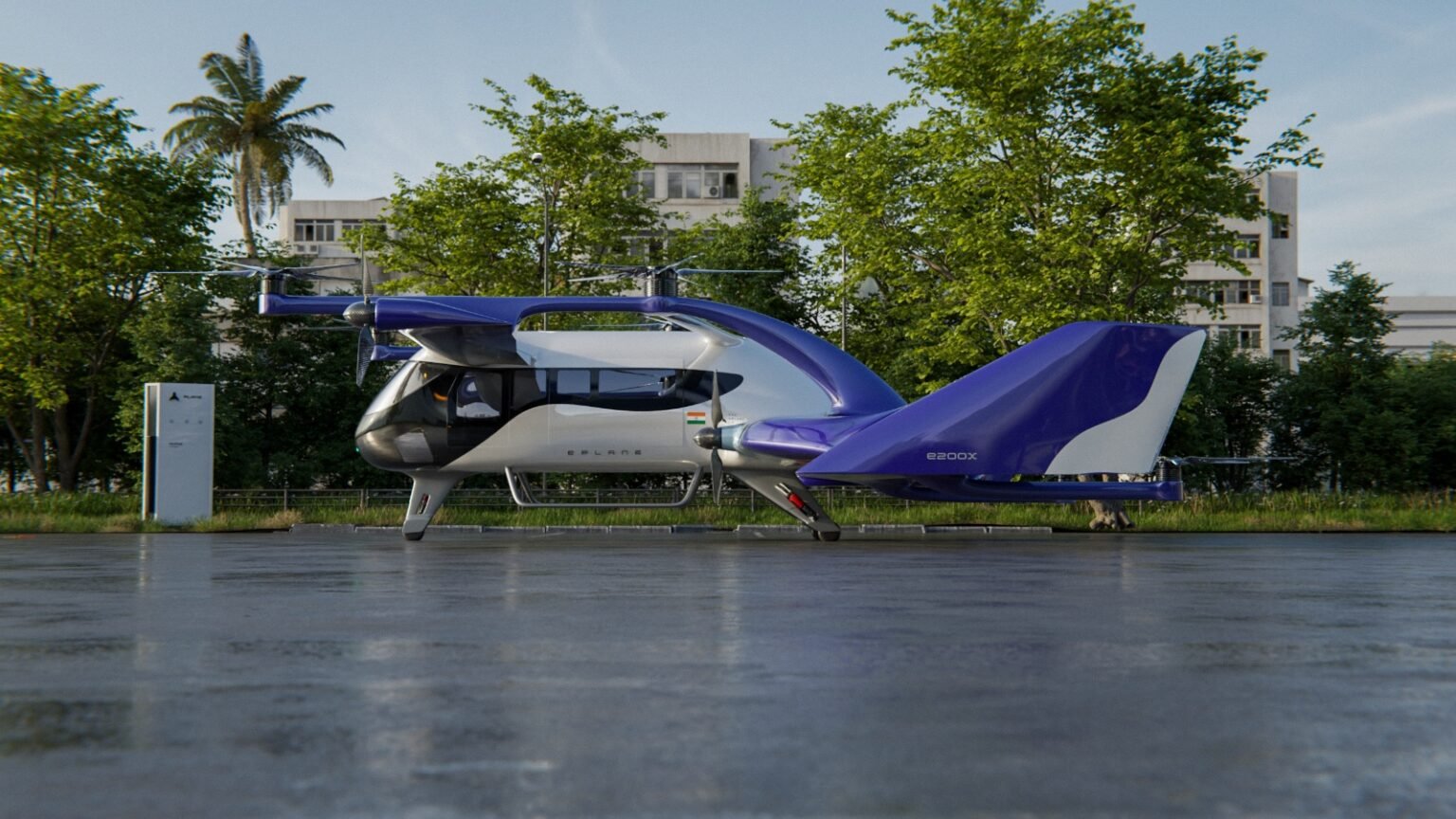
The ePlane Company announced development of India’s first electric air taxi using NVIDIA simulation and computing platforms. The company is building a digital twin of its e200x eVTOL aircraft with NVIDIA Omniverse.
Digital Twin Strategy
The ePlane Company will create a high-fidelity digital twin of the e200x using NVIDIA Omniverse libraries. Engineers will simulate aerodynamics, sensor behavior, and flight scenarios with physics-accurate modeling.
This approach targets a core aviation challenge. Validation.
Physical testing of edge cases demands time, money, and risk exposure. A digital twin enables large-scale virtual testing across extreme conditions.
Simulation Advantages
The digital twin allows teams to:
• Model complex aerodynamic interactions
• Test sensor failures and anomalies
• Evaluate collision and emergency scenarios
• Train autonomy and flight algorithms
Kalibrating algorithms in simulation reduces dependency on costly real-world trials.
Onboard Computing Platform
The aircraft will use the NVIDIA IGX platform as its onboard computing system. The platform integrates multiple sensor inputs, including cameras and radar systems.
Primary functions include:
• Sensor fusion
• Decision processing
• Situational awareness systems
• Visualization pipelines
Urban Air Mobility operations require rapid interpretation of dense environmental data. Edge computing platforms address this requirement.
AI Model Integration
The ePlane Company plans future integration of:
• NVIDIA Cosmos world foundation models
• NVIDIA Nemotron open-weight AI models
These systems support training environments, autonomy research, and operational modeling.
Statements From ePlane Leadership
Prof. Satya Chakravarthy, Founder and CTO of The ePlane Company, emphasized simulation-driven validation. The company aims to stress-test aircraft systems repeatedly in virtual environments before flight deployment.
Engineering teams described the digital twin as central to safety modeling, algorithm training, and system reliability assessment.
Certification Focus
According to Vishnu Ramakrishnan, SVP of Business Partnerships and AAM Strategy, the collaboration treats aircraft hardware, sensors, and computing as a unified certifiable system.
This reflects a broader shift in aerospace certification. Software, AI, and compute systems now form critical flight components.
Impact on Indian Aviation
High-fidelity simulation demands high-performance computing infrastructure. GPU-accelerated workloads support real-time physics rendering and large-scale scenario modeling.
Digital twin systems also enable predictive maintenance modeling by mirroring component configurations and failure patterns.
Company Background
Incubated at IIT Madras, The ePlane Company is developing the compact e200x electric air taxi. The company holds India’s first Design Organisation Approval for a private electric aircraft.
Operations include a 60,000 sq ft manufacturing facility in Chennai.
Industry Context
Electric vertical mobility platforms continue to gain attention in urban transport strategies. Simulation-first engineering workflows are becoming standard practice across aerospace development programs.
The collaboration between The ePlane Company and NVIDIA reflects this transition toward software-defined aviation systems.
Related EV News
- AutoFlight Unveils World’s Largest eVTOL as China Pushes Flying Cars
- China Tests Modular eVTOL Flying Car With Road and Air Modes
- Lamborghini Flying Car Concept Imagines a Blade Runner Future
- Xpeng Aridge Begins Marketing Ahead of Flying Car Mass Production
- Vertical Aerospace Debuts Silent Electric Air Taxi in New York