

- Electric Vehicles
- Compare Electric Cars
- NIO EC6 vs Nio ES9
NIO EC6 vs Nio ES9
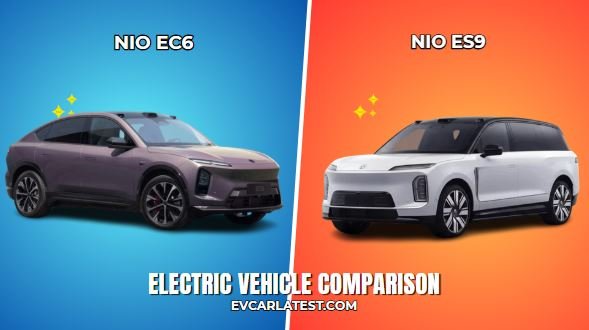
NIO builds both the EC6 and the ES9 in China, but they serve different buyers. The EC6 is a mid-size coupe SUV — lower roofline, sportier silhouette, aimed at drivers who want something that looks sharp on urban roads without going full sedan. The ES9 is a large, three-row flagship SUV for buyers who need seating for six or seven and want NIO’s most premium hardware in a practical shape. The comparison is timely because both models now sit in NIO’s 2024 lineup with updated specs, making it a genuine choice rather than an obvious tier decision.
Range and Charging
The EC6 offers CLTC-rated range of up to 580km on the 100kWh battery pack. Real-world WLTP-equivalent sits closer to 460–490km. It supports 11kW AC charging and up to 130kW DC fast charging, getting from 10–80% in roughly 31 minutes. The ES9 carries a larger 100kWh standard pack with CLTC range around 620km (approximately 490–510km real-world). DC charging tops out at 140kW, shaving about 3–5 minutes off the same charge window. Both vehicles support NIO’s battery swap network, which cuts recharge time to under 5 minutes at a swap station — a practical edge neither rival outside NIO can match.
Price, Availability and Market Fit
The EC6 starts at approximately RMB 298,000 (roughly $41,000 USD) in China, with long-range and performance variants stepping up from there. The ES9 starts around RMB 388,000 ($54,000 USD). Both are primarily available in China, Norway, Germany, the Netherlands, Sweden, and Denmark through NIO’s European rollout. Neither is officially sold in Nigeria, Kenya, or South Africa yet, though grey-market imports have begun appearing. If you’re choosing between these two, the core question is: do you have passengers or cargo that actually need the extra row? If not, the EC6 undercuts the ES9 by a meaningful margin.
Ecosystem and Rivals
Within NIO’s own lineup, EC6 buyers might also consider the EC7 (larger coupe SUV) or the ET5 (sports sedan at a lower price). ES9 buyers should look at the ES8, which is similar in size but slightly older in platform. Outside NIO, the BMW iX and Mercedes EQE SUV compete with the ES9 in pricing and segment, while the BYD Seal U and Volkswagen ID.4 undercut the EC6 on price in markets where both are sold. The NIO battery-swap ecosystem is what keeps this comparison relevant over those alternatives — no other brand at this price offers on-demand battery replacement.
Pros and Cons
The EC6 earns points for its coupe roofline, which most buyers in this segment actually prefer for aesthetics without a significant cargo penalty. Its 0–100 km/h time of around 4.5 seconds on the dual-motor variant gives it real performance credentials. And at a lower starting price, it delivers most of NIO’s tech stack without paying for space you may not need. On the downside, rear headroom is tight for taller passengers due to the sloped roof, and it lacks a third row entirely — ruling it out for larger families. The ES9 makes sense for buyers who genuinely use seven seats regularly; the third row is usable rather than decorative. It also gets marginally better charging speeds and a more commanding road presence. However, it costs significantly more for features that EC6 buyers rarely use, and its size makes urban parking noticeably harder.
Quick Verdict
Choose the EC6 if you want a sporty daily driver that covers most of what NIO offers at a lower cost. Choose the ES9 if seating capacity and flagship positioning matter more than keeping the price down. The battery swap advantage applies equally to both, so that shouldn’t be the deciding factor. It really comes down to how many seats you actually need.

| |
| Price | $49,000.00 $69,000.00 |
| Our Rating | |
| Brand | NIO NIO |
| Category | Electric Cars Electric Cars |
MODEL
| Full Model Name | NIO EC6 (2026) NIO ES9 (天行 / Tiān Xíng) |
| Generation | 2nd generation (NT2.5 platform refresh) 1st Generation |
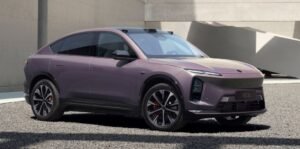
| Segment / Class | Mid-size premium electric coupe SUV Full-size Luxury SUV (F-segment) |
| Available Trims / Variants | Standard Range (75 kWh) · Long Range (100 kWh) Executive Premium Edition · Executive Signature Edition · Horizon Edition |
| Powertrain Options | Dual-motor AWD only Dual-motor AWD (single powertrain configuration across all trims) |
| Additional Notes | In Europe sold as NIO EL6; 2026 model year reflects the May 2025 NT2.5 platform refresh Flagship SUV counterpart to the NIO ET9 sedan. Shares NT 3.0 platform and most ET9 technologies. |
LAUNCH
| Reveal Date | May 10, 2025 (reservation open); May 20, 2025 (deliveries) January 2026 (CES announcement); April 9, 2026 (pre-sales + tech deep-dive) |
| Launch Year | 2025 (2026 model year) 2026 |
| Availability Status | On sale — China; available in select European markets as EL6 On sale (launched May 27, 2026) |
| Brand / Manufacturer | NIO Inc. NIO Inc. |
| Country of origin | China China |
| Assembly Country | China (Hefei, Anhui — JAC-NIO plant) China (F2 Plant, Hefei, Anhui) |
| Markets Available | China (primary); Germany, Norway, Netherlands, Sweden, Denmark (as EL6) China (initial); NIO's European markets expected later |
| Grey Market Import | Possible via China/UAE sourcing Possible via grey-market channels |
| Base Price (USD) |
~$49,400 (RMB 358,000 with 75 kWh) · ~$57,400 (RMB 416,000 with 100 kWh) · BaaS body-only from ~$39,700 (RMB 288,000)
~$69,000 (full vehicle, Executive Premium) · ~$54,000 with BaaS battery rental ¥498,000 full vehicle · ¥390,000 with BaaS Executive Premium ~$69K / ~$54K BaaS · Signature ~$77K / ~$62K BaaS · Horizon ~$87K / ~$72K BaaS |
| Additional Notes | BaaS monthly battery rental: RMB 728 (75 kWh) / RMB 1,128 (100 kWh) Launch prices came in ¥30,000 lower than April pre-sale prices. BaaS (Battery-as-a-Service) separates battery cost from vehicle cost. |
BATTERY
| Battery Capacity |
75.0 kWh / 70.5 kWh 100 kWh / ~95 kWh (est.) 102 kWh (Gross) 95.0 kWh (Net/Usable) |
| Battery Chemistry | NMC NMC (Nickel Manganese Cobalt) |
| Battery Architecture | Swappable pack (NIO standard) CTP (Cell-to-Pack); 900V architecture; nominal voltage 720V |
| Thermal Management | Liquid-cooled Active thermal management (confirmed) |
| Range (WLTP/CLTC/EPA) | 486–513 km (302–319 mi) - WLTP - 70.5 kWh 620 km (385 miles) - CLTC |
| Energy Consumption | 13.7–14.5 kWh/100 km (WLTP) - 70.5 kWh 15.3 kWh/100 km (CLTC) |
| Heat Pump | |
| DC Charging (Max kW) | 140 kW 600 kW (5C ultra-fast charging) |
| Charging Time (10–80%) |
~29 min - 70.5 kWh
~11 minutes Charging Time (0–100%) - ~44 minutes |
| Cell Brand | CATL |
| Additional Notes |
Swap station network available in China and select European cities only
Battery SwapYes — NIO 3rd-gen swap stations (~3 minutes) 900V high-voltage architecture across all trims. BaaS model allows battery rental instead of outright purchase. |
PERFORMANCE
| Motor Type | Front: AC induction · Rear: Permanent magnet synchronous (SiC module) Front: AC Induction · Rear: Permanent Magnet Synchronous (PMSM) |
| Motor Configuration | Dual-motor AWD Dual-motor AWD |
| Front Motor Output (kW / HP) | 150 kW / 201 hp 180 kW (~241 hp) |
| Rear Motor Output (kW / HP) | 210 kW / 282 hp 340 kW (~456 hp) |
| Power Output (kW / hp) | 360 kW / 483 hp 520 kW / 707 hp |
| Torque (Nm) | 700 Nm 700 Nm (517 lb-ft) |
| 0–100 km/h / 0-60 mph (seconds) The acceleration numbers are an easy way to compare car performance. We list either time from 0 to 100 km/h or time from 0 to 60mph, depending on which number(s) the manufacturers provide. The lower the acceleration time, the higher performance the car is. | 4.4 s 4.3 seconds |
| Top Speed (km/h / mph) | 200 km/h (124 mph) 220 km/h (137 mph) |
| Transmission / Drive | Single-speed, AWD Single-speed · AWD |
| Rear-Wheel Steering | Yes (SkyRide Intelligent Chassis) |
| Drive Mode | standard NIO multi-mode setup |
BODY
| Body Style | 5-door coupe SUV (fastback roofline) 5-door full-size SUV |
| Platform / Architecture | NT2.5 (NIO Technology Platform 2.5) NT 3.0 |
| Dimensions (L×W×H mm) | 4,849 × 1,995 × 1,697 mm 5,365 × 2,029 × 1,870 mm |
| Drag Coefficient (Cd) | 0.24 0.264 |
| Wheelbase (mm) | 2,915 mm 3,250 mm |
| Front Track (mm) | 1,730 mm |
| Rear Track (mm) | 1,758 mm |
| Ground Clearance (mm) | 181 mm |
| Kerb Weight (kg) | 2,845–2,915 kg |
| Max Laden Weight (kg) | 2,900 kg |
| Suspension (Front / Rear) | Full Active Electrohydraulic Suspension (FAS) — "SkyRide" system; dual-chamber air suspension option |
| Parking Brake | Electronic |
| Trunk/Boot Capacity (L) | 477 L (seats up) · 1,586 L (rear seats folded) |
| Frunk/Bonnet Capacity (L) | 216 L |
| Roof Load (kg) | 100 kg |
| Turning Circle (m) | 10.8 m |
| Approach / Departure Angle | 17° / 20° |
| Aerodynamics | Dual-mode active spoiler; optimised A-pillar rake |
| Additional Notes | At 5,365 mm, the ES9 is China's largest battery electric SUV. Its wheelbase is 179 mm longer than a Cadillac Escalade IQ despite being 332 mm shorter overall. Cabin length claimed at 2,805 mm. |
SAFETY
| Airbags (count) | Front, side, curtain 12 (standard across all variants; total inflation volume 525 L) |
| Anti-lock Braking System (ABS) | Yes Yes |
| Electronic Brakeforce Distribution (EBD) | Yes Yes |
| Electronic Stability Control (ESC) | Yes Yes |
| Traction Control System (TCS) | Yes Yes |
| Low-Speed Pedestrian Warning | Yes |
| Tyre Pressure Monitoring (TPMS) | Yes Yes |
| Child Seat Anchors (ISOFIX / LATCH) | Yes Yes |
| 360° Camera / Surround View | Yes Yes (25 HD cameras) |
| Reversing Camera | Yes Yes |
| Hill Start Assist | Yes Yes |
| Driver Assistance (ADAS) | Yes — NIO Aquila super-sensing system + NIO Supercomputing |
| ADAS Features | Lane departure warning, adaptive cruise control, automatic emergency braking, forward collision warning, rear cross-traffic alert, lane-keep assist City navigation assist, highway assist, auto lane change, auto parking, active safety; 3× LiDAR for 360° 3D perception |
| Autonomous Driving Level | L2+ L2+ (driver assistance; driver must remain attentive) |
| Autonomous Driving System Name | NIO NWM (Nio World Model) driver assistance |
| Autonomous Driving Hardware | 4× Nvidia DRIVE Orin chips (NT2.5) NIO Shenji NX9031 (5nm automotive-grade, in production since March 2025) |
| Over-the-Air (OTA) Safety Updates | Yes Yes |
| Additional Notes | NIO claims the Shenji chip uses ~50% less power than competing flagship chips during city assist and ~40% less in active safety scenarios. |
COMFORT
| Seating Capacity | 5 6-seat or 7-seat layouts |
| Seat Material | Nappa leather (standard on 2026 refresh) Premium |
| Driver Seat Adjustment | Yes |
| Power Seats | Yes Yes |
| Seat Heating | Yes (front standard) Yes |
| Seat Ventilation | Yes |
| Massage Function | Yes |
| Climate Control | Dual-zone Multi-zone |
| PM2.5 Filtration | Yes (standard NIO feature) |
| Steering Wheel | Heated Steer-by-Wire |
| Roof Type | Panoramic roof |
| Ambient Lighting | Yes Yes |
| Rain-Sensing Wipers | Yes Yes |
| Heated Mirrors | Yes Yes |
| Electrically Folding Mirrors | Yes Yes |
| Interior Rear-View Mirror | 8 MP streaming mirror |
| Gear Selector | Stalk-type |
| Noise Insulation | Upgraded on 2026 refresh |
| Bluetooth / Wi-Fi |
Yes
5G OTA updates |
| Wireless Charging | Dual-pad with cooling function (2026 refresh) Yes |
| 5G / LTE | Yes |
| Parking Aids | Front and rear sensors; 360° camera 360-degree cameras |
| Additional Notes | Positioned for business/executive use. Cabin described as "exquisite craftsmanship." |
DISPLAYS
| Centre Screen (inches) | 15.6-inch AMOLED, horizontal orientation Large central touchscreen |
| Driver's Display (inches) | Digital cluster |
| Head-Up Display (HUD) | 19.4-inch Yes |
| Screen Technology | AMOLED |
| Rotatable / Adjustable Screen | No (horizontal fixed) |
| Operating System | NIO OS NIO OS |
| Mirror Link / Apple CarPlay / Android Auto | Not supported (NIO closed ecosystem) |
| Physical Controls | Yes (mix of touch and physical) |
| Voice Control | Yes — Nomi Mate 3.0 AI assistant Yes — NIO NOMI AI assistant |
| Additional Notes | HUD size inherited from ET9 flagship NOMI AI assistant |
LIGHTING
| Headlight Type (LED/Matrix/Laser) | LED LED matrix (precision illumination system — "brighter, wider, longer range") |
| High Beams | Yes — adaptive |
| Daytime Running Lights (DRL) | Yes Yes |
| Adaptive Headlights | Yes |
| Tail Light Design | Signature NIO design |
| Interior Ambient Lighting | Yes Yes |
INFOTAINMENT & AUDIO
| Sound System Brand | LYRA Sound System (NIO proprietary) |
| Speaker Count | 47 |
| Navigation System | Yes (integrated) Yes |
TECHNOLOGY
| Smartphone App Control | Yes (NIO app) Yes — NIO app |
| Keyless Entry / Start | Yes Yes |
| Remote Start | Yes Yes |
| Bluetooth Key | Yes Yes |
| Remote Parking | Yes |
| Automatic Parking | Yes Yes |
| Remote Climate Control | Yes Yes |
| Digital Key | Yes Yes |
| AI Assistant | Yes — Nomi Mate 3.0 Yes — NIO NOMI |
| Over-the-Air Map Updates | Yes Yes |
| Additional Notes | NIO's battery swap ecosystem (3rd-gen stations, ~3-minute swap) is a major ownership differentiator. |
OWNERSHIP
| Official Dealer Network | China (NIO Houses/Spaces); Germany, Norway, Netherlands, Sweden, Denmark (Europe) NIO Spaces / NIO Houses (China, Europe); |
| Service Interval | NIO-to-Door mobile service + NIO service centres |
| Spare Parts Availability | Limited outside China and NIO's European markets |
| Grey Market Support | Possible via China/Dubai sourcing; |
| Roadside Assistance | Yes (in supported markets) Yes (official markets) |
| Additional Notes | NIO's BaaS model allows battery subscription (separate monthly fee); reduces upfront cost but ties owner to NIO's network. Grey-market buyers would not have access to swap stations or BaaS. |
Note
| Data Source | NIO official press releases; CnEVPost; EVKX.net (EL6/EC6 European spec); ArenaEV; AutoTech News Wikipedia (NIO ES9 page) · EVKX.net · Electrek · CnEVPost · BigGo Finance · NIO official website (nio.com/es9) |
| Last Updated | May 2026 May 2026 |
| Additional Notes | Largest SUV in Nio lineup |
| Editor's Note | AC charging status on the NT2.5 EC6 is unconfirmed — the NT2.0 launch removed the OBC entirely; verify against official NIO spec sheet before publishing. WLTP figure for 100 kWh variant on the 2026 refresh has not been published for European markets. All unconfirmed items marked ⚠️. The NIO ES9 is not officially sold in Nigeria or anywhere in Africa. Grey-market import is feasible but buyers would lose BaaS battery-swap privileges, OTA updates may be restricted outside China, and spare parts availability is uncertain. Pricing in NGN at the time of writing: at ~₦1,650/USD, the BaaS base price of ~$54,000 equals approximately ₦89 million — making this a trophy/prestige import rather than a practical choice for most buyers. |
|
Disclaimer Note
Specifications sourced from manufacturer data and may reflect WLTP, CLTC, or EPA test conditions. Import prices in your local are estimates based on grey-market landing costs and exclude duties, clearing fees, and local taxes. Figures are subject to change without notice. Always verify with your local importer before purchase. We can not guarantee that the information on this page is 100% correct