

- Electric Vehicles
- Compare Electric Cars
- Smart Concept #2 vs Smart #5
Smart Concept #2 vs Smart #5
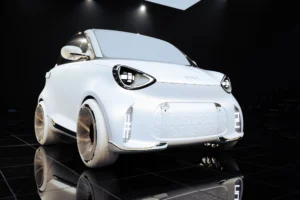
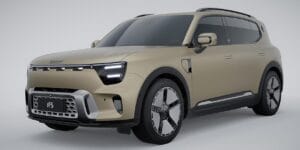
The Smart Concept #2 is a two-seater electric city car — a direct successor to the legendary Fortwo — unveiled at the Beijing Motor Show in April 2026. The Smart #5, by contrast, is a full-size family SUV that launched in late 2024, sitting at the opposite end of the brand’s lineup. Penned by Mercedes-Benz with Smart’s signature “wheels-at-the-corners” design language, the Concept #2 targets urban commuters who want the smallest footprint possible. The #5 is built for families and road-trippers who want space, tech, and serious range. The fact that Smart now fields both extremes in the same brand makes this comparison unusually relevant.

Range & Charging
If the Concept #2’s production specs follow the concept closely, expect around 186 miles (300 km) on the WLTP cycle — appropriate for a city car but limited for longer journeys. Real-world range will likely fall around 150 miles depending on urban versus highway mix. Charging specs have not been confirmed for the production model. The Smart #5, meanwhile, offers up to 369 miles (594 km) WLTP on its 100 kWh battery, with 800V architecture supporting up to 400 kW DC fast charging — enough to go from 10–80% in roughly 15–18 minutes. AC charging details for the #2 remain unconfirmed at concept stage. For the #5, 11 kW AC on-board charging is standard across most markets.
Price, Availability & Market Fit
The Smart #5 launched in the UK from £39,800, with European pricing starting just over €50,000 for the 100 kWh variant. Trims range from the entry-level Pro to the performance-focused Brabus. The Concept #2 has no confirmed pricing yet — it remains a concept as of mid-2026, with production specs and market launch dates still pending. This page helps buyers decide whether to wait for a compact urban Smart or commit now to the #5 as a versatile all-rounder.
Ecosystem & Rival Context
Within Smart’s lineup, the #1 and #3 sit between these two — compact crossovers better suited to buyers who want more than city range but less than full SUV size. Outside Smart, the Concept #2 will face rivals like the Citroën ë-C1 and upcoming Renault 4 E-Tech in the compact EV city segment. The #5 competes with the Tesla Model Y, Kia EV6, and Hyundai Ioniq 5. What keeps this Smart-vs-Smart comparison worthwhile is the shared brand identity — same design studio, same Geely-Mercedes joint venture, very different missions.
Pros & Cons
Smart Concept #2: Its ultra-compact footprint makes it one of the few EVs that genuinely solves city parking stress, which matters in Lagos, Nairobi, or Cape Town’s dense urban cores. Being electric-only from launch means no compromises on powertrain simplicity. Its Fortwo heritage gives it instant brand recognition in markets where the original built a cult following. On the downside, two seats make it impractical for any buyer with a family or regular passengers. And with production specs still unconfirmed, committing interest to this car carries real uncertainty.
Smart #5: Its 369-mile WLTP range removes range anxiety for most drivers, including those navigating long inter-city routes across African markets where charging infrastructure is sparse. A five-star Euro NCAP rating confirmed in 2025 gives safety-conscious buyers verified confidence. The 10–80% charge in 18 minutes on the Brabus variant makes long-distance ownership genuinely practical. The trade-off is price — at £39,800 and above, it sits out of reach for most African grey-market buyers without significant import premiums. Boot space is generous, but the overall size may feel excessive for buyers who only need urban mobility.
Quick Verdict
Choose the Smart #5 if you need a proven, available EV with real-world range, fast charging, and room for five — it’s the more complete car right now. Choose the Smart Concept #2 if you’re a single commuter or city dweller who wants the smallest possible electric footprint and can wait for a production version with confirmed specs. The #5 is a purchase decision today; the #2 is still a promise.
Related EV Comparisons
- Mini Aceman vs Smart #1
- Zeekr X vs Smart #1
- Volvo EX30 vs Smart #1
- VinFast VF3 vs Smart #1
- Smart #1 vs Audi Q4 e-tron
| |
| Price | $25,000.00 $45,000.00 |
| Our Rating | |
| Brand | SMART SMART |
| Category | Electric Cars Electric Cars |
MODEL
| Full Model Name | Smart Concept #2 |
| Generation | 1st generation (#2 nameplate); spiritual successor to Smart ForTwo Gen 3 |
| Segment / Class | Microcar / Electric City Car |
| Available Trims / Variants |
Smart #5 Pro Smart #5 Pro+ / Premium Smart #5 Pulse / Summit Smart #5 Brabus |
| Powertrain Options | Full electric only |
| Additional Notes | Production reveal confirmed for Paris Motor Show, October 2026 |
LAUNCH
| Reveal Date |
April 22, 2026 (Beijing Auto Show)
2024, August 28 - Smart #5 Pro 2024, August 28 - Smart #5 Pro+ / Premium 2024, August 28 - Smart #5 Pulse / Summit 2025, April 08 - Smart #5 Brabus |
| Launch Year | 2027 (expected) |
| Availability Status |
Concept stage; production pending
Available to order. Released 2025, May - Smart #5 Pro Available to order. Released 2025, May - Smart #5 Pro+ / Premium Available to order. Released 2025, May - Smart #5 Pulse / Summit Available to order. Released 2025, May - Smart #5 Brabus |
| Brand / Manufacturer | Smart Automobile (Mercedes-Benz AG × Geely Holding Group JV) |
| Country of origin | China China |
| Assembly Country | China |
| Markets Available | Europe (confirmed); UK from early 2027 |
| Base Price (USD) |
~$25,000 estimated (UK target: ~£20,000)
€ 45,900 - Smart #5 Pro € 50,900 - Smart #5 Pro+ / Premium € 56,900 - Smart #5 Pulse / Summit € 60,900 - Smart #5 Brabus |
BATTERY
| Battery Capacity |
~30–35 kWh
74.4 kWh usable, 76 kWh total - Smart #5 Pro 94 kWh usable, 100 kWh total - Smart #5 Pro+ / Premium 94 kWh usable, 100 kWh total - Smart #5 Pulse / Summit 94 kWh usable, 100 kWh total - Smart #5 Brabus |
| Battery Chemistry |
Liquid-cooled Li-ion LFP (400V type) - Smart #5 Pro Liquid-cooled Li-ion NCM (800V type) - Smart #5 Pro+ / Premium Liquid-cooled Li-ion NCM (800V type) - Smart #5 Pulse / Summit Liquid-cooled Li-ion NCM (800V type) - Smart #5 Brabus |
| Battery Architecture | Smart ECA platform (proprietary) |
| Range (WLTP/CLTC/EPA) |
300 km / 186 miles - WLTP
289 mi WLTP - Smart #5 Pro 367 mi WLTP - Smart #5 Pro+ / Premium 336 mi WLTP - Smart #5 Pulse / Summit 336 mi WLTP - Smart #5 Brabus |
| Energy Consumption |
298 Wh/mi WLTP - Smart #5 Pro 296 Wh/mi WLTP - Smart #5 Pro+ / Premium 320 Wh/mi WLTP - Smart #5 Pulse / Summit 320 Wh/mi WLTP - Smart #5 Brabus |
| Regen Braking (Max kW) | Yes |
| Heat Pump | |
| AC Charging (Max kW) |
Type 2 11 kW Type 2 22 kW |
| DC Charging (Max kW) |
(supports DC fast charging)
CCS 150 kW max, 10-80% in 30 min - Smart #5 Pro CCS 400 kW max (215 kW effective), 10-80% in 18 min - Smart #5 Pro+ / Premium CCS 400 kW max (215 kW effective), 10-80% in 18 min - Smart #5 Pulse / Summit CCS 400 kW max (215 kW effective), 10-80% in 18 min - Smart #5 Brabus |
| Charging Time (10–80%) | Under 20 minutes |
| Additional Notes |
All battery specs are concept-stage targets only
Vehicle-to-Load (V2L) 3.3 kW 220 V power socket in the trunk |
PERFORMANCE
| Motor Type | Electric (single motor, assumed) |
| Motor Configuration | Rear-wheel drive (unconfirmed; consistent with ForTwo lineage) |
| Power Output (kW / hp) |
~100–130 hp estimated
RWD 340 hp (250 kW) - Smart #5 Pro RWD 363 hp (267 kW) - Smart #5 Pro+ / Premium AWD 587 hp (432 kW) - Smart #5 Pulse / Summit AWD 646 hp (475 kW) - Smart #5 Brabus |
| Torque (Nm) |
275 lb-ft (373 Nm) - Smart #5 Pro 373 Nm (275 lb-ft) - Smart #5 Pro+ / Premium 643 Nm (474 lb-ft) - Smart #5 Pulse / Summit 710 Nm (524 lb-ft) - Smart #5 Brabus |
| 0–100 km/h / 0-60 mph (seconds) The acceleration numbers are an easy way to compare car performance. We list either time from 0 to 100 km/h or time from 0 to 60mph, depending on which number(s) the manufacturers provide. The lower the acceleration time, the higher performance the car is. |
6.9 sec 0-62 mph - Smart #5 Pro 6.5 sec 0-62 mph - Smart #5 Pro+ / Premium 4.9 sec 0-62 mph - Smart #5 Pulse / Summit 3.8 sec 0-62 mph - Smart #5 Brabus |
| Top Speed (km/h / mph) |
124 mph (200 km/h) - Smart #5 Pro 124 mph (200 km/h) - Smart #5 Pro+ / Premium 124 mph (200 km/h) - Smart #5 Pulse / Summit 130 mph (210 km/h) - Smart #5 Brabus |
| Transmission / Drive | Single-speed, direct drive Single-speed |
BODY
| Body Style | 2-door, 2-seat microcar hatchback 5 door Hatchback, 5 seats |
| Body Colour Options | Matte white with warm gold two-tone shown on concept |
| Platform / Architecture | Electric Compact Architecture (ECA) SEA2 |
| Dimensions (L×W×H mm) | 2,792 mm Length 184.8 x 75.6 x 67.1 in (4695 x 1920 x 1705 mm) |
| Wheelbase (mm) |
114.2 in (2900 mm) |
| Kerb Weight (kg) |
EU: 2200 kg unladen, 2700 kg gross - Smart #5 Pro EU: 2260 kg unladen, 2760 kg gross - Smart #5 Pro+ / Premium EU: 2345 kg unladen, 2845 kg gross - Smart #5 Pulse / Summit EU: 2378 kg unladen, 2880 kg gross - Smart #5 Brabus |
| Suspension (Front / Rear) | Front MacPherson struts, rear multi-link |
| Wheel Size (inches) | R19, R20 |
| Trunk/Boot Capacity (L) | EU: 630 l, 1530 l max |
| Frunk/Bonnet Capacity (L) | 72 l |
| Towing Capacity (kg) | Not applicable (microcar class) EU: 750 kg unbraked, 1600 kg braked |
| Turning Circle (m) | 6.95 m |
SAFETY
| Airbags (count) | Front, side, rear, head airbag system |
| Child Seat Anchors (ISOFIX / LATCH) | Not applicable (no rear seats) |
| Driver Assistance (ADAS) |
Front radar, front/side/reversing cameras, 12 front/rear sensors. Active lane keeping system, lane change assist, blind spot assist, traffic jam assist, traffic sign recognition, adaptive high beam assist |
COMFORT
| Seating Capacity | 2 Heated front seats |
| Roof Type |
Panoramic glass sunroof, fixed |
| Bluetooth / Wi-Fi |
Android Auto and Apple CarPlay |
| Parking Aids | Front and rear sensors, 360 camera, reversing camera, auto parking assist |
DISPLAYS
| Centre Screen (inches) | 13" touchscreen |
| Driver's Display (inches) | 10.3" |
| Head-Up Display (HUD) | Yes, 25.6" |
| Additional Notes | 13" AMOLED passenger display |
LIGHTING
| Headlight Type (LED/Matrix/Laser) | LED |
| Daytime Running Lights (DRL) | Shown on concept |
| Tail Light Design | LED strip (concept) |
INFOTAINMENT & AUDIO
TECHNOLOGY
| Vehicle-to-Load (V2L) | Confirmed on concept |
OWNERSHIP
| Official Dealer Network | Smart's existing European dealer network |
Note
| Data Source | Smart official press release (April 22, 2026); What Car?, Autoblog, Carscoops, Electrifying.com, Electrive.com |
| Last Updated | May 2026 |
| Additional Notes | |
| Editor's Note | The vast majority of technical specifications remain undisclosed as this is a concept reveal. Battery capacity, motor output, interior features, dimensions beyond length, and pricing outside the UK are all unconfirmed. Production specifications will be published at the Paris Motor Show, October 2026. Do not publish performance or battery figures as confirmed data. |
| Disclaimer | We can not guarantee that the information on this page is 100% correct |
|
Disclaimer Note
Specifications sourced from manufacturer data and may reflect WLTP, CLTC, or EPA test conditions. Import prices in your local are estimates based on grey-market landing costs and exclude duties, clearing fees, and local taxes. Figures are subject to change without notice. Always verify with your local importer before purchase. We can not guarantee that the information on this page is 100% correct