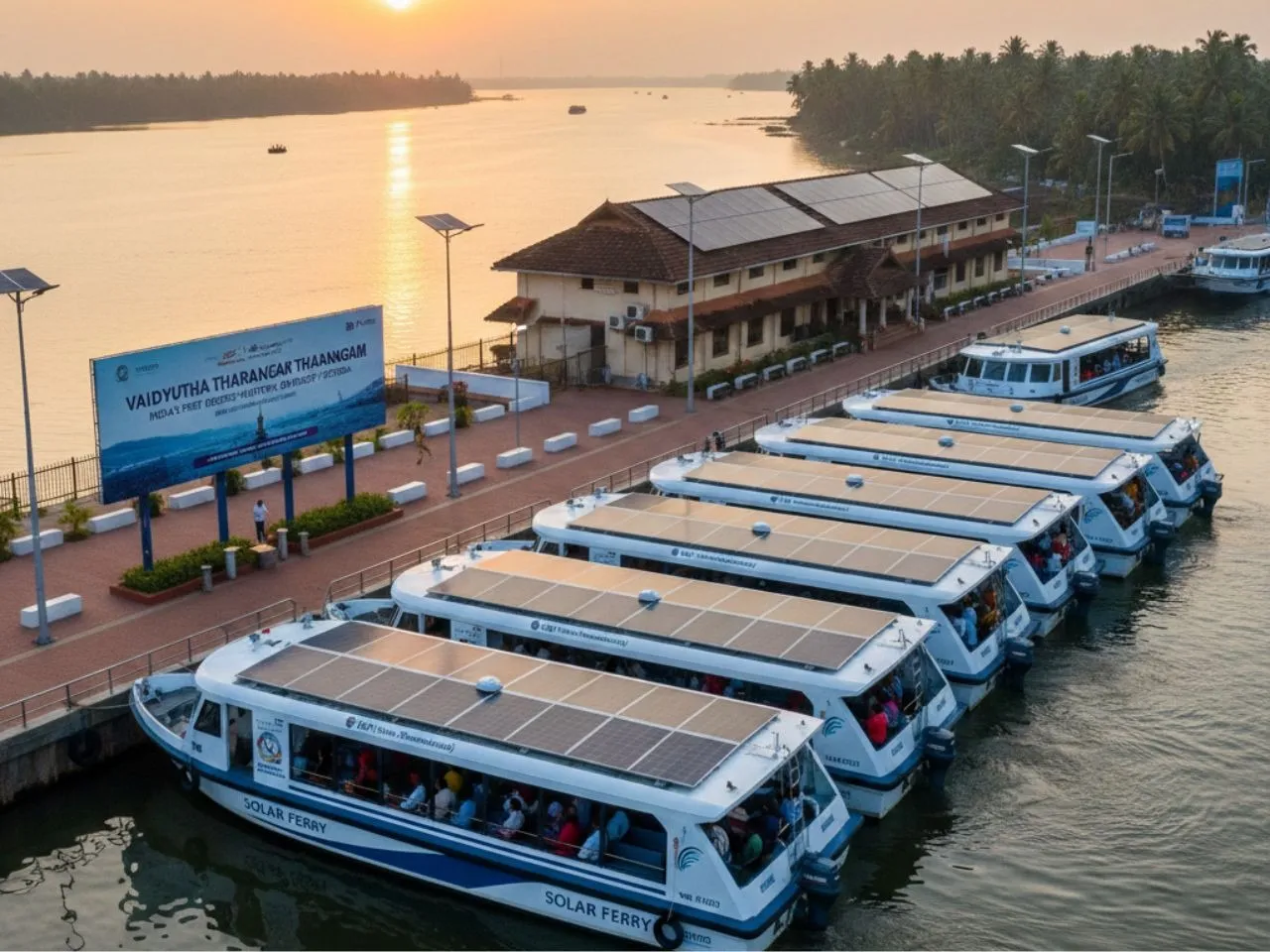
Vaikom, situated along the Vembanad backwaters in Kerala, is moving toward a full solar transition. Authorities plan to power both vessels and station operations with renewable energy. Diesel use at the jetty is ending.
The project supports Kerala’s broader strategy to decarbonise public transport and reduce fuel costs.
Final Phase of Diesel Replacement
On February 20, Transport Minister K B Ganesh Kumar will commission three new solar-powered boats. This marks the last stage of diesel vessel withdrawal on the Vaikom route.
Simultaneously, Agency for Non-Conventional Energy and Rural Technology will begin converting jetty infrastructure to solar power.
After deployment, all scheduled services from Vaikom will operate without fossil fuels.
From Pilot Program to Full Transition
The shift began in 2017. The State Water Transport Department introduced Aditya, the state’s first solar passenger vessel.
The arrival of the new fleet completes the transition. Officials expect lower operating expenses and reduced environmental impact.
According to SWTD data:
• Replacing one diesel vessel avoids roughly 40 tonnes of carbon emissions per year
• Solar propulsion cuts water contamination risks
• Noise levels decline significantly
Battery Upgrade and Faster Operations
Each new solar vessel costs ₹3.15 crore. Every unit uses an 80 kWh battery system. The earlier design relied on a 50 kWh pack, which restricted service hours.
Operational performance:
• Average speed: 10.8 km per hour
• Route time: ~15 minutes on the Vaikom–Thavanakadavu stretch
• Time saving: ~5 minutes versus diesel boats
• Passenger capacity: 75
Higher battery capacity extends daily operations. Services now run until nearly 9 pm. Previous limits ended around 7 pm.
Solar Expansion at the Station
The transition includes shore infrastructure.
Key upgrades:
• 20 kW solar panels installed per vessel
• Solar-linked charging systems at the jetty
• Solar-powered lighting and station utilities
SWTD confirms that station-level energy demand will rely on solar generation.
The jetty conversion budget stands at approximately ₹30 lakh.
Cost Efficiency and Energy Savings
Solar boats draw power from onboard panels and the grid when required. Grid dependence will decline after full solar integration.
Previous grid charging expenses ranged between ₹400 and ₹500 per cycle. Authorities project a significant reduction.
Long-term effects:
• Lower fuel expenditure
• Stable operating costs
• Reduced maintenance overhead
Strategic Impact for Inland Transport
Vaikom’s transition positions Kerala’s inland waterways as a reference model for energy-neutral mobility.
Implications for India’s transport sector:
• Demonstrates solar viability in public marine transport
• Reduces emissions in high-frequency ferry corridors
• Provides predictable cost structures for operators
Kerala’s inland fleet modernisation continues as states evaluate renewable alternatives for short-distance water routes.