

- Electric Vehicles
- Compare Electric Cars
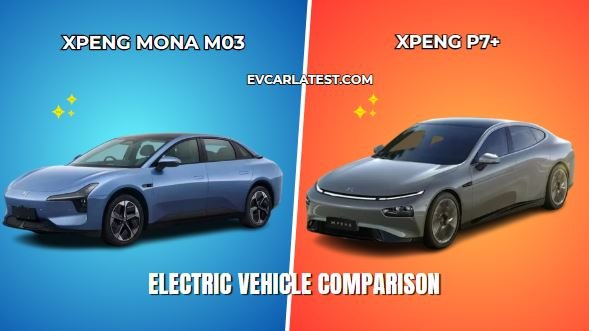
- Xpeng Mona M03 2026 vs XPeng P7+
Xpeng Mona M03 2026 vs XPeng P7+
Both the Mona M03 and P7+ come from XPeng, both are sedans, and both target buyers who want a tech-forward EV without paying a European premium. The M03 is a compact coupe-style sedan pitched at urban buyers on a tighter budget. The P7+ is a larger fastback sedan for buyers who want more cabin space, a longer range, and slightly more presence on the road. With XPeng pushing deeper into grey-market imports across Nigeria, South Africa, and Kenya, this comparison matters for African buyers right now.
Range and Charging
The M03 offers up to 580 km on the CLTC cycle for the long-range version — note that CLTC figures run roughly 15–20% higher than real-world estimates, putting practical range closer to 460–490 km. The P7+ stretches that further, with the top variant rated at 710 km CLTC, translating to around 570–600 km in typical driving. On AC charging, both support 11 kW onboard. DC fast charging tops out at 80 kW for the M03 and 100 kW for the P7+. A 10–80% charge on the M03 takes approximately 30 minutes on a fast charger; the P7+ takes closer to 35–40 minutes due to the larger pack. Charging infrastructure specs for specific trim levels have not been independently confirmed outside China — treat these figures as indicative until verified.
Price, Availability, and Market Fit
In China, the M03 starts around RMB 119,800 (approximately $16,500 USD). The P7+ opens at RMB 209,900 (approximately $29,000 USD). Neither is officially sold in Africa or the UAE. Grey-market import costs will add 30–50% depending on destination — Nigerian buyers should budget NGN 22–28 million for the M03 and NGN 38–46 million for the P7+. South African grey-market estimates sit around ZAR 400,000–490,000 for the M03 and ZAR 680,000–780,000 for the P7+. The M03 suits buyers who want the lowest possible entry point into the XPeng ecosystem. The P7+ is the right call for buyers willing to spend more to get meaningful daily range gains and a bigger interior.
Ecosystem and Rival Context
Within XPeng’s lineup, M03 buyers should also look at the G6 if they want an SUV at a similar spend. P7+ buyers should consider the X9 if budget allows a step up. Outside XPeng, the BYD Seal is the most relevant rival to the M03 — comparable segment, similar pricing in grey-market channels. The Nio ET5 competes squarely against the P7+ on range and tech. Despite those options, an XPeng-versus-XPeng comparison is useful precisely because it isolates the range-versus-cost trade-off within a single brand’s platform and after-sales ecosystem.
Pros and Cons
Mona M03: The lower starting price puts EV ownership within reach for more buyers in African grey-market channels. Its compact footprint is practical in dense urban traffic in Lagos or Nairobi. The CLTC-rated 580 km range covers most city commuters without constant top-ups. On the downside, the smaller battery means highway trips require more planning, particularly where fast chargers are scarce. The coupe roofline also cuts rear headroom, which matters if the car is carrying adults regularly.
XPeng P7+: The longer real-world range reduces charging anxiety on intercity routes where infrastructure is patchy. The larger cabin is more usable as a primary family car. XPeng’s XNGP driver-assist system is more capable on the P7+. However, the higher grey-market import cost narrows its appeal significantly in price-sensitive markets. It is also a harder car to source parts for outside established XPeng markets.
Quick Verdict
Choose the Mona M03 if your priority is keeping the purchase cost low while still getting a capable long-range EV for city use. Choose the P7+ if you need more real-world range for intercity driving and can absorb the higher import cost. The gap between them is roughly $12,500 at source — whether that premium is worth it depends almost entirely on how far you drive and how often charging stops are a problem where you live.
Related EV Comparisons
- Xpeng Mona M03 2026 vs XPeng MONA M03 2024
- Xpeng Mona M03 2026 vs XPeng P5
- Xpeng Mona M03 2026 vs Tesla Model 3 2025
- Xpeng Mona M03 2026 vs BYD Seal 08
- Xpeng Mona M03 2026 vs MG MG4 2026
| |
| Price | $17,000.00 |
| Our Rating | |
| Brand | XPeng XPeng |
| Category | Electric Cars Electric Cars |
MODEL
| Full Model Name | Xpeng Mona M03 (2026) |
| Generation | 2nd generation (facelift of 2024 original) |
| Segment / Class | A-segment compact electric sedan |
| Available Trims / Variants |
540 Long Range Plus · 640 Ultra Long Range Plus · 510 Long Range Max · 610 Ultra Long Range Max · 510 Long Range Ultra SE · 610 Ultra Long Range Ultra SE
XPeng P7+ 61.7 kWh XPeng P7+ 74.9 kWh |
| Powertrain Options | Single front motor FWD (140 kW or 160 kW depending on trim) |
| Special Editions | Ultra SE top trim (deliveries from August 2026) |
| Additional Notes | Successor to XPeng P5; co-developed originally with DiDi |
LAUNCH
| Reveal Date | March 25, 2026 (preview); April 2, 2026 (official launch) 2026, January 09 |
| Launch Year | 2026 |
| Availability Status | On sale in China; Ultra SE trim from August 2026 Coming soon. Expected release 2026, Q2 |
| Brand / Manufacturer | Xpeng Motors (NYSE: XPEV) |
| Country of origin | China China |
| Assembly Country | China (Zhaoqing, Guangdong) |
| Markets Available | China only (official) |
| Grey Market Import | Possible via third-party importers |
| Base Price (USD) | ~$17,380 (¥119,800) — top trim ~$22,000 (¥151,800) |
| Additional Notes | Base price unchanged from 2025 model despite significant upgrades |
BATTERY
| Battery Capacity |
51.8 kWh / 61.6 kWh / 62.2 kWh (gross); 61.0 kWh usable on 62.2 kWh pack
61.7 kWh total - XPeng P7+ 61.7 kWh 74.9 kWh total - XPeng P7+ 74.9 kWh |
| Battery Chemistry | LFP (Lithium Iron Phosphate) — blade cell structure Li-ion LFP 5C battery (800V type) |
| Battery Architecture | 400V nominal (473V); Ultra SE variant upgrades to 800V platform |
| Thermal Management | XP-HP 3.5 in-house thermal management system |
| Range (WLTP/CLTC/EPA) |
485 km – 640 km depending on trim (CLTC)
382 mi CLTC - XPeng P7+ 61.7 kWh 450 mi CLTC - XPeng P7+ 74.9 kWh |
| Energy Consumption |
From 10.8 kWh/100 km (best case, CLTC)
175 Wh/mi NEDC - XPeng P7+ 61.7 kWh 188 Wh/mi NEDC - XPeng P7+ 74.9 kWh |
| Regen Braking (Max kW) | Yes |
| Heat Pump | |
| AC Charging (Max kW) | 7 kW |
| DC Charging (Max kW) | 92–93.6 kW (standard variants); 800V Ultra SE CCS, 10-80% in 12 min |
| Charging Time (10–80%) | ~26–28 min (62.2 kWh pack, standard variants); Ultra SE claims 15 min |
| Cell Brand | EVE Energy (2026); FinDreams (2024–25 models) |
| Battery Preheating | Yes — via XP-HP 3.5 thermal system |
| Additional Notes | Ultra SE 3C fast-charging spec based on manufacturer preview only — not independently verified V2L charging: 6 kW |
PERFORMANCE
| Motor Type | Permanent magnet synchronous motor (PMSM) |
| Motor Configuration | Single front motor (FWD) — all trims |
| Front Motor Output (kW / HP) | 140 kW / 188 hp (Plus trims) · 160 kW / 215 hp (Max / Ultra SE trims) |
| Rear Motor Output (kW / HP) | None |
| Power Output (kW / hp) |
RWD 245 hp (180 kW) - XPeng P7+ 61.7 kWh RWD 313 hp (230 kW) - XPeng P7+ 74.9 kWh |
| Torque (Nm) | 440 Nm (peak, Long Range variants) 450 Nm (332 lb-ft) |
| 0–100 km/h / 0-60 mph (seconds) The acceleration numbers are an easy way to compare car performance. We list either time from 0 to 100 km/h or time from 0 to 60mph, depending on which number(s) the manufacturers provide. The lower the acceleration time, the higher performance the car is. |
7.8 sec (entry) · 7.4 sec (Max/Ultra SE)
6.9 sec 0-62 mph - XPeng P7+ 61.7 kWh 5.9 sec 0-62 mph - XPeng P7+ 74.9 kWh |
| Top Speed (km/h / mph) | 200 km/h (124 mph) 124 mph (200 km/h) |
| Transmission / Drive | Single-speed direct drive Single-speed |
| Rear-Wheel Steering | No |
| Torque Vectoring | No (single motor FWD) |
BODY
| Body Style | 5-door liftback sedan (electric tailgate) 4 door sedan, 5 seats |
| Body Colour Options | Includes Violet and Avocado Green (new 2026 additions); Morning Mist Grey, Noon Blue, Night Grey |
| Platform / Architecture | Xpeng proprietary (standard variants 400V; Ultra SE 800V) B platform (Edward) |
| Dimensions (L×W×H mm) | 4,780 × 1,896 × 1,445 mm 5071 x 1937 x 1512 mm (199.6 x 76.3 x 59.5 in) |
| Drag Coefficient (Cd) | 0.194 0.206 Cd |
| Wheelbase (mm) | 2,815 mm 3000 mm (118.1 in) |
| Ground Clearance (mm) | 160 mm |
| Kerb Weight (kg) | 1,661–1,739 kg depending on variant |
| Suspension (Front / Rear) |
Front - MacPherson strut with adaptive damping (2026 update) Rear - Torsion beam (standard) Front double wishbone, rear multi-link |
| Wheel Size (inches) | 18-inch or 19-inch R19, R20 |
| Tyre Size | 215/50R18 or 235/40R19 |
| Trunk/Boot Capacity (L) | 571 L (seats up) · 1,374 L (seats folded) EU: 725 l, 2221 l max |
| Frunk/Bonnet Capacity (L) | None Yes |
| Roof Load (kg) | 75 kg |
| Towing Capacity (kg) | Not rated EU: 750 kg unbraked, 1500 kg braked |
| Turning Circle (m) | 5.3 m radius |
| Sunroof | Panoramic fixed glass roof (1.22 m² visible area, Low-E laminated, 99.9% UV block) |
| Aerodynamics | Active grille shutters (AGS); 100+ hours wind tunnel testing |
| Additional Notes | Braking distance 100–0 km/h: 35.63 m (manufacturer figure) |
SAFETY
| Airbags (count) | 6 standard Front, side, rear, head airbag system |
| Anti-lock Braking System (ABS) | Yes |
| Electronic Brakeforce Distribution (EBD) | Yes |
| Electronic Stability Control (ESC) | Yes |
| Traction Control System (TCS) | Yes |
| Low-Speed Pedestrian Warning | Yes |
| Structural Safety | High-strength cage-type body structure |
| Tyre Pressure Monitoring (TPMS) | Yes |
| Child Seat Anchors (ISOFIX / LATCH) | Yes |
| 360° Camera / Surround View | Yes (panoramic) |
| Reversing Camera | Yes |
| Hill Start Assist | Yes |
| Driver Assistance (ADAS) | XNGP (Max / Ultra SE trims); basic L2 on Plus trims 3 Front/Rear radars, 360° cameras, 12 sensors. Forward/Rear/Lateral Collision Prevention, Lane Centering, Lane Change Assist, Lane Departure Warning, Traffic Jam Assist, Emergency braking with pedestrian and cyclist monitoring, High beam Assist, Blind Spot Alert, Door Open Warning |
| ADAS Features | AEB · FCW · LCC · Adaptive Cruise · Blind Spot Monitoring · Rear Cross Traffic Alert · NGP (Navigation Guided Pilot) · Auto parking · Memory reverse · AES ice/snow steering assist (Max and above) |
| Autonomous Driving Level | L2 (supervised) |
| Autonomous Driving Hardware | Plus: single Orin chip; Max/Ultra SE: dual Orin-X (508 TOPS combined); Ultra SE adds Turing AI chip (750 TOPS) |
| Over-the-Air (OTA) Safety Updates | Yes |
| Additional Notes | Meets China 2026 national battery safety standards ahead of schedule |
COMFORT
| Seating Capacity | 5 Heated, ventilated and massaging front and rear seats |
| Seat Material | Leather (standard across trims) |
| Driver Seat Adjustment | 6-way electric |
| Seat Heating | Front seats — standard |
| Seat Ventilation | Front seats — standard |
| Climate Control | Dual-zone automatic |
| Steering Wheel | Heated (2026 addition); tilt and telescopic (manual adjustment) |
| Roof Type | Fixed panoramic glass Panoramic glass sunroof |
| Ambient Lighting | Yes |
| Electrically Folding Mirrors | Yes (frameless; auto-tilt in reverse) |
| Noise Insulation | Double-layer acoustic glass (2026 addition) |
| Bluetooth / Wi-Fi | Yes |
| Wireless Charging | Yes |
| 5G / LTE | Yes (LTE confirmed; 5G not confirmed) |
| Parking Aids | Front and rear sensors, 360 camera, reversing camera, Automatic Parking Assistance System |
| Additional Notes | Automated parking; point-to-point parking assist; memory reverse |
DISPLAYS
| Centre Screen (inches) | 15.6 inches 15.6" touchscreen |
| Driver's Display (inches) | No separate instrument cluster — integrated into central screen 8.8" |
| Head-Up Display (HUD) | No Yes |
| Rear Passenger Screen | No |
| Display Resolution | 2.5K |
| Screen Technology | LCD (screen-to-body ratio 88.5%) |
| Operating System |
Tianji AIOS 6.0 (2026 update) MT8676 cockpit chip · 24 GB RAM (2026); base uses Snapdragon 8155 / 16 GB RAM |
| Mirror Link / Apple CarPlay / Android Auto | Not supported (Xpeng proprietary OS) |
| Physical Controls | Minimal; steering wheel buttons retained |
| Voice Control | Yes — "Xiao P" AI assistant; 4-zone voice recognition; <0.9 sec response (Max) |
| Additional Notes | 8" rear passenger display |
LIGHTING
| Headlight Type (LED/Matrix/Laser) | LED |
| Daytime Running Lights (DRL) | Yes — "010" split 3D starburst cluster design |
| Tail Light Design | T-shaped LED clusters |
| Interior Ambient Lighting | Yes |
INFOTAINMENT & AUDIO
| Sound System Brand | Xpeng Surround Sound (proprietary) |
| Speaker Count | 18 speakers in 7.1.4 panoramic soundstage arrangement |
| Streaming Services | Yes (China ecosystem) |
| AM/FM/DAB Radio | FM; DAB not applicable in China |
| Navigation System | Yes — with OTA map updates |
| Gaming / App Store | Yes (via Tianji AIOS 6.0) |
TECHNOLOGY
| Smartphone App Control | Yes |
| Keyless Entry / Start | Yes |
| Remote Start | Yes |
| Bluetooth Key | Yes |
| Vehicle-to-Load (V2L) | Yes — up to 3.3 kW |
| Remote Parking | Yes |
| Automatic Parking | Yes |
| Remote Climate Control | Yes |
| Digital Key | Yes |
| AI Assistant | Yes — "Xiao P" (XGPT large model; emotional recognition, contextual reasoning) |
| Over-the-Air Map Updates | Yes — full vehicle OTA |
OWNERSHIP
| Official Dealer Network | China only |
| Grey Market Support | None — no official parts, warranty, or software support outside China |
| Resale Value | Strong in China; unknown in grey-market regions |
| Insurance Category | Varies by country; no official category outside China |
| Roadside Assistance | China only |
Note
| Data Source | CnEVPost, EVKX.net, Gasgoo, Wikipedia, CarNewsChina, Wancheng EV, ArenaEV, evcarlatest.com |
| Last Updated | May 2026 |
| Editor's Note | Ultra SE charging specs (800V, 15-min 10–80%) are based on manufacturer preview statements and have not been independently road-tested. WLTP and EPA range equivalents are not officially published — all range figures are CLTC. Attributes marked "not confirmed" could not be verified from available 2026 sources at time of writing. |
|
Disclaimer Note
Specifications sourced from manufacturer data and may reflect WLTP, CLTC, or EPA test conditions. Import prices in your local are estimates based on grey-market landing costs and exclude duties, clearing fees, and local taxes. Figures are subject to change without notice. Always verify with your local importer before purchase. We can not guarantee that the information on this page is 100% correct