

BYD Seal U vs BYD Tang
If you’re deciding between the BYD Seal U vs BYD Tang, here’s the short version: the Seal U is the cheaper, five-seat SUV with enough range for daily driving, and the Tang is the pricier, seven-seat flagship with more range, more power, and standard all-wheel drive. The rest of this comparison explains why, using WLTP-rated figures for both.
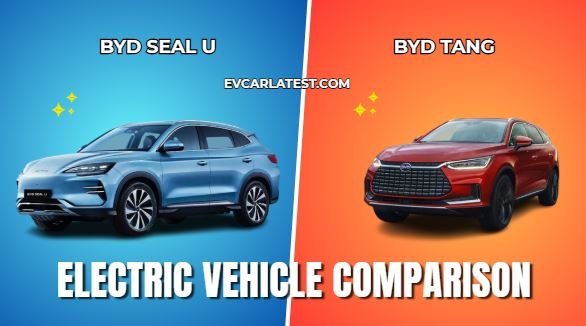
Range and Battery: WLTP Figures Compared
The Seal U comes in two battery sizes. Comfort trim uses a 71.8 kWh Blade battery rated at 261 miles WLTP, and Design trim steps up to an 87 kWh pack rated at 311 miles WLTP.
The Tang uses one battery across its lineup: a 108.8 kWh LFP pack rated at roughly 329 miles, or 530 km, WLTP. That’s the biggest gap between these two cars. The Tang carries about 20% more usable capacity than the Seal U Design, and the range figure shows it.
Charging Speed: What the Numbers Actually Say
Seal U Comfort peaks at 115 kW on DC, and Design peaks at 140 kW, with a 30–80% top-up taking around 27 to 28 minutes on either trim.
The BYD Seal U vs BYD Tang charging gap narrows once you factor in the Tang’s much larger battery. Still, the Tang’s DC ceiling is where sources start to disagree. Some manufacturer-adjacent listings put it at 190 kW, while several independent charging guides put it closer to 170 kW, with 30–80% sessions landing around 30 to 35 minutes. I’d treat 170–190 kW as a range rather than a confirmed number until BYD publishes a single figure for your market.
Price and Availability
The BYD Seal U vs BYD Tang price gap is the clearest number in this comparison. Seal U Comfort starts around €42,000, and Design starts around €47,000, pricing that puts it in line with the Tesla Model Y and Volkswagen ID.4. The Tang starts near €69,600, a jump that’s mostly explained by the bigger battery and the extra row of seats rather than badge premium alone.
The Seal U has been on sale in Europe since February 2024. The current-generation Tang followed in December 2024. Both are listed as available to order as of September 2026, though trims and pricing shift by market, so check BYD’s own configurator before you commit to a number.
Seating, Safety, and Tech
The Seal U seats five and uses a single front motor making 218 hp and 310–330 Nm, depending on trim. Boot space runs 552 liters, or 1,440 liters with the rear seats folded.
The Tang seats seven and pairs dual motors for 517 hp and 502 lb-ft, with all-wheel drive standard. Both cars carry a five-star Euro NCAP rating. Screen sizes are close: a 12.3-inch driver display on both, and a rotating center touchscreen that runs 12.8 inches on the Tang and either 12.8 or 15.6 inches on the Seal U, depending on trim. The Tang adds a head-up display that the Seal U doesn’t offer at any trim level.
Pick the Seal U if you want a straightforward electric SUV for commuting and weekend trips and don’t need a third row. Pick the Tang if you’re cross-shopping seven-seat EVs and are willing to pay a real premium for the extra range, power, and seating.
For the full spec sheets behind these numbers, see our standalone BYD Seal U and BYD Tang reviews, and BYD’s own Seal U product page for manufacturer-listed specs.
Specs current as of September 2026 and sourced from manufacturer data and independent EV-database listings. Prices and availability vary by market — confirm with your local importer before purchase.
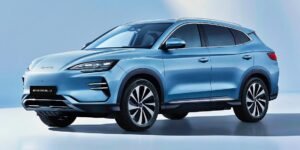
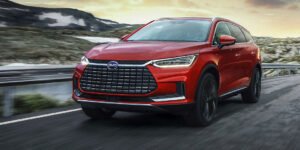
| |
| Price | $42,000.00 $70,000.00 |
| Our Rating | |
| Brand | BYD BYD |
| Category | Electric Cars Electric Cars |
MODEL
| Full Name | BYD Seal U EV |
| Segment | Midsize/Compact SUV (C-SUV) |
PRICE & AVAILABILITY
| Base Price |
€ 42,000 -BYD Seal U Comfort € 47,000 - BYD Seal U Design € 69,600 |
| Availability Status |
On sale in select markets (Italy, Southeast Asia); not sold in UK (PHEV only there) Available to order. Released 2024, December |
| Markets Available | Europe (select countries), Southeast Asia, China |
POWER
| Battery Capacity |
71.8 kWh total - BYD Seal U Comfort 87 kWh total - BYD Seal U Design 108 kWh total |
| Range |
(WLTP): 420 km (Comfort) / 500 km (Design)
329 mi WLTP |
| DC Charging |
CCS 115 kW, 30-80% in 27 min, 10-80% in 42 min -BYD Seal U Comfort CCS 140 kW, 30-80% in 28 min, 10-80% in 43 min - BYD Seal U Design CCS 190 kW |
| Charging Time | ~28 minutes (DC fast charge) |
| AC Charging |
Type 2 11 kW, 0-100% in 7.5 hours - BYD Seal U Comfort Type 2 11 kW, 0-100% in 9.3 hours - BYD Seal U Design Type 2 11 kW |
| Energy Consumption | Not officially confirmed Consumption |
| Regen Braking |
Yes |
PERFORMANCE
| Power Output |
FWD 218 hp (160 kW) AWD 517 hp (380 kW) |
| 0–100 km/h The acceleration numbers are an easy way to compare car performance. We list either time from 0 to 100 km/h or time from 0 to 60mph, depending on which number(s) the manufacturers provide. The lower the acceleration time, the higher performance the car is. |
9.3 sec 0-62 mph - BYD Seal U Comfort 9.6 sec 0-62 mph - BYD Seal U Design 4.9 sec 0-62 mph |
| Motor Configuration | Single motor, front-mounted, PMSM |
| Torque |
310 Nm (229 lb-ft) - BYD Seal U Comfort 330 Nm (243 lb-ft) - BYD Seal U Design 680 Nm (502 lb-ft) |
| Top Speed |
109 mph (175 km/h) 112 mph (180 km/h) |
BODY & DIMENSIONS
| Dimensions |
4785 x 1890 x 1668 mm (188.4 x 74.4 x 65.7 in)
4870 x 1950 x 1725 mm (191.7 x 76.8 x 67.9 in) |
| Platform | e-platform 3.0 |
| Suspensions |
Front MacPherson struts, rear multi-link, independent front and rear suspension |
| Boot Capacity |
EU: 552 l, 1440 l max EU: 940 l, 1655 l max |
| Kerb Weight |
EU: 2020 kg unladen, 2430 kg gross - BYD Seal U Comfort EU: 2147 kg unladen, 2557 kg gross - BYD Seal U Design EU: 2705 kg unladen, 3204 kg gross |
| Ground Clearance | Not officially confirmed |
| Bonnet Capacity | Not applicable/not confirmed No |
| Sunroof | Panoramic sunroof (standard) |
| Wheels | R20, R22 |
| Towing | EU: 750 kg unbraked, 1500 kg braked |
SAFETY & DRIVER ASSISTANCE
| Airbags |
8 airbags: front, side, rear, 3rd row side, including head airbag system |
| ADAS Features | Adaptive cruise control, lane-keeping assist, rear cross-traffic alert, 360° camera |
| Autonomous Driving Level | Level 2 |
| Crash Test Ratings |
NCAP 2023: 5 stars |
| Over-the-Air Updates | Yes |
COMFORT & SEATING
| Seating Capacity |
5
Heated and ventilated front seats |
| Seat Material | Vegan (synthetic) leather |
DISPLAYS & CONNECTIVITY
| Centre Screen |
15.6-inch rotating touchscreen 12.8" rotating touchscreen |
| Mirror Link | Both supported |
| Driver's Display |
12.3-inch digital cluster
12.3" |
| Head-Up Display | Yes No |
TECHNOLOGY
| Vehicle-to-Load | Yes |
| Vehicle-to-Grid | Not confirmed |
ADDITIONAL SPECS
| Headlight Type | Full LED with adaptive high-beam |
| Navigation System | Not officially confirmed |
| Remote Parking | Not officially confirmed |
Note
| Additional Notes | Some tech specs (screen, HUD, sound system) are shared across Seal U trims including the PHEV, so may carry over 1:1 to the EV. |
|
Disclaimer Note
Specifications sourced from manufacturer data and may reflect WLTP, CLTC, or EPA test conditions. Import prices in your local are estimates based on grey-market landing costs and exclude duties, clearing fees, and local taxes. Figures are subject to change without notice. Always verify with your local importer before purchase. We can not guarantee that the information on this page is 100% correct