

- Electric Vehicles
- Compare Electric Cars
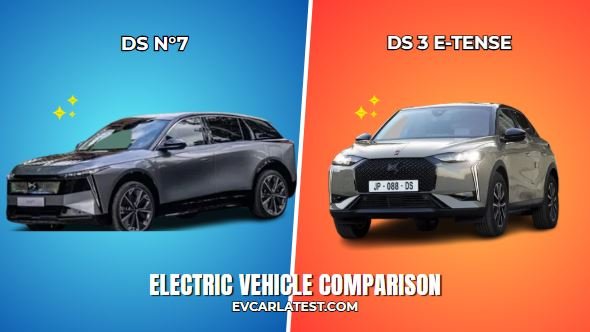
- DS N°7 vs DS 3 E-Tense
DS N°7 vs DS 3 E-Tense
The DS N°7 is a midsize premium electric SUV from DS Automobiles, the French luxury arm of Stellantis, aimed at buyers who want European design credentials and a spacious interior without stepping into German territory. The DS 3 E-Tense is a compact electric crossover from the same brand, targeting urban professionals who want distinctive styling in a smaller, easier-to-park package. This comparison matters now because both models are increasingly appearing in grey-market imports across South Africa, Kenya, and Nigeria, making the segment choice between them a real decision for African EV buyers.
Range & Charging
The DS N°7 delivers up to 470 km on the WLTP cycle in its long-range configuration. Real-world range in mixed urban and highway driving typically lands around 380–410 km. It supports DC fast charging at up to 150 kW, with a 10–80% charge taking roughly 30 minutes at a compatible station. AC charging runs at 11 kW on a standard home wallbox.
The DS 3 E-Tense (50 kWh version) offers 400 km WLTP, with real-world estimates closer to 310–340 km. DC fast charging tops out at 100 kW, putting the 10–80% window at around 30–35 minutes. AC charging is rated at 11 kW. The gap in DC charging speed is noticeable for longer trips but less relevant for typical daily urban use.
Price, Availability & Market Fit
In Europe, the DS N°7 starts at approximately €45,000, which translates to roughly ₦72–78 million or ZAR 890,000 via grey-market import after duties. The DS 3 E-Tense opens closer to €35,000 — around ₦56–60 million or ZAR 690,000 landed. Both arrive as individual imports with no official dealership support in most African markets. If your budget ceiling sits under ₦65 million and you primarily drive within a city, the DS 3 answers the question. If you need genuine long-distance comfort and can stretch the budget, the N°7 earns it.
Ecosystem & Rival Context
Within DS Automobiles, buyers considering the N°7 should also look at the DS 9 if a saloon form factor appeals. DS 3 buyers looking for a step up might consider the DS 4 E-Tense before committing. Outside the brand, the BYD Atto 3 competes directly with the DS 3 on range and price and is more accessible in South Africa and Kenya. The Peugeot e-2008 (a Stellantis platform sibling) is another alternative at the DS 3’s price point. This comparison still wins because it isolates buyers already drawn to French premium design from a single brand — a genuinely different buying decision from choosing between unrelated manufacturers.
Pros & Cons
DS N°7: Its 470 km WLTP range makes it genuinely viable for intercity routes, which matters in markets where charging infrastructure remains sparse. The larger cabin accommodates families without compromise. Its 150 kW charging speed reduces stops meaningfully on longer drives. However, the higher import cost limits its audience to buyers with significant disposable income. Parts and service availability in Africa is also a real concern given no official presence.
DS 3 E-Tense: Its compact dimensions make urban navigation and parking significantly easier — a practical advantage on Lagos or Nairobi streets. The lower entry price broadens access without sacrificing the brand’s signature interior quality. It handles daily commuting on a single charge comfortably. That said, its 100 kW DC ceiling means longer waits on road trips. Rear passenger space is tight for four adults on extended journeys.
Quick Verdict
Choose the DS N°7 if range and passenger space are your primary concerns — it’s the better long-distance family EV of the two. Choose the DS 3 E-Tense if you drive mainly within a city and want premium French styling at a more accessible import price. The trade-off is simple: space and range versus compactness and cost. Neither has local after-sales support in most African markets, so factor that equally into both decisions.
Related EV Comparisons
- DS N°7 E-Tense vs DS N°8
- DS N°7 E-Tense vs DS N°7
- BMW i4 vs DS N°8
- Hyundai Inster vs DS 3 Crossback E-Tense
- DS 3 Crossback E-Tense vs Mazda MX-30
| |
| Price | $51,000.00 $42,000.00 |
| Our Rating | |
| Brand | DS DS |
| Category | Electric Cars Electric Cars |
MODEL
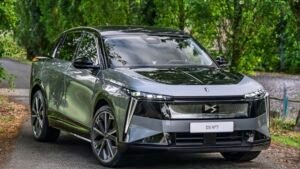
| Full Model Name | DS N°7 (DS Number Seven) |
| Generation | 1st generation (successor to DS 7) |
| Segment / Class | Compact luxury crossover SUV |
| Available Trims / Variants |
N°7, PALLAS, ÉTOILE, LA PREMIÈRE
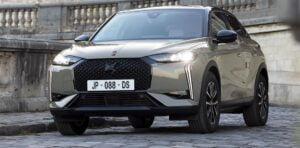
DS 3 E-Tense 54kWh |
| Powertrain Options | E-Tense FWD (230 hp / 73.7 kWh) · E-Tense FWD Long Range (245 hp / 97.2 kWh) · E-Tense AWD Long Range (350 hp / 97.2 kWh) · Hybrid (145 hp, 48V mild hybrid) |
| Special Editions | ÉTOILE Ligne Business (first launch variant, fleet-focused) |
| Additional Notes | First DS model to use the STLA Medium platform; replaces the DS 7 which sold ~14,000 units in 2025 |
LAUNCH
| Reveal Date |
March 17, 2026
2022, September 27 |
| Launch Year | 2026 (orders open France March 2026; deliveries autumn 2026) |
| Availability Status |
Announced; order phase open in France and Germany
Available to order. Released 2023, January 09 |
| Brand / Manufacturer | DS Automobiles (Stellantis) |
| Country of origin | France |
| Assembly Country | Italy (Melfi plant) |
| Markets Available | France, Germany, wider Europe (confirmed); UK expected |
| Base Price (USD) | ~€46,990 (E-Tense FWD) / ~€43,900 (Hybrid) — approx. $51,000–52,000 USD at current rates € 41,700 |
| Additional Notes | First consumer-facing price (€46,990) covers base E-Tense FWD; top-spec fleet launch price was €64,200 |
BATTERY
| Battery Capacity | 73.7 kWh (usable) · 97.2 kWh (usable, Long Range) 50.8 kWh usable, 54 kWh total |
| Battery Chemistry |
NMC (Nickel Manganese Cobalt)
Liquid-cooled Li-ion 400V |
| Battery Architecture | 400V |
| Thermal Management | Active thermal management; battery preheating/preconditioning (standard on PALLAS and above via heat pump) |
| Range (WLTP/CLTC/EPA) |
FWD: 543 km · FWD Long Range: 740 km · AWD Long Range: 679 km
250 mi WLTP |
| Energy Consumption |
203 Wh/mi WLTP |
| Regen Braking (Max kW) |
2 modes, with gear selector |
| Heat Pump | |
| AC Charging (Max kW) |
7.4–11 kW standard; 22 kW optional
Type 2 11 kW, 0-100% in 5 hours |
| DC Charging (Max kW) | 160 kW peak (maintained between 20–55% SoC) CCS 100 kW max, 0-80% in 25 min |
| Charging Time (10–80%) | ~27 min (97.2 kWh) · ~31 min (73.7 kWh) — figures quoted at 20–80% by DS |
| Cell Brand | ACC (Automotive Cells Company) — 97.2 kWh pack produced at Billy-Berclau Gigafactory, France |
| Battery Preheating | Yes — automatic when destination set in nav; manual via centre display |
PERFORMANCE
| Motor Configuration | Single front motor (FWD variants) · Dual motor front + rear (AWD Long Range) |
| Front Motor Output (kW / HP) | FWD: 169 kW / 230 hp · FWD Long Range: 180 kW / 245 hp |
| Rear Motor Output (kW / HP) | AWD Long Range: combined 350 hp / 257 kW |
| Power Output (kW / hp) |
169 kW / 230 hp (base) · 180 kW / 245 hp (LR FWD) · 257 kW / 350 hp (AWD)
FWD 156 hp (115 kW) |
| Peak Power (kW / hp) | FWD boost: 191 kW / 260 hp · LR FWD boost: 206 kW / 280 hp · AWD boost: 272 kW / 370 hp |
| Torque (Nm) |
260 Nm (192 lb-ft) |
| 0–100 km/h / 0-60 mph (seconds) The acceleration numbers are an easy way to compare car performance. We list either time from 0 to 100 km/h or time from 0 to 60mph, depending on which number(s) the manufacturers provide. The lower the acceleration time, the higher performance the car is. | AWD Long Range: 5.4 sec 8.7 sec 0-62 mph |
| Top Speed (km/h / mph) | 190 km/h (all E-Tense variants, electronically limited) 93 mph (150 km/h) |
| Transmission / Drive | 8-speed automatic (Hybrid); single-speed reduction (BEV) |
| Overboost / Boost Mode | Yes — temporary power increase on all E-Tense variants |
| Additional Notes | Hybrid pairs 1.2L 3-cylinder Miller-cycle petrol + 21 kW electric motor in a 6-speed DCT; can drive in EV mode up to 50% of the time in urban use |
BODY
| Body Style | 5-door compact luxury crossover SUV 5 door crossover, 4 seats |
| Platform / Architecture | STLA Medium (Stellantis) PSA EMP1 |
| Dimensions (L×W×H mm) | 4,660 × 1,900 × 1,630 4118 x 1802 x 1534 mm (162.1 x 70.9 x 60.4 in) |
| Drag Coefficient (Cd) | 0.26 |
| Wheelbase (mm) | 2,790 2558 mm (100.7 in) |
| Suspension (Front / Rear) |
DS Active Scan Suspension (camera-linked adaptive damping) — trim-dependent; standard configuration not confirmed
Front MacPherson struts, rear multi-link |
| Wheel Size (inches) | 19 or 20-inch standard; 21-inch on top trim R17, R18 |
| Trunk/Boot Capacity (L) |
Up to 560 L (500 L minimum in AWD config with subwoofer)
EU: 350 l, 1050 l max |
| Frunk/Bonnet Capacity (L) | No |
| Towing Capacity (kg) | No |
| Sunroof | Panoramic roof (40% larger than DS 7 predecessor) |
| Additional Notes | Body is 7 cm longer and wheelbase 5 cm longer than the outgoing DS 7; 40/20/40 rear seat split; height-adjustable boot floor |
SAFETY
| Airbags (count) |
Side airbags, front and rear, head airbag system |
| Anti-lock Braking System (ABS) | Yes (standard) |
| Electronic Stability Control (ESC) | Yes (standard) |
| Tyre Pressure Monitoring (TPMS) | Yes |
| Child Seat Anchors (ISOFIX / LATCH) | Yes |
| 360° Camera / Surround View | Yes (LA PREMIÈRE trim) |
| Reversing Camera | Yes (from PALLAS trim) |
| Night Vision | Yes — DS Night Vision (infrared, detects pedestrians/animals up to 300 m) |
| Hill Start Assist | Yes (standard) |
| Driver Assistance (ADAS) |
DS Drive Assist 2.0 (from ÉTOILE trim)
Front radar and 4 cameras, 12 sensors. Extended Emergency Braking System with pedestrian and cyclist recognition (5-140 km/h), Active Safety Brake (up to 85km/h), Lane Keeping Assist, Lane Departure Warning, Active Blind Spot Detection, Extended Traffic Sign Recognition, High Beam Assist |
| ADAS Features | Adaptive cruise control, lane positioning, semi-automatic lane changes, speed limit recognition, AEB, blind spot monitoring, driver attention alert |
| Autonomous Driving Level | SAE Level 2 |
| Autonomous Driving System Name | DS Drive Assist 2.0 |
| Additional Notes | DS 7 predecessor held 5-star Euro NCAP — N°7 rating pending |
COMFORT
| Seating Capacity |
5
Heated front seats |
| Seat Material | Fabric (base) · Leather / Nappa / Alcantara (higher trims) |
| Driver Seat Adjustment | Electric (confirmed for upper trims) |
| Passenger Seat Adjustment | Electric (confirmed for upper trims) |
| Seat Heating | Yes (from PALLAS trim) |
| Seat Ventilation | Yes (upper trims) |
| Massage Function | Yes (front seats, upper trims) |
| Climate Control | Dual-zone (standard) |
| Steering Wheel | Heated; X-shaped design (DS signature) |
| Roof Type |
Panoramic (enlarged vs predecessor)
No glass roof |
| Ambient Lighting | Yes |
| Noise Insulation | Laminated acoustic front side windows (PALLAS+); enhanced cabin soundproofing |
| Bluetooth / Wi-Fi |
Yes
Wired Android Auto and Apple CarPlay |
| Wireless Charging | Yes (from PALLAS trim) |
| Parking Aids |
Front and rear sensors + reversing camera (PALLAS+); 360° camera (LA PREMIÈRE)
Front and rear sensors, 360 camera, autonomous parking |
| Additional Notes | Interior available in five "mood" themes including blue Alcantara + brushed aluminium; centre armrest with storage cubby |
DISPLAYS
| Centre Screen (inches) |
16-inch touchscreen (DS IRIS System)
10.3" touchscreen |
| Driver's Display (inches) | 10-inch digital instrument cluster 7" |
| Head-Up Display (HUD) | Yes — augmented/extended HUD Yes, retractable |
| Operating System | DS IRIS System 2.0 with ChatGPT integration |
| Mirror Link / Apple CarPlay / Android Auto | Apple CarPlay and Android Auto (wireless, from PALLAS trim) |
| Voice Control | Yes — AI-based voice assistant (ChatGPT integrated) |
| Additional Notes | Digital rear-view mirror (dual-mode: traditional + wide-angle camera) from ÉTOILE trim |
LIGHTING
| Headlight Type (LED/Matrix/Laser) | DS Pixel LED Vision (adaptive matrix LED, from ÉTOILE trim) |
| Daytime Running Lights (DRL) | Yes |
| Adaptive Headlights | Yes (DS Pixel LED Vision) |
| Welcome Lighting | Yes (DS signature lighting) |
| Additional Notes | DS LUMINASCREEN illuminated front grille on ÉTOILE trim; DS Night Vision infrared system is a separate pedestrian detection system, not a lighting unit |
INFOTAINMENT & AUDIO
| Sound System Brand | FOCAL (Electra 3D, optional / top trim) |
| Speaker Count | Up to 14 (FOCAL system) |
| Navigation System | Yes — DS IRIS System 2.0 with connected 3D navigation and real-time EV routing |
| Additional Notes | EV Routing uses real-time battery data to plan charging stops; integrates with Free2Move Charge network (800,000 points across Europe) |
TECHNOLOGY
| Smartphone App Control | Yes — MyDS app |
| Keyless Entry / Start | Yes |
| Vehicle-to-Load (V2L) | Yes — 230V AC output via adapter plugged into charge port |
| Remote Climate Control | Yes (via MyDS app) |
| AI Assistant | Yes — ChatGPT integrated via DS IRIS System 2.0 |
| Additional Notes | DS Active Scan Suspension uses a windscreen camera to read road surface and adjust each damper individually in milliseconds |
OWNERSHIP
| Official Dealer Network | Europe only (France, Germany confirmed at launch) |
Note
| Data Source | DS Automobiles official press (Stellantis Media), Electrive, InsideEVs, Electric Cars Report, What Car?, Wikipedia, DS UK product page |
| Last Updated | June 2026 |
| Editor's Note | Several specs — including kerb weight, towing capacity, split motor outputs, battery warranty, and full ADAS availability by trim — have not been officially published ahead of the autumn 2026 retail launch. All unconfirmed fields are flagged. Charging benchmarks quoted at 20–80%, not 10–80%, as DS has not published a 10–80% figure. |
| Disclaimer | We can not guarantee that the information on this page is 100% correct |
|
Disclaimer Note
Specifications sourced from manufacturer data and may reflect WLTP, CLTC, or EPA test conditions. Import prices in your local are estimates based on grey-market landing costs and exclude duties, clearing fees, and local taxes. Figures are subject to change without notice. Always verify with your local importer before purchase. We can not guarantee that the information on this page is 100% correct