- Electric Vehicles
- Compare Electric Cars
- Hyundai IONIQ 9 2026 vs Hyundai EO (Elexio)
Hyundai IONIQ 9 2026 vs Hyundai EO (Elexio)
The Hyundai IONIQ 9 is a full-size, three-row electric SUV and Hyundai’s global EV flagship; the Hyundai Elexio — badged EO in China — is a compact-to-mid-size five-seat electric SUV from the Beijing Hyundai joint venture. The IONIQ 9 suits large families and fleets needing three-row practicality; the Elexio suits urban buyers wanting tech-heavy commuting range without flagship pricing. Both are confirmed 2026 production models, making them realistic grey-market import options for African buyers comparing Hyundai’s range from opposite ends.
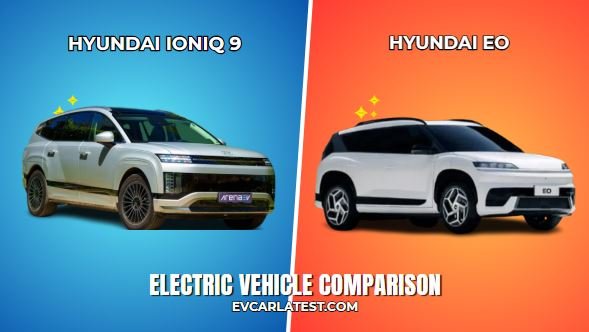
On range, the IONIQ 9 is rated up to 620 km WLTP on rear-wheel-drive Long Range, dropping to 555–580 km on AWD; US EPA figures reach 335 miles (≈539 km). The Elexio is rated 546–562 km WLTP (Australia spec), with Hyundai quoting up to 722 km CLTC in China; real-world figures sit closer to 500–550 km. Charging varies by market: IONIQ 9’s 800V system claims 10–80% in 24 minutes in Europe, though US material cites ~40 minutes; Elexio charges 10–80% in about 38 minutes on a 150 kW charger. IONIQ 9’s AC charging tops out at 11 kW; Elexio’s AC figure is unconfirmed.
On price, the IONIQ 9 starts at $60,555 in the US (six trims, S through Calligraphy Design), roughly ₦83.6 million before duties, and from €69,900 in Europe. The Elexio retails from AU$57,990–$61,990 driveaway (Elexio and Elite trims), roughly ₦52–57 million before freight. Neither sells officially in Nigeria, Kenya, or South Africa, so both arrive only via grey-market import — Australian Elexio units are right-hand drive, while China-spec EO units are left-hand drive and a better fit for Nigeria. This page helps you decide whether budget and household size point toward a large family hauler or a smaller urban runabout.
Within Hyundai’s range, IONIQ 9 buyers should also weigh the IONIQ 5 and IONIQ 6, while Elexio shoppers sit between the Kona Electric and IONIQ 5. Each has a platform-mate: the Kia EV9 mirrors IONIQ 9’s three-row layout, and the Kia EV5 shares Elexio’s Chinese underpinnings. Outside Hyundai-Kia, the Volvo EX90 and Rivian R1S rival the IONIQ 9, while the BYD Song L and Tesla Model Y rival the Elexio. This comparison still wins because it lets a buyer weigh two genuinely different Hyundai EVs rather than chase brands with thinner African parts support.
IONIQ 9 pros: A 620 km WLTP range and 24-minute fast-charging ease range anxiety on long African road trips. The seven-seat, three-row layout gives families a real fuel-SUV alternative. Global multi-market availability gives importers more sourcing routes.
IONIQ 9 cons: A near-₦84 million starting price before duties puts it out of reach for most buyers. Its size and turning radius make it a poor fit for tight Nigerian city streets.
Elexio pros: A sub-₦60 million landed estimate reaches more upper-middle-income buyers. Its 27-inch display and Android Automotive system give flagship-feeling tech at mid-size pricing. LFP chemistry tolerates heat and frequent fast-charging better than nickel-based packs.
Elexio cons: Limited left-hand-drive availability complicates sourcing for Nigeria. Charging and parts support remain unproven outside China and Australia.
QUICK VERDICT: Choose the IONIQ 9 if you need three-row family space and maximum highway range, and can absorb a near-₦84 million entry cost before duties. Choose the Elexio if a smaller footprint, lower landed price, and tech-forward cabin matter more than seating for seven. Both remain grey-market imports in Nigeria, Kenya, and South Africa, so sourcing and after-sales support should weigh as heavily as the spec sheet.


| |
| Price | $58,000.00 |
| Our Rating | |
| Brand | Hyundai Hyundai |
| Category | Electric Cars Electric Cars |
MODEL
| Full Model Name | 2026 Hyundai IONIQ 9 |
| Generation | 1st Generation |
| Segment / Class | Midsize three-row electric SUV |
| Available Trims / Variants |
S (RWD), SE (AWD), SEL (AWD), Performance Limited (AWD), Performance Calligraphy (AWD), Performance Calligraphy Design (AWD)
Hyundai EO (Elexio) FWD Hyundai EO (Elexio) AWD |
| Powertrain Options | Single-motor RWD (215 hp) · Dual-motor AWD (303 hp) · Dual-motor Performance AWD (422 hp) |
| Additional Notes | Hyundai's first three-row battery-electric model |
LAUNCH
| Reveal Date | November 2024 (LA Auto Show) May 7, 2025 |
| Launch Year | 2025 (sold as 2026 model year) |
| Availability Status | On sale (US, May 2025) Pre-sales begin October 2025; production from October 16, 2025 |
| Brand / Manufacturer | Hyundai Motor Company |
| Country of origin | South Korea (designed); USA (assembled) China (Beijing Hyundai joint venture) |
| Assembly Country | USA — Metaplant America, Bryan County, Georgia |
| Markets Available | United States, Canada, South Korea; select others TBC |
| Grey Market Import | Yes |
| Base Price (USD) | $58,955 (S RWD, before destination) — $78,090 (Performance Calligraphy Design AWD) |
| Additional Notes | US-assembled; eligible for $7,500 federal EV tax credit (credit status subject to change). Grey market landed cost in Nigeria estimated ₦130–145 million at base, after duty, VAT, and clearing |
BATTERY
| Battery Capacity | 110.3 kWh gross 101.7 kWh LFP (by FinDream, a BYD subsidiary) |
| Battery Chemistry | NMC (Nickel Manganese Cobalt) Lithium Iron Phosphate (LFP) battery |
| Battery Architecture | 800V |
| Thermal Management | Liquid-cooled |
| Range (WLTP/CLTC/EPA) | 335 mi / 539 km (S RWD) · 320 mi / 515 km (SE/SEL AWD) · 311 mi / 500 km (Performance AWD) — EPA cycle (CLTC): Up to 700 km (~ 435 mi) |
| Energy Consumption | 92 MPGe (S) · 88 MPGe (SE/SEL) · 85 MPGe (Performance) |
| Regen Braking (Max kW) | Supports 4 levels + single-pedal mode (media reports) |
| Heat Pump | |
| AC Charging (Max kW) | 10.9 kW 11 kW (three-phase) reported in some descriptions |
| DC Charging (Max kW) | 350 kW peak 30 % → 80 % in ~ 27 minutes |
| Charging Time (10–80%) | ~24 minutes at 350 kW DC |
| Battery Warranty | 10 years / 100,000 miles |
| Battery Preheating | Yes |
| Additional Notes | NACS port standard; CCS adapter included; compatible with Tesla Supercharger network V2L (vehicle-to-load / external power output) is mentioned in media for Elexio version |
PERFORMANCE
| Motor Type | Permanent magnet synchronous |
| Motor Configuration | Single rear (S RWD) · Dual front+rear (SE/SEL and Performance AWD) |
| Front Motor Output (kW / HP) | ~160 kW per motor on Performance AWD |
| Power Output (kW / hp) |
160 kW / 215 hp (RWD) · 226 kW / 303 hp (AWD) · 315 kW / 422 hp (Performance AWD)
160 kW (~ 214 hp), FWD -Hyundai EO (Elexio) FWD 233 kW (~ 312 hp), AWD - Hyundai EO (Elexio) AWD |
| Torque (Nm) | ~350 Nm / 258 lb-ft (RWD) · ~605 Nm / 446 lb-ft (AWD) · ~700 Nm / 516 lb-ft (Performance AWD) |
| 0–100 km/h / 0-60 mph (seconds) The acceleration numbers are an easy way to compare car performance. We list either time from 0 to 100 km/h or time from 0 to 60mph, depending on which number(s) the manufacturers provide. The lower the acceleration time, the higher performance the car is. | 4.9 sec claimed (Performance AWD) |
| Top Speed (km/h / mph) | ~200 km/h / 124 mph (Hyundai stated — Performance AWD) 185 km/h |
| Transmission / Drive | Single-speed, RWD or AWD |
BODY
| Body Style | 5-door, 3-row SUV 5-door compact crossover SUV, 5 seats |
| Body Colour Options | Multiple — includes Ionosphere Green, Cosmic Blue, Snow White Pearl; full list market-dependent |
| Platform / Architecture | E-GMP (Electric Global Modular Platform) Hyundai E-GMP (800V architecture) |
| Dimensions (L×W×H mm) |
5,060 × 1,981 × 1,791 mm
Length: 4,615 mm Width: 1,875 mm Height: 1,675 mm |
| Wheelbase (mm) | 3,129 mm (123.2 in) 2,750 mm |
| Ground Clearance (mm) | 175 mm (6.9 in) |
| Kerb Weight (kg) | ~2,725 kg / 6,008 lbs (Performance Calligraphy — varies by trim) |
| Max Laden Weight (kg) | 3,320 kg / 7,319 lbs |
| Suspension (Front / Rear) | long-wheelbase E-GMP with hydro bushings noted in reviews |
| Wheel Size (inches) | 21 inches (Performance trims confirmed) |
| Parking Brake | Electronic (EPB) — standard on E-GMP |
| Trunk/Boot Capacity (L) | 620 L (behind row 3) · 1,323 L (behind row 2) · 2,461 L (maximum) 506 liters (boot) |
| Frunk/Bonnet Capacity (L) | 88 L (RWD) / 52 L (AWD) |
| Towing Capacity (kg) | 2,268 kg / 5,000 lbs (Performance AWD with trailer brakes) |
| Turning Circle (m) | 12.5 m / 41 ft (diameter) |
| Sunroof | Available — panoramic; standard vs optional varies by trim |
| Additional Notes | Flush door handles, full-width LED light bars, hidden D-pillar styling |
SAFETY
| Airbags (count) | Yes |
| Anti-lock Braking System (ABS) | Yes |
| Electronic Brakeforce Distribution (EBD) | Yes |
| Electronic Stability Control (ESC) | Yes |
| Traction Control System (TCS) | Yes |
| Tyre Pressure Monitoring (TPMS) | Yes |
| Child Seat Anchors (ISOFIX / LATCH) | Yes — up to 4 positions (2nd and 3rd row) |
| 360° Camera / Surround View | Yes |
| Reversing Camera | Yes |
| Hill Start Assist | Yes |
| Driver Assistance (ADAS) | Yes — standard across all trims at no subscription cost Level 2+ intelligent driving assistance |
| ADAS Features | Highway Driving Assist, Lane Keeping Assist, Blind-Spot Collision Warning, Rear Cross-Traffic Alert, Forward Collision Avoidance — full list varies by trim |
| Autonomous Driving Level | standard semi-autonomous features only |
| Over-the-Air (OTA) Safety Updates | Yes |
| Crash Test Ratings | IIHS TOP SAFETY PICK+ (2025) |
COMFORT
| Seating Capacity | 6 or 7 — configuration-dependent 5 seats |
| Seat Material | Varies by trim (cloth base, leatherette/leather upper trims) |
| Driver Seat Adjustment | Power |
| Passenger Seat Adjustment | Power |
| Seat Heating | Yes |
| Seat Ventilation | Yes (upper trims) |
| Massage Function | Yes (Calligraphy trim second row) |
| Climate Control | Dual or tri-zone |
| Steering Wheel | Heated |
| Roof Type | Panoramic sunroof |
| Ambient Lighting | Yes |
| Rain-Sensing Wipers | Yes |
| Heated Mirrors | Yes |
| Electrically Folding Mirrors | Yes |
| Bluetooth / Wi-Fi |
Dual wireless phone charging pads 29 storage compartments / cubbies In-cab digital experience, AI voice assist, OTA updates |
| Wireless Charging | Yes |
| Parking Aids | Yes — front and rear sensors ADAS-assisted parking features |
| Additional Notes | Minimalist interior, hidden drawers, floating roof rails in some renderings |
DISPLAYS
| Centre Screen (inches) | 12.3 inches 27-inch ultra-thin display (spanning passenger + center) |
| Driver's Display (inches) | 12.3 inches Smaller instrument display ahead of driver |
| Head-Up Display (HUD) | Available |
| Operating System | ccNC (Hyundai Connected Car Navigation Cockpit) — Pleos Connect (Android Automotive) planned for future models |
| Mirror Link / Apple CarPlay / Android Auto | Yes — wireless |
| Voice Control | Yes |
| Additional Notes | Dual 12.3-inch display setup; supports split-screen multi-window view No physical buttons on dashboard (touch / digital control paradigm) |
LIGHTING
| Headlight Type (LED/Matrix/Laser) | LED |
| Daytime Running Lights (DRL) | Yes |
| Adaptive Headlights | Yes |
| Tail Light Design | Signature horizontal LED strip — distinctive retro-influenced design |
| Interior Ambient Lighting | Yes |
| Additional Notes | Polarising exterior styling noted across multiple independent reviews |
INFOTAINMENT & AUDIO
| AM/FM/DAB Radio | Yes |
| Navigation System | Yes — built-in |
| USB Ports (count/type) | Multiple USB-C — 100 W per passenger position |
| Additional Notes | Wireless Apple CarPlay and Android Auto confirmed and functional |
TECHNOLOGY
| Smartphone App Control | Yes (Hyundai app) |
| Keyless Entry / Start | Yes |
| Remote Start | Yes |
| Vehicle-to-Load (V2L) | Yes — 1.5 kW / 110 V outlet (trunk) |
| Automatic Parking | Yes |
| Remote Climate Control | Yes |
| Digital Key | Yes |
| Over-the-Air Map Updates | Yes |
| Additional Notes | NACS port standard; compatible with Tesla Supercharger and IONNA charging networks |
OWNERSHIP
| Official Dealer Network | USA, Canada, South Korea |
| Additional Notes | US-assembled; buyer receives complimentary ChargePoint Home Flex Level 2 charger or $400 charging credit |
Note
| Data Source | Hyundai Motor America press releases; Cars.com; KBB; Edmunds; Carbuzz; Electrek; Roadtripper.ca |
| Last Updated | June 2026 |
| Editor's Note | Usable battery capacity (vs. gross 110.3 kWh), individual motor output splits, full ADAS feature list by trim, suspension specification, and frunk capacity for US-market RWD/AWD — flag as unconfirmed until Hyundai publishes updated official spec sheet |


|
Disclaimer Note
Specifications sourced from manufacturer data and may reflect WLTP, CLTC, or EPA test conditions. Import prices in your local are estimates based on grey-market landing costs and exclude duties, clearing fees, and local taxes. Figures are subject to change without notice. Always verify with your local importer before purchase. We can not guarantee that the information on this page is 100% correct