- Electric Vehicles
- Compare Electric Cars
- Hyundai IONIQ 9 2026 vs Hyundai Ioniq 9
Hyundai IONIQ 9 2026 vs Hyundai Ioniq 9
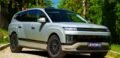
Hyundai launched the IONIQ 9 directly as a 2026 model (no separate 2025 model year), so this isn’t a year-over-year comparison — it’s a trim-level breakdown of the same 2026 nameplate: the entry-level S RWD versus the flagship Calligraphy Design AWD. Both are three-row electric SUVs from Hyundai’s IONIQ sub-brand, built at the automaker’s Metaplant America facility near Savannah, Georgia. The S trim suits budget-conscious families who want maximum range and simplicity, while the Calligraphy targets buyers who want luxury-SUV features without leaving the Hyundai badge. This comparison matters now because all six trims are on sale simultaneously, so the “which one” decision is live for anyone shopping today.
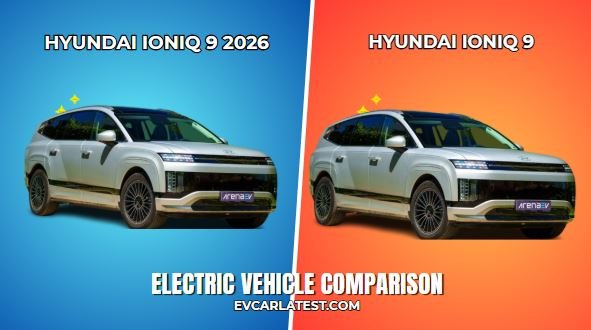
Range & Charging. Both trims share a 110.3 kWh battery, but weight and drivetrain shift the numbers. The S RWD is EPA-rated at 335 miles, actually the longest range in the lineup due to its lighter single-motor setup. The Calligraphy AWD Performance trim is EPA-rated at 311 miles. Real-world range typically lands 10–15% below EPA figures in mixed driving. Charging is identical across trims: an 800V architecture supports up to 350 kW DC fast charging via NACS, with Hyundai claiming a 10–80% charge in about 24 minutes. AC charging tops out around 11 kW (10.9 kW per the owner’s manual), meaning a full charge from a home Level 2 charger takes roughly 7–10 hours on both trims.
Price, Availability & Market Fit. The S RWD starts at $58,955, while the Calligraphy Design AWD tops the range at $76,490 — both figures exclude a $1,600 destination charge. In between sit the SE ($62,795), SEL ($66,320), and Limited ($71,250). All six trims are available now through US Hyundai dealers, with the IONIQ 9 also on sale in South Korea, Canada, Australia, and select other markets. This page exists to answer one question directly: is the roughly $17,500 gap between S and Calligraphy worth it for your household — and for most buyers focused purely on range and value, the answer leans toward the lower trims.
Ecosystem & Rival Context. Within Hyundai’s own EV lineup, the IONIQ 5 and IONIQ 6 sit below the IONIQ 9 in size and price for buyers who don’t need three rows. The IONIQ 9’s closest relative is the Kia EV9, built on the same E-GMP platform with similar dimensions but slightly less range. Outside the Hyundai-Kia family, the Rivian R1S and Volvo EX90 compete near the Calligraphy’s price point. The IONIQ 9 holds its own against those rivals largely because even its base trim undercuts them on price while matching or beating them on range.
Pros & Cons.
The S RWD offers the longest range in the lineup at 335 miles, a genuine advantage for road-trip families. It’s also the best value entry point at under $59,000, and it still includes a 12.3-inch touchscreen, wireless CarPlay/Android Auto, and seven USB-C ports as standard. Its drawbacks: 215 horsepower feels modest for a nearly 3-ton SUV, and it misses out on ventilated seats, Bose audio, and captain’s-chair second-row seating.
The Calligraphy brings 422 horsepower and genuine luxury touches — premium leatherette, a head-up display, and a 14-speaker Bose system — which matter to buyers cross-shopping traditional luxury SUVs. It also gets the more usable AWD Performance powertrain. On the downside, it costs nearly $17,500 more than the S, and its 311-mile range is noticeably shorter, a real trade-off for long-distance drivers.
QUICK VERDICT: Choose the S RWD if you prioritize maximum range and the lowest possible price. Choose the Calligraphy if power, luxury materials, and premium tech matter more than squeezing out every extra mile. Neither trim is objectively “better” — the S is the smarter buy for efficiency-focused families, while the Calligraphy is built for buyers who’d otherwise be shopping the Rivian R1S or Volvo EX90.
| |
| Price | $58,000.00 $60,000.00 |
| Our Rating | |
| Brand | Hyundai Hyundai |
| Category | Electric Cars Electric Cars |
MODEL
| Full Model Name | 2026 Hyundai IONIQ 9 |
| Generation | 1st Generation |
| Segment / Class | Midsize three-row electric SUV |
| Available Trims / Variants |
S (RWD), SE (AWD), SEL (AWD), Performance Limited (AWD), Performance Calligraphy (AWD), Performance Calligraphy Design (AWD)
Hyundai Ioniq 9 Long Range RWD Hyundai Ioniq 9 Long Range AWD Hyundai Ioniq 9 Performance |
| Powertrain Options | Single-motor RWD (215 hp) · Dual-motor AWD (303 hp) · Dual-motor Performance AWD (422 hp) |
| Additional Notes | Hyundai's first three-row battery-electric model |
LAUNCH
| Reveal Date |
November 2024 (LA Auto Show)
2024, November 21 |
| Launch Year | 2025 (sold as 2026 model year) |
| Availability Status | On sale (US, May 2025) Coming soon. Expected release 2025, Q1 |
| Brand / Manufacturer | Hyundai Motor Company |
| Country of origin | South Korea (designed); USA (assembled) South Korea |
| Assembly Country | USA — Metaplant America, Bryan County, Georgia |
| Markets Available | United States, Canada, South Korea; select others TBC |
| Grey Market Import | Yes |
| Base Price (USD) |
$58,955 (S RWD, before destination) — $78,090 (Performance Calligraphy Design AWD)
$ 60,600 - Hyundai Ioniq 9 Long Range RWD $ 64,400 - Hyundai Ioniq 9 Long Range AWD $ 72,900 - Hyundai Ioniq 9 Performance |
| Additional Notes | US-assembled; eligible for $7,500 federal EV tax credit (credit status subject to change). Grey market landed cost in Nigeria estimated ₦130–145 million at base, after duty, VAT, and clearing |
BATTERY
| Battery Capacity |
110.3 kWh gross
110.3 kWh total |
| Battery Chemistry | NMC (Nickel Manganese Cobalt) Liquid-cooled Li-Ion NCM (800V type) |
| Battery Architecture | 800V |
| Thermal Management | Liquid-cooled |
| Range (WLTP/CLTC/EPA) |
335 mi / 539 km (S RWD) · 320 mi / 515 km (SE/SEL AWD) · 311 mi / 500 km (Performance AWD) — EPA cycle
385 mi WLTP (335 mi EPA) - Hyundai Ioniq 9 Long Range RWD 320 mi EPA -Hyundai Ioniq 9 Long Range AWD 311 mi EPA - Hyundai Ioniq 9 Performance |
| Energy Consumption | 92 MPGe (S) · 88 MPGe (SE/SEL) · 85 MPGe (Performance) 312 Wh/mi WLTP - Hyundai Ioniq 9 Long Range RWD |
| Regen Braking (Max kW) | Yes |
| Heat Pump | |
| AC Charging (Max kW) |
10.9 kW
Type 2 11 kW |
| DC Charging (Max kW) |
350 kW peak
CCS, 10-80% in 24 min (with 350 kW charger) |
| Charging Time (10–80%) | ~24 minutes at 350 kW DC |
| Battery Warranty | 10 years / 100,000 miles |
| Battery Preheating | Yes |
| Additional Notes |
NACS port standard; CCS adapter included; compatible with Tesla Supercharger network
Vehicle to load (V2L) |
PERFORMANCE
| Motor Type | Permanent magnet synchronous |
| Motor Configuration | Single rear (S RWD) · Dual front+rear (SE/SEL and Performance AWD) |
| Front Motor Output (kW / HP) | ~160 kW per motor on Performance AWD |
| Power Output (kW / hp) |
160 kW / 215 hp (RWD) · 226 kW / 303 hp (AWD) · 315 kW / 422 hp (Performance AWD)
RWD 218 hp (160 kW) - Hyundai Ioniq 9 Long Range RWD AWD 303 hp (230 kW) - Hyundai Ioniq 9 Long Range AWD AWD 422 hp (320 kW) - Hyundai Ioniq 9 Performance |
| Torque (Nm) |
~350 Nm / 258 lb-ft (RWD) · ~605 Nm / 446 lb-ft (AWD) · ~700 Nm / 516 lb-ft (Performance AWD)
258 lb-ft (350 Nm) - Hyundai Ioniq 9 Long Range RWD 605 Nm (446 lb-ft) - Hyundai Ioniq 9 Long Range AWD 700 Nm (516 lb-ft) - Hyundai Ioniq 9 Performance |
| 0–100 km/h / 0-60 mph (seconds) The acceleration numbers are an easy way to compare car performance. We list either time from 0 to 100 km/h or time from 0 to 60mph, depending on which number(s) the manufacturers provide. The lower the acceleration time, the higher performance the car is. |
4.9 sec claimed (Performance AWD)
8.4 sec 0-60 mph (9.4 sec 0-62 mph) - Hyundai Ioniq 9 Long Range RWD 6.2 sec 0-60 mph (6.7 sec 0-62 mph) - Hyundai Ioniq 9 Long Range AWD 4.9 sec 0-60 mph (5.2 sec 0-62 mph) - Hyundai Ioniq 9 Performance |
| Top Speed (km/h / mph) |
~200 km/h / 124 mph (Hyundai stated — Performance AWD)
115 mph (185 km/h) - Hyundai Ioniq 9 Long Range RWD 124 mph (200 km/h) - Hyundai Ioniq 9 Long Range AWD 124 mph (200 km/h) - Hyundai Ioniq 9 Performance |
| Transmission / Drive | Single-speed, RWD or AWD Single-speed |
BODY
| Body Style |
5-door, 3-row SUV
5 door SUV, 6 seats |
| Body Colour Options | Multiple — includes Ionosphere Green, Cosmic Blue, Snow White Pearl; full list market-dependent |
| Platform / Architecture |
E-GMP (Electric Global Modular Platform)
E-GMP |
| Dimensions (L×W×H mm) |
5,060 × 1,981 × 1,791 mm
199.2 x 78.0 x 70.5 in (5060 x 1980 x 1790 mm) |
| Drag Coefficient (Cd) |
0.259 Cd |
| Wheelbase (mm) |
3,129 mm (123.2 in)
123.2 in (3130 mm) |
| Ground Clearance (mm) | 175 mm (6.9 in) |
| Kerb Weight (kg) | ~2,725 kg / 6,008 lbs (Performance Calligraphy — varies by trim) |
| Max Laden Weight (kg) | 3,320 kg / 7,319 lbs |
| Suspension (Front / Rear) |
long-wheelbase E-GMP with hydro bushings noted in reviews
Front MacPherson + multi-link, rear multi-link |
| Wheel Size (inches) |
21 inches (Performance trims confirmed)
R19, R20, R21 |
| Parking Brake | Electronic (EPB) — standard on E-GMP |
| Trunk/Boot Capacity (L) |
620 L (behind row 3) · 1,323 L (behind row 2) · 2,461 L (maximum)
EU: 620 l, 1323 l max |
| Frunk/Bonnet Capacity (L) |
88 L (RWD) / 52 L (AWD)
88 l - Hyundai Ioniq 9 Long Range RWD 52 l - Hyundai Ioniq 9 Long Range AWD 52 l - Hyundai Ioniq 9 Performance |
| Towing Capacity (kg) | 2,268 kg / 5,000 lbs (Performance AWD with trailer brakes) US: 5000 lb braked (EU: 5512 lb braked) |
| Turning Circle (m) | 12.5 m / 41 ft (diameter) |
| Sunroof | Available — panoramic; standard vs optional varies by trim |
| Additional Notes |
1323l luggage space with the third-row seats folded flat |
SAFETY
| Airbags (count) |
Side, front and rear, including head airbag system |
| Anti-lock Braking System (ABS) | Yes |
| Electronic Brakeforce Distribution (EBD) | Yes |
| Electronic Stability Control (ESC) | Yes |
| Traction Control System (TCS) | Yes |
| Tyre Pressure Monitoring (TPMS) | Yes |
| Child Seat Anchors (ISOFIX / LATCH) | Yes — up to 4 positions (2nd and 3rd row) |
| 360° Camera / Surround View | Yes |
| Reversing Camera | Yes |
| Hill Start Assist | Yes |
| Driver Assistance (ADAS) |
Yes — standard across all trims at no subscription cost
Front and corner radars, cameras. Forward/Side/Reverse Parking Collision-Avoidance Assist, Autonomous Emergency Braking with Pedestrian and Cyclist Recognition, Blind Spot Collision-Avoidance Assist, Rear Cross-Traffic Collision-Avoidance Assist, Lane Keeping Assist 2, Safe Exit Assist, High Beam Assist, Intelligent Speed Limit Assist, Driver Attention Warning, Hands-On Detection |
| ADAS Features | Highway Driving Assist, Lane Keeping Assist, Blind-Spot Collision Warning, Rear Cross-Traffic Alert, Forward Collision Avoidance — full list varies by trim |
| Over-the-Air (OTA) Safety Updates | Yes |
| Crash Test Ratings | IIHS TOP SAFETY PICK+ (2025) |
COMFORT
| Seating Capacity |
6 or 7 — configuration-dependent
Heated and ventilated front seats with massage, swivel heated rear seats |
| Seat Material | Varies by trim (cloth base, leatherette/leather upper trims) |
| Driver Seat Adjustment | Power |
| Passenger Seat Adjustment | Power |
| Seat Heating | Yes |
| Seat Ventilation | Yes (upper trims) |
| Massage Function | Yes (Calligraphy trim second row) |
| Climate Control | Dual or tri-zone |
| Steering Wheel | Heated |
| Roof Type |
Panoramic glass sunroof, tilt & slide |
| Ambient Lighting | Yes |
| Rain-Sensing Wipers | Yes |
| Heated Mirrors | Yes |
| Electrically Folding Mirrors | Yes |
| Bluetooth / Wi-Fi |
Wireless Android Auto and Apple CarPlay |
| Wireless Charging | Yes |
| Parking Aids |
Yes — front and rear sensors
Front and rear sensors, 360 camera, front and reversing camera, Remote Smart Parking Assist |
DISPLAYS
| Centre Screen (inches) |
12.3 inches
12" touchscreen |
| Driver's Display (inches) | 12.3 inches 12" |
| Head-Up Display (HUD) | Available Yes |
| Operating System | ccNC (Hyundai Connected Car Navigation Cockpit) — Pleos Connect (Android Automotive) planned for future models |
| Mirror Link / Apple CarPlay / Android Auto | Yes — wireless |
| Voice Control | Yes |
| Additional Notes | Dual 12.3-inch display setup; supports split-screen multi-window view |
LIGHTING
| Headlight Type (LED/Matrix/Laser) | LED |
| Daytime Running Lights (DRL) | Yes |
| Adaptive Headlights | Yes |
| Tail Light Design | Signature horizontal LED strip — distinctive retro-influenced design |
| Interior Ambient Lighting | Yes |
| Additional Notes | Polarising exterior styling noted across multiple independent reviews |
INFOTAINMENT & AUDIO
| AM/FM/DAB Radio | Yes |
| Navigation System | Yes — built-in |
| USB Ports (count/type) | Multiple USB-C — 100 W per passenger position |
| Additional Notes | Wireless Apple CarPlay and Android Auto confirmed and functional |
TECHNOLOGY
| Smartphone App Control | Yes (Hyundai app) |
| Keyless Entry / Start | Yes |
| Remote Start | Yes |
| Vehicle-to-Load (V2L) | Yes — 1.5 kW / 110 V outlet (trunk) |
| Automatic Parking | Yes |
| Remote Climate Control | Yes |
| Digital Key | Yes |
| Over-the-Air Map Updates | Yes |
| Additional Notes | NACS port standard; compatible with Tesla Supercharger and IONNA charging networks |
OWNERSHIP
| Official Dealer Network | USA, Canada, South Korea |
| Additional Notes | US-assembled; buyer receives complimentary ChargePoint Home Flex Level 2 charger or $400 charging credit |
Note
| Data Source | Hyundai Motor America press releases; Cars.com; KBB; Edmunds; Carbuzz; Electrek; Roadtripper.ca |
| Last Updated | June 2026 |
| Editor's Note | Usable battery capacity (vs. gross 110.3 kWh), individual motor output splits, full ADAS feature list by trim, suspension specification, and frunk capacity for US-market RWD/AWD — flag as unconfirmed until Hyundai publishes updated official spec sheet |
|
Disclaimer Note
Specifications sourced from manufacturer data and may reflect WLTP, CLTC, or EPA test conditions. Import prices in your local are estimates based on grey-market landing costs and exclude duties, clearing fees, and local taxes. Figures are subject to change without notice. Always verify with your local importer before purchase. We can not guarantee that the information on this page is 100% correct