

- Electric Vehicles
- Compare Electric Cars
- AITO M9 2026 vs AITO M8
AITO M9 2026 vs AITO M8
The AITO M9 2026 and AITO M8 are both large, six-seat SUVs built under Huawei’s Seres partnership and sold primarily in China. The M9 sits at the top of the AITO range — a full-size flagship for buyers who want the biggest cabin and the highest-spec HarmonyOS interior available. The M8 is positioned one tier below, targeting families who want similar technology at a lower entry price. Both went on sale in China within 18 months of each other, which makes the choice between them a real decision for buyers in that budget band right now.
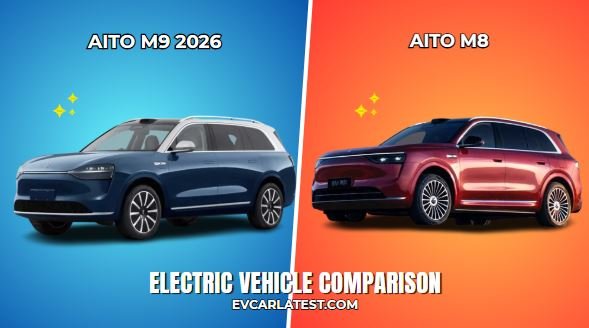
Range and Charging
Both models are sold in pure BEV and extended-range EREV configurations. For the BEV variants, the M9 2026 is rated at approximately 630 km on CLTC — note this is CLTC, which typically runs 15–20% higher than real-world figures. The M8 BEV is rated at around 600 km CLTC (unconfirmed — spec sheet pending official release). EREV variants on both push total range past 1,200 km combined under CLTC conditions. DC fast charging on the M9 supports up to 100 kW (unconfirmed); 10–80% is estimated at under 35 minutes at a compatible fast charger. M8 charging specs are not yet officially confirmed for all variants.
Price, Availability and Market Fit
The M9 2026 starts at approximately CNY 469,800 in China. The M8 starts from around CNY 258,800 — roughly CNY 210,000 less for the base trim. Neither model has an official distributor in Nigeria, Kenya, or South Africa as of mid-2025, but grey-market import pricing for the M8 is estimated in the NGN 20–25M range; the M9 would land higher, closer to NGN 35M+, depending on trim and freight. If you are deciding between them, the core question is whether the M9’s larger cabin and flagship positioning justifies the significant price gap over the M8.
Ecosystem and Rival Context
Within AITO’s own range, the M7 sits below the M8 and is worth considering if budget is the primary constraint. Outside of AITO, the Li Auto L8 and L9 are the most direct rivals — they operate in the same EREV segment at comparable price points and have broader service networks in China. The Nio ES8 is the EV-only alternative worth looking at. This AITO-vs-AITO comparison still makes sense over cross-brand rivals because both vehicles share the same HarmonyOS ecosystem, making the software and interface transition zero — a real factor for Huawei-ecosystem buyers.
Pros and Cons
The M9 2026 carries a larger cabin that genuinely accommodates three rows with usable third-row legroom, which matters if you regularly carry six adults. Its flagship trim includes a more advanced Huawei LiDAR-based driver assistance stack, useful on unfamiliar or poorly mapped roads. The longer estimated range on the BEV version makes it easier to cover long-distance routes without range anxiety. On the downside, the M9’s price premium is substantial — buyers who don’t need the extra space are paying for headroom they may rarely use. Parts and service outside China remain uncertain for grey-market imports.
The M8 gives most of the M9’s technology — HarmonyOS, Huawei’s driver assistance hardware, EREV availability — at a price that is roughly half. For buyers who need six seats but don’t require a full third-row bench, the value case is harder to argue against. The M8 also has a slightly more manageable footprint for urban driving. Its main weaknesses: the final charging and range specs are not fully confirmed across all variants, and it lacks the brand prestige of the M9 for buyers where that matters.
Quick Verdict
Choose the AITO M9 2026 if you regularly carry six passengers and want the most capable HarmonyOS setup AITO currently offers. Choose the M8 if a six-seat family SUV with strong technology is what you need and the M9’s price puts it out of reach. The gap between them is real but so is the price difference — most buyers won’t fill the extra M9 capability week to week.
Related EV Comparisons
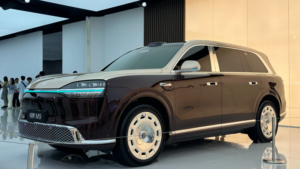
| |
| Price | $70,000.00 $53,132.00 |
| Our Rating | |
| Brand | Aito Aito |
| Category | Electric Cars Electric Cars |
MODEL
| Full Model Name | AITO M9 2026 |
| Generation | 2nd Generation |
| Segment / Class | Full-size luxury SUV |
| Available Trims / Variants | Max+, Ultra, Ultimate Extended Edition 5-seat and 6-seat versions; trims include “Max+”, “Ultra”, single-motor and dual-motor AWD options. |
| Powertrain Options | BEV (pure electric); EREV (range-extended) |
| Special Editions | Ultimate Extended Edition — extended wheelbase, tri-motor, 2.0T range extender |
LAUNCH
| Reveal Date | 28 May 2026 BEV variants announced July 2025 |
| Launch Year | 2026 |
| Availability Status | On sale in China from May 2026 Pre-order open, market launch tentatively set for August 2025. |
| Brand / Manufacturer | Aito / HIMA (Huawei Intelligent Mobility Alliance + Seres) |
| Country of origin | China China |
| Assembly Country | China |
| Markets Available | China (official); grey market only elsewhere |
| Grey Market Import | Possible via parallel import |
| Base Price (USD) | ~$70,600 (¥479,800) — Max+; up to ~$97,000 (¥659,800) — Ultimate Extended ~ ¥378,000 (China) for entry-level BEV version. |
BATTERY
| Battery Capacity | 120 kWh (BEV) 100 kWh CATL battery pack for all BEV variants. |
| Battery Chemistry | NMC lithium-ion (CATL) 800-volt architecture; likely NMC chemistry. |
| Battery Architecture | 800V high-voltage platform (BEV) |
| Thermal Management | Liquid-cooled |
| Range (WLTP/CLTC/EPA) | BEV: 750 km CLTC; EREV: 340–422 km pure electric CLTC; 1,405 km combined CLTC. Up to ~ 705 km (CLTC). |
| Energy Consumption | ~ 23.7 kWh / 100 km (when measured under some standard). |
| Heat Pump | |
| Cell Brand | CATL |
| Additional Notes | EREV uses 52 kWh pack (carry-over from 2025 refresh); BEV upgraded to 120 kWh from Gen 1's 100 kWh Battery protection system ≈ 15-layer; many sensors for safety |
PERFORMANCE
| Motor Type | Permanent magnet synchronous |
| Motor Configuration | Dual motor (Max+, Ultra); Tri-motor (Ultimate Extended Edition) |
| Power Output (kW / hp) |
EREV standard: 497 kW / 667 hp; Ultimate Extended: 664 kW / 890 hp
Single-motor version: up to ~227 kW. Dual-motor AWD version: combined ~387 kW |
| Peak Power (kW / hp) | 664 kW / 890 hp (Ultimate Extended) |
| Torque (Nm) | Not all sources give full torque; dual-motor likely ~598 Nm. |
| 0–100 km/h / 0-60 mph (seconds) The acceleration numbers are an easy way to compare car performance. We list either time from 0 to 100 km/h or time from 0 to 60mph, depending on which number(s) the manufacturers provide. The lower the acceleration time, the higher performance the car is. | BEV: 4.5 sec; Ultimate Extended: 3.99 sec ~ 4.8-5.2 seconds depending on version. |
| Top Speed (km/h / mph) | 251 km/h (Ultimate Extended) ~ 200 km/h. |
| Transmission / Drive | Single-speed, AWD all trims |
| Rear-Wheel Steering | Yes — ±8° |
| Additional Notes | Huawei Tuling active chassis platform; CDC dampers standard |
BODY
| Body Style | 5-door full-size luxury SUV Full-size luxury SUV, 5-door; offered in 5-seat and 6-seat layouts. |
| Body Colour Options | Desert Gold Brown, Sayram Blue, Canghai Silver Blue (new); others not confirmed |
| Platform / Architecture | HIMA EV/EREV platform; Xuanwu Architecture 2.0 body structure Huawei’s “Giant Whale” 800V high-voltage platform / upgraded Tuling platform. |
| Dimensions (L×W×H mm) | Standard: 5,285 × 2,026 × 1,845 mm; Ultimate Extended: 5,402 × 2,026 × 1,845 mm 5,190×1,999×1,795 mm |
| Drag Coefficient (Cd) | ~ 0.255–0.259 Cd depending on source. |
| Wheelbase (mm) | Standard: 3,125 mm; Ultimate Extended: 3,236 mm 3,105 mm |
| Ground Clearance (mm) | ~18° / ~20° |
| Kerb Weight (kg) | ~2,670 kg in some versions. |
| Suspension (Front / Rear) | Dual-chamber air suspension standard; CDC dampers; front double wishbone Independent; double wishbone front, independent rear. |
| Wheel Size (inches) | Options include 20- or 21-inch wheels; tires around 255/50 R20 front, 275/50 R20 rear or 265/45-285/45 R21. |
| Trunk/Boot Capacity (L) | Rear trunk volume ~ 392-1323 L depending on seat configuration. |
| Frunk/Bonnet Capacity (L) | Has a powered front-trunk (“extra-large frunk”). |
| Turning Circle (m) | 5.1 m (5.4 m vehicle) |
| Sunroof | Panoramic roof |
| Additional Notes | 91% high-strength steel and aluminium alloy body; A/B pillars use 2,200 MPa submarine-grade hot-formed steel |
SAFETY
| Anti-lock Braking System (ABS) | Yes |
| Electronic Brakeforce Distribution (EBD) | Yes |
| Electronic Stability Control (ESC) | Yes |
| Traction Control System (TCS) | Yes |
| Structural Safety | Xuanwu Architecture 2.0; 91% high-strength materials; 2,200 MPa A/B pillars |
| Tyre Pressure Monitoring (TPMS) | Yes |
| Child Seat Anchors (ISOFIX / LATCH) | Yes |
| 360° Camera / Surround View | Yes |
| Reversing Camera | Yes |
| Driver Assistance (ADAS) | Huawei Qiankun ADS 5.0 — standard across all trims Huawei ADS 4 advanced driver-assistance; many sensors (LiDAR, cameras, radars, ultrasonics) for active safety. |
| ADAS Features | Full-scenario navigation, car-to-car routing, advanced auto parking |
| Autonomous Driving Level | L2+ advanced driver assistance Level 2+ autonomous driving; supervised autonomous features. |
| Autonomous Driving System Name | Huawei Qiankun ADS 5.0 |
| Autonomous Driving Hardware | 6 LiDAR, 5 millimetre-wave radars, 12 ultrasonic radars, 12 HD cameras |
| Over-the-Air (OTA) Safety Updates | Yes |
| Additional Notes | ADS 5.0 is a major upgrade over Gen 1's ADS 3.0/3.3 |
COMFORT
| Seating Capacity | 4-seat, 5-seat, or 6-seat configurations available 5 or 6 seats; in 6-seat version, second row includes captain / “zero-gravity” style seats with recline; front passenger seat folds for leg-rest when unoccupied. Heating, ventilation etc |
| Power Seats | Yes |
| Seat Heating | Yes |
| Roof Type | Panoramic cabin; likely panoramic roof option. — |
| Ambient Lighting | Yes |
| Bluetooth / Wi-Fi | HarmonyOS version; likely strong integration with Huawei tech. |
| Wireless Charging | Ye |
| 5G / LTE | Yes |
| Parking Aids | 360° cameras, front and rear radar, auto parking via ADS 5.0 Multiple sensors; LiDAR; 4D millimeter-wave radars; intelligent parking assistance. |
| Additional Notes | Retractable running boards available; gesture-controlled doors on some trims Many customization interior colours; sound system; frunk; flexible seating layouts. |
DISPLAYS
| Centre Screen (inches) | Dual 17.2-inch 3.4K displays Multiple displays integrated into dashboard (three displays in front); large infotainment screens. |
| Driver's Display (inches) | 12.3-inch instrument cluster AR-HUD, reportedly ~68-inch augmented reality head-up display. |
| Head-Up Display (HUD) | AR-HUD — confirmed; projection size not confirmed for Gen 2 Yes, AR-HUD. Same as above |
| Rear Passenger Screen | Optional 32-inch retractable projection screen |
| Display Resolution | 3.4K (main screens) |
| Operating System | HarmonyOS — Harmony Cockpit 5.2 |
| Voice Control | Yes — integrated with Pangu and DeepSeek large models |
| Additional Notes | Triple-screen cockpit (12.3" + dual 17.2"); 32" optional rear projection screen Rear seat screens; projector display for rear seats; floating window mode etc. |
LIGHTING
| Headlight Type (LED/Matrix/Laser) | Intelligent projection headlights |
| Daytime Running Lights (DRL) | Yes |
| Adaptive Headlights | Yes |
| Interior Ambient Lighting | Yes |
| Additional Notes | Headlights support interactive signalling function |
INFOTAINMENT & AUDIO
| Sound System Brand | Huawei Sound |
| Audio Output (watts) | 2,920W |
| Navigation System | Yes — Huawei maps |
| Rear Entertainment | Optional 32-inch retractable projection screen |
| Additional Notes | Harmony Cockpit 5.2 system |
TECHNOLOGY
| Smartphone App Control | Yes |
| Keyless Entry / Start | Yes |
| Bluetooth Key | Yes |
| Remote Parking | Yes — via ADS 5.0 |
| Automatic Parking | Yes |
| Digital Key | Yes |
| Smart Home Integration | Yes — HarmonyOS ecosystem |
| AI Assistant | Yes — Pangu + DeepSeek large model integration |
| Over-the-Air Map Updates | Yes |
OWNERSHIP
| Official Dealer Network | China only at launch |
| Service Interval | No official support outside China |
| Spare Parts Availability | Limited outside China |
| Import Duty Class | Varies by country |
Note
| Data Source | HIMA official launch (May 28, 2026); CarNewsChina report (May 28, 2026) |
| Last Updated | May 29, 2026 |
| Additional Notes |
The BEV variant adds an extra-large frunk, quieter operation, and lower running costs vs the EREV versions. Pre-orders include special colour / design packages (e.g. Night Purple, Black Obsidian). |
| Editor's Note | Full technical documentation expected within weeks of launch. Page will be updated as confirmed specs are released. WLTP and EPA range figures not available at time of writing. |

|
Disclaimer Note
Specifications sourced from manufacturer data and may reflect WLTP, CLTC, or EPA test conditions. Import prices in your local are estimates based on grey-market landing costs and exclude duties, clearing fees, and local taxes. Figures are subject to change without notice. Always verify with your local importer before purchase. We can not guarantee that the information on this page is 100% correct