- Electric Vehicles
- Compare Electric Cars
- BYD Seagull vs Wuling Hongguang Mini EV
BYD Seagull vs Wuling Hongguang Mini EV
The BYD Seagull and the Wuling Hongguang Mini EV are both low-cost electric vehicles developed for the Chinese domestic market, sitting at the most affordable end of the global EV price spectrum. The Seagull is built by BYD on its e-Platform 3.0 Evo architecture and is positioned as a proper small hatchback with full road capability. The Hongguang Mini EV is produced by SAIC-GM-Wuling, a joint venture between SAIC Motor, General Motors, and Liuzhou Wuling Motors, and is a micro electric city car that became the best-selling electric vehicle in China during 2020 and 2021. Both vehicles target cost-driven buyers in urban China — young first-time car owners, retirees, and low-income commuters who need basic point-to-point transportation at the lowest possible purchase price. The Seagull extends its reach toward buyers who want slightly more capability and longer journeys without stepping up to mid-range pricing.
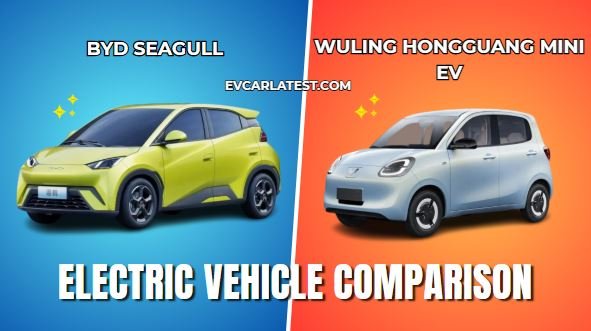
The BYD Seagull is rated at up to 405 km on the CLTC cycle on its long range version, with the standard range version sitting at approximately 305 km CLTC. Both figures are strong for the price category and reflect BYD’s blade battery technology applied to an entry-level product. The Wuling Hongguang Mini EV is rated at between 120 km and 200 km CLTC depending on the variant and battery configuration, with the base version sitting at the lower end of that range. The gap between these two vehicles on range is substantial and is the single most important practical difference between them. On charging, the Seagull supports up to 40 kW DC fast charging on compatible variants alongside AC charging. The Hongguang Mini EV relies primarily on AC slow charging, with most standard variants carrying no DC fast-charging capability at all. For buyers who depend on public charging infrastructure rather than home overnight charging, this difference is significant.
The Wuling Hongguang Mini EV starts at approximately RMB 32,800 in China for the base configuration, making it one of the least expensive new electric vehicles ever sold at scale anywhere in the world. The BYD Seagull starts at around RMB 69,800 for the standard range version, which is roughly double the Mini EV’s entry price. Both vehicles are sold primarily in China through their respective dealer and sales networks. The Seagull has begun international expansion under the Dolphin Mini nameplate in select markets including Latin America and parts of Southeast Asia, while the Hongguang Mini EV remains concentrated in China with very limited international presence. This page helps buyers in China decide whether the Mini EV’s significantly lower price is sufficient for their daily use pattern, or whether the Seagull’s longer range, faster charging, and more complete feature set justify paying considerably more.
BYD’s broader lineup includes the Dolphin, Atto 3, Seal, Han, Tang, Sea Lion 06, Sea Lion 7, and an expanding range of models across multiple segments, with the Seagull sitting as the brand’s most affordable entry point globally. Wuling’s other electric vehicles include the Wuling Bingo, a slightly larger hatchback positioned above the Mini EV, and the Wuling Cloud EV targeting buyers who want more range and features within the SAIC-GM-Wuling family. Outside these two brands, the main rivals in this segment are the Chery QQ Ice Cream, which competes directly with the Hongguang Mini EV on micro EV pricing in China, and the Leapmotor T03, which sits closer to the Seagull in size and capability while targeting a similar budget-conscious buyer.
The BYD Seagull’s three main strengths are its CLTC range of up to 405 km which far exceeds anything the Mini EV offers and makes it viable for longer urban and suburban trips, its DC fast-charging capability which gives it practical usability on public charging infrastructure, and its blade battery technology which BYD applies across its entire range including this entry-level model for improved thermal stability. Its two weaknesses are its starting price, which at roughly double the Mini EV’s base cost removes it from consideration for buyers at the bottom of the budget range, and its exterior dimensions, which are larger than the Mini EV and reduce some of the parking and maneuverability advantages that micro EVs offer in dense city environments. The Wuling Hongguang Mini EV’s three main strengths are its starting price of around RMB 32,800 which remains one of the lowest for any new electric vehicle sold at volume globally, its compact micro-car dimensions that make it exceptionally easy to park and navigate in tight urban streets and congested Chinese cities, and its proven sales record that reflects genuine mass-market demand across a wide range of urban buyers in China. Its two weaknesses are its range ceiling of 120 to 200 km CLTC which limits it to short urban use and makes it impractical for any journey beyond the immediate city, and its lack of DC fast charging on standard variants which means public charging infrastructure is largely inaccessible for quick top-ups when away from a home socket.
Quick Verdict: These two vehicles serve different needs despite overlapping on price sensitivity. The Hongguang Mini EV works for buyers whose entire daily driving pattern stays within 80 to 100 km, who charge at home every night, and for whom the lowest possible purchase price is the primary filter. The Seagull costs more but functions as a complete small car capable of handling a wider range of trips, public charging stops, and longer urban-to-suburban journeys. Buyers in China who need only a short-range urban runabout and want to spend as little as possible will find the Mini EV adequate for that narrow use case. Buyers who want more range, the ability to fast charge when needed, or a vehicle that can occasionally travel beyond city boundaries will find the Seagull the more practical long-term choice despite the higher upfront cost.
Related EV Comparisons
- BYD Sealion 06 vs Tesla Model Y
- Stelato S9 vs BYD Han
- XPeng MONA M03 vs BYD Dolphin
- XPeng MONA M03 vs BYD Qin Plus EV
- BYD Seagull vs DongFeng Nammi Box


| |
| Price | $25,000.00 $5,000.00 |
| Our Rating | |
| Brand | BYD Wuling |
| Category | Electric Cars Electric Cars |
MODEL
| Available Trims / Variants |
BYD Seagull Active BYD Seagull Active (Europe Version) BYD Seagull Fly BYD Seagull Boost BYD Seagull Comfort Models: Mini EV, Mini EV Macaron, Mini EV GameBoy Edition |
LAUNCH
| Reveal Date | 2023, April 18 2020 |
| Availability Status | Available to order. Released 2023, April 26 In production |
| Country of origin | China China |
| Base Price (USD) | € 23,000 £ 18,700 Starting around $5,000 |
BATTERY
| Battery Capacity | 30 kWh usable 9.3 / 13.9 / 17.3 kWh |
| Battery Chemistry | BYD Blade LFP (Lithium Iron Phosphate) LFP (Lithium Iron Phosphate) |
| Range (WLTP/CLTC/EPA) | 137 mi WLTP (mi WLTP) 75–130 miles (120–210 km CLTC) |
| Energy Consumption | 248 Wh/mi WLTP 10–12 kWh/100 km |
| Regen Braking (Max kW) | Regenerative braking (mild) Regenerative braking |
| Heat Pump | |
| AC Charging (Max kW) | Type 2 6.6 kW 6.5 hours (220V standard) |
| DC Charging (Max kW) | CCS 30 kW, 30-80% in 30 min |
| Additional Notes | Battery heating & protection features Simple plug-in home charging |
PERFORMANCE
| Power Output (kW / hp) | FWD 75 hp (55 kW) 27–41 HP; Rear-wheel drive |
| Torque (Nm) | 135 Nm (100 lb-ft) 85 Nm |
| 0–100 km/h / 0-60 mph (seconds) The acceleration numbers are an easy way to compare car performance. We list either time from 0 to 100 km/h or time from 0 to 60mph, depending on which number(s) the manufacturers provide. The lower the acceleration time, the higher performance the car is. | 13 sec 0-62 mph 20 sec (0–100 km/h, estimated) |
| Top Speed (km/h / mph) | 81 mph (130 km/h) 62 mph (100 km/h) |
BODY
| Body Style | 5 door hatchback, 5 seats 3-door hatchback (4 seats) |
| Platform / Architecture | BYD e-Platform 3.0 SGMW electric micro platform |
| Dimensions (L×W×H mm) | 3,780 × 1,715 × 1,540 mm (L×W×H): 2,917 × 1,493 × 1,621 mm |
| Drag Coefficient (Cd) | 0.32 Cd 0.38 |
| Wheelbase (mm) | 2500 mm (98.4 in) 1,940 mm |
| Ground Clearance (mm) | 131 - 154 mm (5.2 - 6.1 in) 125 mm |
| Kerb Weight (kg) | EU: 1160 kg unladen 665–760 kg |
| Suspension (Front / Rear) | Front MacPherson struts, rear twist-beam Front MacPherson / Rear Leaf Spring |
| Wheel Size (inches) | R15, R16 12–13 inch steel/alloy |
| Trunk/Boot Capacity (L) | 230 L (up to 930 L with rear seats folded) 74–741 L (rear seats folded) |
| Frunk/Bonnet Capacity (L) | No |
| Towing Capacity (kg) | No |
| Additional Notes | 61% high-strength steel body Extremely compact turning radius (~4.2 m) |
SAFETY
| Airbags (count) | 8 airbags: front, side, rear, including head airbag system Driver + passenger (on select trims) |
| Driver Assistance (ADAS) | Front radar, 360 camera system, reverse camera, Front Cross Pedestrian Alert, Traffic Sign Recognition, Automatic Emergency Braking System ABS, EBD, tire pressure monitoring |
| Crash Test Ratings | NCAP 2023: 5 stars Meets local safety standards (basic rating) |
COMFORT
| Seating Capacity | Heated front seats 4 cloth seats, folding rear bench |
| Roof Type | Fixed Optional two-tone design |
| Bluetooth / Wi-Fi | Android Auto and Apple CarPlay Bluetooth, USB; no Android Auto/CarPlay |
| Parking Aids | Rear sensors, reversing camera, automatic parking Rear sensors, optional reverse camera |
| Additional Notes | Keyless entry & start, power windows, heated seats (optional) Manual windows on base trim, A/C standard on higher trims |
DISPLAYS
| Centre Screen (inches) | 10.1-inch rotating touchscreen (DiLink system) Basic infotainment (8-inch touchscreen on GameBoy Edition) |
| Driver's Display (inches) | 7" 7-inch digital instrument cluster |
| Head-Up Display (HUD) | No |
| Additional Notes | Wireless charging pad & USB ports Simple layout, physical controls |
LIGHTING
INFOTAINMENT & AUDIO
TECHNOLOGY
OWNERSHIP
Note
| Additional Notes |
Global Names: Dolphin Mini / Dolphin Surf / Atto 1 (depending on market) Cold Weather Range: Drops to ~150 mi in freezing conditions Warranty: Lifetime battery warranty (first owner, China) China’s best-selling micro EV; perfect for tight city spaces and daily short-range commutes. |


|
Disclaimer Note
Specifications sourced from manufacturer data and may reflect WLTP, CLTC, or EPA test conditions. Import prices in your local are estimates based on grey-market landing costs and exclude duties, clearing fees, and local taxes. Figures are subject to change without notice. Always verify with your local importer before purchase. We can not guarantee that the information on this page is 100% correct