- Electric Vehicles
- Compare Electric Cars
- BYD Sealion 06 vs Tesla Model Y
BYD Sealion 06 vs Tesla Model Y
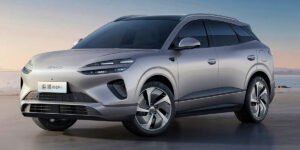
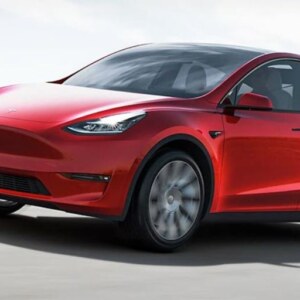
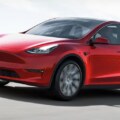
The BYD Sealion 06 and the Tesla Model Y are both mid-size electric SUVs targeting the mainstream crossover segment. The Sealion 06 is built by BYD, China’s largest electric vehicle manufacturer, and sits on the brand’s e-Platform 3.0 architecture. The Model Y is Tesla’s best-selling global vehicle and the current volume leader in the electric crossover segment worldwide. The Sealion 06 targets price-sensitive buyers in markets where BYD has an established presence, particularly those looking for a lower-cost alternative to European and American EV brands. The Model Y targets a broad buyer base ranging from first-time EV adopters to existing Tesla owners upgrading within the ecosystem.
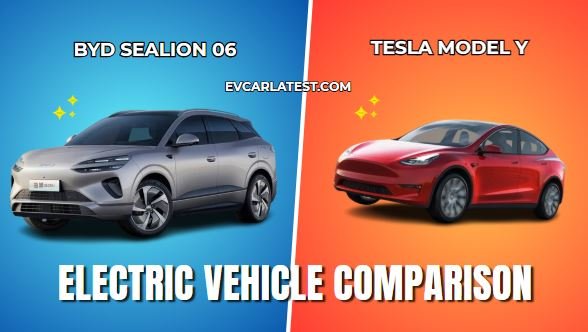
The BYD Sealion 06 Long Range is rated at approximately 450 km on the WLTP cycle, with the standard range version sitting around 360 km WLTP. The Tesla Model Y Long Range AWD is EPA-rated at around 330 miles, which converts to approximately 531 km, giving it a range advantage on the longer configuration. The standard rear-wheel drive Model Y sits around 418 km WLTP in European trim. On charging, the Sealion 06 supports up to 150 kW DC fast charging. The Model Y charges at up to 250 kW on Tesla’s V3 Superchargers. Tesla holds a clear advantage on peak charging speed, and its Supercharger network adds a further practical edge in regions where third-party fast charging infrastructure is inconsistent.
The BYD Sealion 06 starts at approximately €32,000 in Europe and is priced competitively in Australia and Southeast Asian markets, positioning it several thousand euros below the Model Y in most overlapping markets. The Tesla Model Y starts at around €42,990 in Europe and $43,990 in the United States. The Sealion 06 is not currently sold in the United States, limiting its availability to China, Europe, Australia, the Middle East, and select Asian and African markets. The Model Y is available across all major global markets with a well-established direct-sales and service infrastructure. This page helps buyers in markets where both vehicles are sold — primarily Europe and Australia — decide whether the Sealion 06’s lower price justifies the trade-offs against the Model Y’s range, charging network, and brand infrastructure.
BYD’s broader electric lineup includes the Seal sedan, Atto 3 compact SUV, Han executive sedan, Tang large SUV, Dolphin hatchback, and Sea Lion 7, with the Sealion 06 sitting in the middle of a wide and expanding model range. Tesla’s current lineup alongside the Model Y includes the Model 3, Model S, Model X, and Cybertruck. Outside these two brands, the main rivals in this segment are the Hyundai Ioniq 5, which competes closely with the Model Y on features and charging speed, and the Volkswagen ID.4, which targets the same mid-size crossover buyer at a comparable price point in Europe.
The BYD Sealion 06’s three main strengths are its significantly lower starting price compared to the Model Y in overlapping markets, its blade battery technology which BYD positions as safer and more thermally stable than conventional lithium-ion cell formats, and its well-equipped standard trim levels that include features many rivals charge extra for. Its two weaknesses are its 150 kW DC charging ceiling, which is slower than the Model Y on compatible hardware, and its limited brand recognition and service network outside China, which remains a practical concern for buyers in newer BYD markets. The Tesla Model Y’s three main strengths are its access to the Supercharger network which remains the most reliable fast-charging infrastructure across North America and Europe, its longer real-world range on the Long Range AWD configuration, and its over-the-air software updates that continuously modify vehicle behaviour and add features after purchase. Its two weaknesses are its higher starting price, which places it out of reach for buyers who find the Sealion 06 adequate for their needs, and its interior material quality, which remains below what some buyers expect at its price point compared to rivals including the Sealion 06.
Quick Verdict: The Sealion 06 makes a straightforward case on price. In markets where both vehicles are available, it costs noticeably less while delivering comparable range on the long range version. The Model Y counters with faster charging, a more established service presence, and Supercharger network access that remains a tangible advantage for long-distance driving. Buyers who charge primarily at home and want to spend less should look closely at the Sealion 06. Buyers who depend on public fast charging infrastructure and want the security of an established service network have a stronger case for the Model Y.
Related EV Comparisons
- Tesla Model Y vs Hyundai Ioniq 5
- GMC Hummer EV Pickup vs Tesla Cybertruck
- Jeep Wagoneer S vs Tesla Model Y
- Tesla Cybertruck vs Ford F-150 Lightning
- Tesla Model X vs Rivian R1S
| |
| Price | $19,000.00 $45,000.00 |
| Our Rating | |
| Brand | BYD TESLA |
| Category | Electric Cars Electric Cars |
MODEL
| Available Trims / Variants |
Single-motor RWD, Extended range, Dual-motor AWD Tesla Model Y Standard Range+ RWD 60kWh Tesla Model Y Long Range AWD 82kWh Tesla Model Y Long Range RWD Tesla Model Y Long Range RWD USA Tesla Model Y Performance |
LAUNCH
| Reveal Date |
2025 launch with 2026 model year
2022, August - Tesla Model Y Standard Range+ RWD 60kWh 2021 - Tesla Model Y Long Range AWD 82kWh 2024, April 11 - Tesla Model Y Long Range RWD 2024, May 06 - Tesla Model Y Long Range RWD USA 2019 - Tesla Model Y Performance |
| Availability Status |
In production and on sale
Available. Released 2022, August - Tesla Model Y Standard Range+ RWD 60kWh Available to order. Released 2021 - Tesla Model Y Long Range AWD 82kWh Available to order. Released 2024, April - Tesla Model Y Long Range RWD Available to order. Released 2024, May - Tesla Model Y Long Range RWD USA Available to order. Released 2020 - Tesla Model Y Performance |
| Country of origin | China United States |
| Base Price (USD) |
$19,800 to $23,400
€ 45,000 £ 45,000 - Tesla Model Y Standard Range+ RWD 60kWh $ 48,000 € 52,500 £ 53,000 - Tesla Model Y Long Range AWD 82kWh € 49,000 - Tesla Model Y Long Range RWD $ 45,000 - Tesla Model Y Long Range RWD USA $ 51,500 € 58,500 £ 60,000 - Tesla Model Y Performance |
BATTERY
| Battery Capacity |
65.28 or 78.72 kWh
60 kWh total - Tesla Model Y Standard Range+ RWD 60kWh 75 kWh usable, 82 kWh total - Tesla Model Y Long Range AWD 82kWh 78.1 kWh total - Tesla Model Y Long Range RWD 76 kWh usable, 82 kWh total - Tesla Model Y Performance |
| Battery Chemistry |
Blade LFP battery
Liquid-cooled Li-ion 360V LFP battery - Tesla Model Y Standard Range+ RWD 60kWh Liquid-cooled Li-ion 360V - Tesla Model Y Long Range AWD 82kWh Liquid-cooled Li-ion NCM (400V type) - Tesla Model Y Long Range RWD Liquid-cooled (400V type) - Tesla Model Y Long Range RWD USA Liquid-cooled Li-ion 360V - Tesla Model Y Performance |
| Range (WLTP/CLTC/EPA) |
(mi WLTP/CLTC): 520–605 km CLTC (~323–376 mi)
260 mi EPA (283 mi WLTP) - Tesla Model Y Standard Range+ RWD 60kWh 351 mi WLTP (310 mi EPA) - Tesla Model Y Long Range AWD 82kWh 373 mi WLTP - Tesla Model Y Long Range RWD 320 mi EPA - Tesla Model Y Long Range RWD USA 319 mi WLTP (279 mi EPA) - Tesla Model Y Performance |
| Energy Consumption |
14.1 kWh/100 km
253 Wh/mi WLTP - Tesla Model Y Standard Range+ RWD 60kWh 272 Wh/mi WLTP (280 Wh/mi EPA) - Tesla Model Y Long Range AWD 82kWh 249 Wh/mi WLTP - Tesla Model Y Long Range RWD 249 Wh/mi WLTP - Tesla Model Y Long Range RWD USA 275 Wh/mi WLTP (280 Wh/mi EPA) - Tesla Model Y Performance |
| Regen Braking (Max kW) | Regen braking standard 2 levels, via driving modes, no regen when pedal braking |
| Heat Pump | |
| AC Charging (Max kW) |
7 hours typical home charging
Type 2 7.7 kW - Tesla Model Y Standard Range+ RWD 60kWh Type 2 11 kW, 0-100% in 7 hours 31 min - Tesla Model Y Long Range AWD 82kWh Type 2 11 kW -Tesla Model Y Long Range RWD Type 2 11 kW - Tesla Model Y Long Range RWD USA Type 2 11 kW, 0-100% in 7 hours 31 min - Tesla Model Y Performance |
| DC Charging (Max kW) |
30–80% in ~18 minutes
Supercharger V3 250 kW max, 10-80% in 30 min CCS 250 kW max, 10-80% in 30 min |
| Additional Notes | 400V or optional 800V architecture depending on trim |
PERFORMANCE
| Power Output (kW / hp) |
170 kW to 180 kW (about 228–241 hp) RWD; higher power AWD RWD 347 hp (255 kW) - Tesla Model Y Standard Range+ RWD 60kWh AWD 514 hp (378 kW) - Tesla Model Y Long Range AWD 82kWh RWD 347 hp (255 kW) - Tesla Model Y Long Range RWD RWD - Tesla Model Y Long Range RWD USA AWD 534 hp (393 kW) - Tesla Model Y Performance |
| Torque (Nm) | 330 Nm RWD 347 hp (255 kW) - Tesla Model Y Long Range RWD |
| 0–100 km/h / 0-60 mph (seconds) The acceleration numbers are an easy way to compare car performance. We list either time from 0 to 100 km/h or time from 0 to 60mph, depending on which number(s) the manufacturers provide. The lower the acceleration time, the higher performance the car is. |
0–100 km/h: ~7.5–7.7 seconds
6.6 sec 0-60 mph (6.9 sec 0-62 mph) - Tesla Model Y Standard Range+ RWD 60kWh 4.8 sec 0-60 mph (5 sec 0-62 mph) - Tesla Model Y Long Range AWD 82kWh 5.9 sec 0-62 mph - Tesla Model Y Long Range RWD 6.5 sec 0-60 mph - Tesla Model Y Long Range RWD USA 3.5 sec 0-60 mph (3.7 sec 0-62 mph) - Tesla Model Y Performance |
| Top Speed (km/h / mph) |
185 km/h (115 mph)
135 mph (217 km/h) - Tesla Model Y Standard Range+ RWD 60kWh 135 mph (217 km/h) - Tesla Model Y Long Range AWD 82kWh 135 mph (217 km/h) - Tesla Model Y Long Range RWD 135 mph (217 km/h) - Tesla Model Y Long Range RWD USA 155 mph (250 km/h) - Tesla Model Y Performance |
| Transmission / Drive | Single-speed |
BODY
| Body Style | 5-door SUV, 5 seats 5 door, SUV, 5/7 seats |
| Platform / Architecture | e-Platform 3.0 Evo |
| Dimensions (L×W×H mm) | (L/W/H): 4810/1920/1675 mm 4750 x 1920 x 1624 mm (187.0 x 75.6 x 63.9 in) |
| Drag Coefficient (Cd) | 0.23 Cd |
| Wheelbase (mm) | 2820 mm 2890 mm (113.8 in) |
| Ground Clearance (mm) | 167 mm (6.6 in) |
| Kerb Weight (kg) |
1,890–2,090 kg
EU: 1909 kg unladen - Tesla Model Y Standard Range+ RWD 60kWh EU: 2056 kg unladen - Tesla Model Y Long Range AWD 82kWh EU: 1959 kg unladen - Tesla Model Y Long Range RWD EU: 2072 kg unladen, 2591 kg gross - Tesla Model Y Performance |
| Suspension (Front / Rear) | MacPherson front, multi-link rear Front double wishbone-type coil spring, rear multi-link |
| Wheel Size (inches) | 19″ R19, R20, R21 |
| Trunk/Boot Capacity (L) | 757 L, seats folded ~1,630 L EU: 854 l, 2041 l max |
| Frunk/Bonnet Capacity (L) | 142 L 117 l |
| Towing Capacity (kg) | EU: 750 kg unbraked, 1600 kg braked |
SAFETY
| Airbags (count) | Seven airbags standard 8 airbags: front, side, rear, head airbag system, front seats knee airbags |
| Driver Assistance (ADAS) | DiPilot 100 driver assist, blind-spot alert, AEB 3 front, 2 side, and 3 rear cameras, 6 front and 6 rear sensors (up to 250m object detection). Automatic Emergency Braking, Dynamic Brake Lights, Lane Assist, Collision Avoidance Assist, Speed Assist, Lane Departure Avoidance, Traffic Light, and Stop Sign Control |
| Autonomous Driving Level | Highway Navigation On Autopilot support Autopilot with full Self-Driving capability |
| Crash Test Ratings | NCAP 2022: 5 stars, NHTSA 2020-2022: 5 stars |
COMFORT
| Seating Capacity | 5 seats, ventilated/heated front options in some trims Heated front seats, heated rear seats, heated third row seats |
| Roof Type | Panoramic sunroof in many trims All-glass roof |
| Bluetooth / Wi-Fi | Wireless Apple CarPlay/Android Auto, NFC key, advanced nav |
| Parking Aids | 360° camera and sensors on many trims 6 front and rear sensors, reversing camera, Parking Assist |
| Additional Notes | Wireless charging, in-car ETC |
DISPLAYS
| Centre Screen (inches) | Large central touchscreen 15" touchscreeen |
| Driver's Display (inches) | Digital instrument cluster No |
| Head-Up Display (HUD) | Available on select trims No |
LIGHTING
INFOTAINMENT & AUDIO
TECHNOLOGY
OWNERSHIP
Note
| Additional Notes | Advanced safety systems include sentinel and remote view functions |
| Disclaimer | We can not guarantee that the information on this page is 100% correct |

|
Disclaimer Note
Specifications sourced from manufacturer data and may reflect WLTP, CLTC, or EPA test conditions. Import prices in your local are estimates based on grey-market landing costs and exclude duties, clearing fees, and local taxes. Figures are subject to change without notice. Always verify with your local importer before purchase. We can not guarantee that the information on this page is 100% correct