

- Electric Vehicles
- Compare Electric Cars
- Honda Super-ONE vs Honda e
Honda Super-ONE vs Honda e
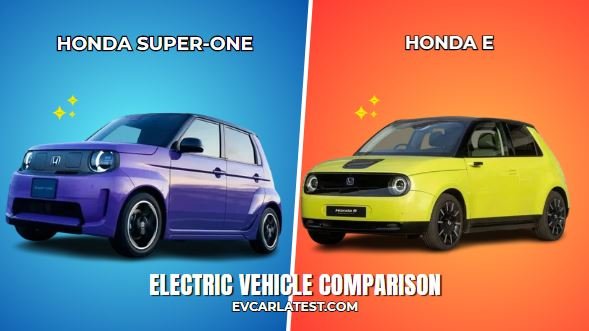
The Honda Super-ONE is a compact electric hatchback launched in Japan and Singapore in early 2026, built on the N-One e: platform but widened for international markets and aimed at younger urban drivers who want some personality alongside their daily commute. The Honda e, by contrast, was a premium city hatchback Honda sold in Europe from 2020 until it was discontinued in January 2024, built for design-conscious buyers who prized distinctive styling and a high-spec interior over long range. With the Super-ONE now positioning itself as the spiritual successor to the Honda e — same size, same urban brief, significantly lower price — this comparison answers whether the new car actually earns that title.
Range & charging
The Super-ONE carries a 29.6 kWh usable battery and returns 205 km on the WLTP cycle — Honda’s Japanese press release quotes 274 km under the WLTC test, which is a different and generally more lenient standard. The Honda e has a larger 35.5 kWh pack and manages 222 km WLTP in its top Advance trim, giving it a modest real-world edge on urban routes. Both cars max out at 50 kW DC charging: the Super-ONE reaches 80% in around 30 minutes from 10%, while the Honda e takes closer to 40 minutes over the same window due to its average charge rate sitting around 30 kW. On AC, the Super-ONE accepts 6 kW and takes roughly 4.5 hours for a full charge; the Honda e handles 6.6 kW and completes a charge in about 4 hours. Neither car is designed for long motorway runs, and that should be understood before buying either.
Price, availability & market fit
The Super-ONE launched in Japan from approximately $21,300, with the UK version — sold as the Super-N — expected under £25,000 when it goes on sale in July 2026. The Honda e started at £26,160 new but is now out of production, available only as a used import from Europe. Neither car is officially sold in Nigeria, Kenya, or South Africa, so both require grey market import. For African buyers weighing these two, the Super-ONE is the more practical choice simply because it is new, carries a factory warranty, and has an active supply chain — the Honda e is a better-finished car but comes with no service pipeline and thinning parts availability over time. This page helps you decide which of the two makes sense given your budget, import access, and tolerance for buying used.
Ecosystem & rival context
Honda’s only other EV currently on sale in Europe is the e:Ny1 SUV, which offers 412 km WLTP range from £38,000 — a different segment entirely. For buyers weighing alternatives at this price point, the Dacia Spring (230 km WLTP, from approximately €17,000) and the Leapmotor T03 are the closest rivals on affordability, though neither matches the Super-ONE on driving character or the Honda e on interior quality. The Super-ONE wins this comparison over those alternatives because it delivers something neither the Spring nor the T03 attempts: an EV that behaves like it has a gearbox, which is a real point of difference for buyers coming from petrol cars.
Pros & cons
The Super-ONE’s three strongest points are its Boost Mode and simulated seven-speed gearbox, which give it a genuinely engaging feel that most city EVs simply do not have; its 1,090 kg kerb weight, which is unusually light for an EV and pays off in both efficiency and handling; and the fact that it is available new with a warranty, which matters significantly when importing to a market without Honda dealer support. Its two weaknesses are range — 205 km WLTP is thin for anything beyond city use, and Boost Mode trims that further in practice — and the synthetic sounds and fake gearshifts, which will actively irritate buyers who prefer the clean simplicity of a standard EV.
The Honda e’s strongest qualities are its interior, which still stands out in 2026 against used rivals at a similar price thanks to its dual 12.3-inch screens, camera door mirrors, and wraparound dashboard design; its slightly better real-world urban range over the Super-ONE; and the wider used market in Europe, which gives buyers more choice on mileage, trim, and condition. On the negative side, it was discontinued in January 2024 with no replacement planned, meaning no new stock, no factory warranty on used examples, and parts availability that will only get harder to guarantee as the years pass. It was also expensive when new — which means early used prices were stubbornly high, and genuine value has only recently started to appear.
Quick verdict
Choose the Super-ONE if a new car with a warranty, a lower price, and a driving experience that does something different matters to you. Choose the Honda e if interior quality and slightly better urban range are your priorities and you are comfortable buying used with no factory backup. For buyers in Nigeria, Kenya, or South Africa importing either via grey market, the Super-ONE is the sounder long-term bet — it is newer, cheaper, and still in production. The Honda e is the more refined product, but it is a dead model with no future support structure behind it.

| |
| Price | $21,000.00 $38,000.00 |
| Our Rating | |
| Brand | HONDA HONDA |
| Category | Electric Cars Electric Cars |
MODEL
| Full Model Name | Honda Super-ONE |
| Generation | 1st generation |
| Segment / Class | A-segment compact electric hatchback |
| Available Trims / Variants | Single trim (Japan launch); UK sold as Super-N Honda e Advance |
| Powertrain Options | FWD, single front motor |
| Special Editions | Boost Violet Pearl paint finish |
| Additional Notes | Evolved from Japan-only N-ONE e: kei car for international markets |
LAUNCH
| Reveal Date | October 2025 (Japan Mobility Show concept); February 2026 (production confirmed) 2019, May |
| Launch Year | 2026 |
| Availability Status | On sale in Japan from May 22, 2026; UK (as Super-N) July 2026; Australia H2 2026 Available to order. Released 2020 |
| Brand / Manufacturer | Honda Motor Co., Ltd. |
| Country of origin | Japan Japan |
| Assembly Country | Japan |
| Markets Available | Japan, UK, Australia, New Zealand, Singapore; Europe planned |
| Grey Market Import | Possible in markets with no official launch |
| Base Price (USD) | ~$21,300 (Japan, ¥3,390,200 incl. tax); UK under £20,000; AUD ~$30,000 € 38,000 £ 34,160 |
BATTERY
| Battery Capacity | 29.6 kWh usable (carried over from N-ONE e:; Honda has not officially disclosed capacity for Super-ONE) 29 kWh usable, 35.5 kWh total |
| Battery Chemistry | Water-cooled Li-ion 355V |
| Battery Architecture | Flat floor-mounted pack |
| Range (WLTP/CLTC/EPA) | 274 km WLTC (Japan cycle); ~205 km WLTP (European cycle) 137 mi WLTP |
| Energy Consumption | 277 Wh/mi WLTP |
| Regen Braking (Max kW) |
Single Pedal Control (One-pedal driving) available in CITY mode
Yes, automatic level adjustment |
| Heat Pump | |
| AC Charging (Max kW) |
~6 kW (based on N-ONE e: carry-over spec)
Type 2 6.6 kW, 0-100% in 5 hours 59 min |
| DC Charging (Max kW) |
CCS 100 kW max, 0-80% in 36 min CCS 100 kW max, 0-80% in 36 min |
| Charging Time (10–80%) | ~30 min (20–80% DC); ~4.5 hours full AC |
| Additional Notes |
Vehicle to load (V2L) 230V electrical outlet (1.5 KW max) on the center console |
PERFORMANCE
| Motor Type | Single permanent magnet electric motor |
| Motor Configuration | Front-mounted (FWD) |
| Power Output (kW / hp) |
47 kW / 64 PS / 63 hp
RWD 154 hp (113 kW) |
| Peak Power (kW / hp) | 70 kW / 95 PS / 94 hp |
| Torque (Nm) | 162 Nm 315 Nm (232 lb-ft) |
| 0–100 km/h / 0-60 mph (seconds) The acceleration numbers are an easy way to compare car performance. We list either time from 0 to 100 km/h or time from 0 to 60mph, depending on which number(s) the manufacturers provide. The lower the acceleration time, the higher performance the car is. | 8.3 sec 0-62 mph |
| Top Speed (km/h / mph) |
90 mph (145 km/h) |
| Transmission / Drive | Single-speed; simulated 7-speed gearbox with paddle shifters in Boost Mode Single-speed |
| Rear-Wheel Steering | No |
| Drive Mode | 5 modes: ECON, CITY, NORMAL, SPORT, BOOST |
| Overboost / Boost Mode | Yes — button on steering wheel; activates 70 kW, paddle shifts, and Active Sound Control |
| Torque Vectoring | No |
| Simulated Sound | Yes — Bose Active Sound Control; virtual engine sounds synced to throttle input |
| Additional Notes | Boost Mode also activates purple ambient lighting and a fake tachometer display |
BODY
| Body Style |
5-door hatchback
5 door hatchback, 4 seats |
| Body Colour Options | Multiple including Boost Violet Pearl; two-tone combinations available |
| Platform / Architecture | Modified Honda N-ONE e: platform (widened, dedicated chassis) |
| Dimensions (L×W×H mm) |
3,589 mm × 1,573 mm × 1,616 mm
3894 x 1752 x 1512 mm (153.3 x 69.0 x 59.5 in) |
| Wheelbase (mm) | 2,520 mm 2538 mm (99.9 in) |
| Front Track (mm) | Widened by 10 mm vs N-ONE e |
| Rear Track (mm) | Widened by 10 mm vs N-ONE e |
| Ground Clearance (mm) | 145 mm (5.7 in) |
| Kerb Weight (kg) |
1,090 kg
EU: 1520 kg unladen, 1870 kg gross |
| Suspension (Front / Rear) | Front MacPherson struts, rear multi-link |
| Wheel Size (inches) | 16-inch R16, R17 |
| Brakes (Front / Rear) | Disc (front) / Drum (rear) |
| Trunk/Boot Capacity (L) |
EU: 171 l, 861 l max |
| Frunk/Bonnet Capacity (L) |
None
No |
| Towing Capacity (kg) | No |
| Turning Circle (m) | ~5.2 m |
| Additional Notes | Blister fenders, front and rear aerodynamic air ducts; lowered suspension vs standard kei-spec donor Digital Side Mirrors |
SAFETY
| Airbags (count) | 6 — dual front, front side, curtain airbags (curtains extend to rear) Side airbags, front and rear, including head airbag system |
| Anti-lock Braking System (ABS) | Yes |
| Electronic Stability Control (ESC) | Yes (standard) |
| Traction Control System (TCS) | Yes |
| Low-Speed Pedestrian Warning | Yes |
| Child Seat Anchors (ISOFIX / LATCH) | Yes — both rear seats |
| Driver Assistance (ADAS) | Honda SENSING (latest version, standard fit) Front radar and camera. Automatic front emergency braking with pedestrian & cyclist recognition, Lane Departure Prevention, Lane Keeping Assist, Traffic Sign Recognition, High Beam Assist, Lead Car Departure Notification, Blind Spot Warning |
| ADAS Features | Adaptive cruise control, traffic jam assist, lane departure warning/intervention, pedestrian collision mitigation, speed sign recognition, lead car departure notification, automatic high beam |
| Autonomous Driving Level | Level 2 |
| Crash Test Ratings | NCAP 2020: 4 stars |
| Additional Notes | Honda SENSING is standard across all markets |
COMFORT
| Seating Capacity | 4 Heated front seats |
| Seat Material | Blue fabric sport seats (exclusive to Super-ONE) |
| Driver Seat Adjustment | Manual (assumed) |
| Seat Heating | Confirmed (heated seats) |
| Massage Function | No |
| Steering Wheel | Sports-spec; heated; Boost Mode button |
| Roof Type | Panoramic glass sunroof |
| Bluetooth / Wi-Fi | Yes (via Honda CONNECT) Wired or Wireless Android Auto and Wireless Apple CarPlay |
| Parking Aids |
Front and rear sensors, 360 camera, reversing camera, self parking |
| Additional Notes | Asymmetric blue seat upholstery; horizontal instrument panel for improved forward sightlines |
DISPLAYS
| Centre Screen (inches) | 9-inch Honda CONNECT touchscreen Two 12.3" touchscreens, two 6" (Side Camera Mirror System) |
| Driver's Display (inches) | 7-inch digital instrument cluster (themes change with drive mode) 9" |
| Head-Up Display (HUD) | No |
| Rear Passenger Screen | No |
| Operating System | Google-integrated (Google Maps, Google Assistant) |
| Physical Controls | Yes |
| Voice Control | Yes (Google Assistant via Honda CONNECT) |
| Additional Notes | Display changes to purple-themed in Boost Mode |
LIGHTING
| Headlight Type (LED/Matrix/Laser) | LED |
| Daytime Running Lights (DRL) | Yes — circular LED design |
| Adaptive Headlights | Automatic high beam (via Honda SENSING) |
| Tail Light Design | Horizontal rear LED with Honda name lettering across tailgate |
| Interior Ambient Lighting | Yes — changes from blue to purple in Boost Mode |
| Additional Notes | "Honda" name displayed across tailgate rather than logo |
INFOTAINMENT & AUDIO
| Sound System Brand | Bose |
| Speaker Count | 8 speakers |
| Audio Output (watts) | Bose Dynamic Speed Compensation (auto-adjusts volume/tone with speed) |
| Streaming Services | Via Google integration |
| Navigation System | Google Maps (via Honda CONNECT) |
TECHNOLOGY
| Vehicle-to-Load (V2L) | Yes — up to 1,500W external power output |
| Vehicle-to-Grid (V2G) | Available on Japan-market platform |
| Vehicle-to-Vehicle (V2H) | Available in Japan |
| Remote Parking | No |
OWNERSHIP
| Official Dealer Network | Honda Cars dealers (Japan); mainstream dealers in AU, UK, NZ, SG |
| Spare Parts Availability | Expected through official Honda network; limited outside launch markets |
| Grey Market Support | Minimal; no official parts pipeline for non-launch markets |
| Roadside Assistance | Expected through Honda dealer network |
Note
| Data Source | Honda Global Newsroom, Paul Tan's Automotive News, RACV, ArenaEV, Electrek, CarsGuide, Automotive World, electrive.com |
| Last Updated | May 27, 2026 |
| Additional Notes | For China market only, dubbed as GAC Honda e:NP1 |
| Editor's Note | Several specs — battery chemistry, AC/DC charging kW, boot volume, 0–100 time, top speed, and suspension type — remain unconfirmed by Honda directly. Figures inferred from the N-ONE e: platform or third-party previews are flagged. This sheet will require updating once Honda publishes full technical documentation for each export market. |
| Disclaimer | We can not guarantee that the information on this page is 100% correct |


|
Disclaimer Note
Specifications sourced from manufacturer data and may reflect WLTP, CLTC, or EPA test conditions. Import prices in your local are estimates based on grey-market landing costs and exclude duties, clearing fees, and local taxes. Figures are subject to change without notice. Always verify with your local importer before purchase. We can not guarantee that the information on this page is 100% correct