

- Home
- Electric Vehicles
- Compare Electric Cars
- Citroen Ami vs Dacia Spring Electric 2026
Citroen Ami vs Dacia Spring Electric 2026
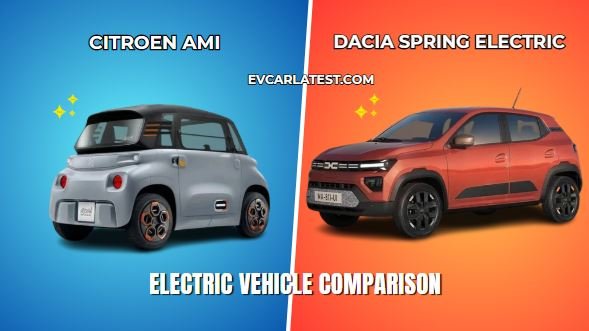
The Citroën Ami is a two-seat electric quadricycle — a micro-mobility pod built for city-only travel, produced by Stellantis under the French Citroën brand. The Dacia Spring Electric is a proper four-seat A-segment hatchback from Romanian brand Dacia, under the Renault Group. The Ami targets commuters who need minimal urban transport, while the Spring targets budget-conscious first-time EV buyers who need a functional everyday car. With the Spring receiving updates for 2026 and the Ami expanding into new markets, this comparison is timely for buyers considering either as a city-focused EV entry point.
Range & Charging
The Citroën Ami carries a 5.5 kWh battery with a claimed WLTP range of 75 km. Real-world range sits closer to 60–65 km depending on terrain and load. It charges exclusively via a standard household 2.3 kW socket, reaching full charge in approximately 3 hours. There is no DC fast charging option.
The Dacia Spring 2026 uses a 26.8 kWh battery with a WLTP-rated range of around 220 km. Real-world range is approximately 170–190 km in mixed driving. It supports 7.4 kW AC charging and 30 kW DC fast charging — getting from 10–80% in roughly 45 minutes on a DC charger, or about 3.5 hours on AC. The Spring is clearly the stronger choice for range and charging flexibility.
Price, Availability & Market Fit
The Citroën Ami starts at approximately €8,000 (~$8,700 USD / ₦13.5M NGN at current parallel rates). It is primarily sold in Western Europe, with limited availability in select Middle Eastern and North African markets. It is not a standard car and cannot legally be driven on motorways or highways.
The Dacia Spring 2026 starts at around €16,900 (~$18,400 USD / ₦28.5M NGN). Trim options include Essential and Expression variants, with the Expression adding DC fast charge capability. The Spring is sold across Europe, with grey-market imports reaching South Africa and East Africa. If your question is which one functions as a practical daily vehicle with real resale value, this page answers clearly: the Spring wins for most buyers.
Ecosystem & Rival Context
Within Citroën’s lineup, the ë-C3 is the next logical step up for buyers who outgrow the Ami’s limitations. Within Dacia’s range, the Spring has no direct sibling but sits below the Sandero and Logan in the brand hierarchy. Rival alternatives at a similar price or segment include the Renault Twingo Electric and the BYD Seagull (where available), both offering stronger feature sets. This Ami vs Spring comparison still matters because no other pairing so clearly illustrates the trade-off between micro-mobility simplicity and genuine car functionality.
Pros & Cons
Citroën Ami The Ami’s extremely low entry price makes EV ownership accessible without a significant financial commitment. Its 3-hour household charge means no special infrastructure is needed — a wall socket is sufficient. Its compact dimensions make parking and maneuvering in dense city traffic genuinely effortless.
However, the 75 km WLTP range makes it unsuitable for anything beyond short urban trips, which limits its usefulness for most African city realities where distances between destinations can be significant. Its 45 km/h top speed also means it cannot legally or safely share space with highway traffic.
Dacia Spring The Spring’s 220 km WLTP range handles real-world African city driving with margin to spare. DC fast charging support at 30 kW makes it practical for longer journeys with planned stops. As a full four-seat car with a boot, it functions as an actual family or household vehicle.
On the downside, the Spring’s starting price is roughly double the Ami’s, which is a meaningful barrier in NGN or KES terms. Its 30 kW DC charging, while present, is slow compared to newer EVs in the same price class.
Quick Verdict
Choose the Citroën Ami if your commute is under 50 km daily, you have no highway driving needs, and your priority is the lowest possible EV entry cost. Choose the Dacia Spring if you need a real car — one with four seats, highway capability, and enough range to serve as your primary vehicle. For most buyers in Nigeria, Kenya, or South Africa importing via grey market, the Spring is the only practical choice between these two.
Related EV Comparisons


| |
| Price | $8,900.00 $18,000.00 |
| Our Rating | |
| Brand | CITROEN DACIA |
| Category | Electric Cars Electric Cars |
MODEL
| Full Model Name | Citroën Ami 100% Electric Dacia Spring Electric (2nd generation, 2026) |
| Segment / Class | Light electric quadricycle (L6e) A-segment electric city car |
| Available Trims / Variants | My Ami (base), My Ami Pop, My Ami Peps, Ami Buggy Expression, Journey |
| Powertrain Options | Single: 6 kW electric motor, FWD only Single front motor, 82 PS standard; optional Fast-Charge Pack adds DC charging + V2L |
PRICE & AVAILABILITY
| Base Price (USD) | ~$8,900 (€8,190 France); ~£8,995 UK From €17,900 (Europe, Expression trim) |
| Availability Status | On sale Just unveiled (Sept 10, 2026) |
| Markets Available | France, UK, Germany, Spain, Italy, Belgium, select EU markets Europe confirmed |
| Brand / Manufacturer | Citroën (Stellantis Group) Dacia (Renault Group) |
BATTERY & CHARGING
| Battery Capacity | 5.5 kWh gross / 5.4 kWh usable 27.5 kWh (LFP) |
| Range (WLTP/CLTC/EPA) | 75 km / 47 miles (WMTC cycle; quoted as WLTP-equivalent in some markets) (WLTP): Up to 250 km (~155 miles) |
| DC Charging (Max kW) | None — no DC charging capability 50 kW — only with optional Fast-Charge Pack; base version has no DC charging |
| Charging Time (10–80%) | ~3–4 hours from standard household socket (15–80%): 28 min (50 kW DC, optional pack) · 9 hrs (standard 6.6 kW AC home socket) |
| AC Charging (Max kW) | 2.3 kW (integrated onboard charger, standard 230V household socket) 6.6 kW standard; 11 kW with Fast-Charge Pack |
| Battery Warranty | 3-year / 25,000-mile battery warranty (UK); varies by market Not disclosed |
| Energy Consumption | ~73 Wh/km (estimated based on battery size and range) Not disclosed |
PERFORMANCE
| Power Output (kW / hp) | 6 kW / 8 hp (continuous) 60 kW / 82 PS (80 hp) |
| 0–100 km/h / 0-60 mph (seconds) The acceleration numbers are an easy way to compare car performance. We list either time from 0 to 100 km/h or time from 0 to 60mph, depending on which number(s) the manufacturers provide. The lower the acceleration time, the higher performance the car is. | Not applicable (top speed below 100 km/h) 12.1 seconds |
| Motor Configuration | Single motor, front axle Single motor, front-wheel drive |
| Torque (Nm) | 40 Nm 175 Nm |
| Top Speed (km/h / mph) | 45 km/h / 28 mph (electronically limited by quadricycle classification) 130 km/h / ~81 mph |
BODY & DIMENSIONS
| Dimensions (L×W×H mm) | 2,410 × 1,390 × 1,525 mm 3,850 × 1,740 × 1,520 mm |
| Trunk/Boot Capacity (L) | 63 L (rear boot) + 260 L storage ahead of passenger seat 337 L (up to 1,283 L with rear seats folded) |
| Body Style | 2-door micro hatchback (quadricycle) 5-door hatchback |
| Kerb Weight (kg) | 470–483 kg (varies by trim) From 1,212 kg |
| Ground Clearance (mm) | Not disclosed officially Not disclosed |
| Frunk/Bonnet Capacity (L) | No frunk 18 L (optional add-on) |
| Sunroof | Panoramic glass sunroof (standard on most trims) Not offered |
SAFETY & DRIVER ASSISTANCE
| ADAS Features | None Not disclosed |
| Autonomous Driving Level | None (Level 0) Driver-assistance only (no autonomy) |
| Crash Test Ratings | Not rated by Euro NCAP Not yet tested |
| Over-the-Air (OTA) Safety Updates | No Not disclosed |
COMFORT & SEATING
| Seating Capacity | 2 (driver + 1 passenger, side by side) 4 |
| Seat Material | Basic fabric Fabric (Expression); mixed fabric/TEP (Journey) |
| Wireless Charging | No Not offered |
DISPLAYS & CONNECTIVITY
| Centre Screen (inches) | None — smartphone cradle/mount only None on Expression (phone-based "Media Control" app instead); 10.1" Media Nav Live on Journey and above |
| Mirror Link / Apple CarPlay / Android Auto | No native integration; smartphone used independently via cradle Via smartphone app on Expression; built-in on Journey+ |
| Driver's Display (inches) | Small digital speedometer cluster 7-inch digital cluster (all trims) |
| Head-Up Display (HUD) | No Not offered |
TECHNOLOGY
| Vehicle-to-Load (V2L) | No Available with optional Fast-Charge Pack |
| Vehicle-to-Grid (V2G) | No Not offered |
| Over-the-Air Map Updates | No Not disclosed |
ADDITIONAL SPECS
| Headlight Type (LED/Matrix/Laser) | LED Automatic headlamps |
| Adaptive Headlights | No Not offered |
| Sound System Brand | Not disclosed |
| Speaker Count | Not disclosed |
| Navigation System | Media Nav Live (Journey and above) |
| Face Recognition | Not offered |
| Fingerprint Sensor | Not offered |
| Remote Parking | Not offered |
| Official Dealer Network | Confirmed for Europe; other markets |
| Service Interval | Not disclosed |
| Roadside Assistance | Not disclosed |
Note
| Data Source | Citroën UK official technical spec sheet; UltimateSpecs; EncyCARpedia; What Car?; Electrifying.com Dacia press materials, reported via paultan.org (Sept 10, 2026), with cross-checks against Carwow, Parkers, Euro NCAP |
| Last Updated | May 2025 September 12, 2026 |
| Additional Notes | Range figure uses WMTC cycle (motorcycle test standard), not standard WLTP car cycle This is the all-new second-gen Spring, revealed this week — separate from the current facelifted first-gen still sold in the UK (24.3 kWh battery, 225 km WLTP, from ~£11,990–£16,995) |
| Editor's Note | Several attributes (thermal management, front/rear track, ground clearance, payload) are not published by Citroën officially — fields marked "Not disclosed" or "unconfirmed" should not be estimated or filled with assumptions Several fields (crash rating, warranty, full ADAS list, additional trims) haven't been published by Dacia yet |


|
Disclaimer Note
Specifications sourced from manufacturer data and may reflect WLTP, CLTC, or EPA test conditions. Import prices in your local are estimates based on grey-market landing costs and exclude duties, clearing fees, and local taxes. Figures are subject to change without notice. Always verify with your local importer before purchase. We can not guarantee that the information on this page is 100% correct