

- Home
- Electric Vehicles
- Compare Electric Cars
- Mini Cooper Electric vs Fiat 500e Cabrio
Mini Cooper Electric vs Fiat 500e Cabrio
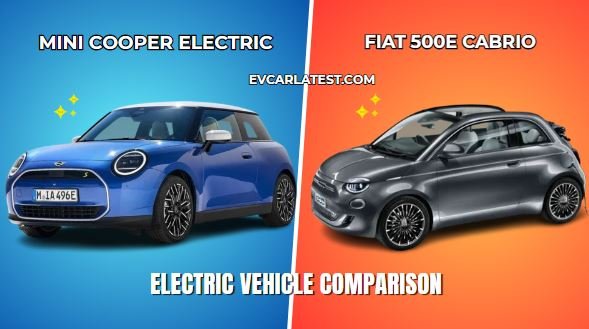
The Mini Cooper Electric and the Fiat 500e Cabrio are two of the most recognizable small EVs in the market — both trade on heritage, both target urban buyers who want personality over practicality, and both have made it onto the radar of African grey-market importers looking for compact, affordable electrics. The Mini is a three-door hot hatch from BMW Group, built in Oxford and aimed at drivers who want something spirited. The 500e Cabrio is a convertible city car from Stellantis, styled as a modern take on the original Cinquecento, targeting buyers who prioritize style and open-air driving. With both models available through grey-market channels in Nigeria, Kenya, and South Africa, this comparison is worth making now.
Range & Charging
The Mini Cooper Electric (SE trim, standard battery) covers around 270 km on the WLTP cycle. Real-world range in mixed conditions runs closer to 200–220 km. The larger battery option in newer trims pushes WLTP range to around 402 km — a much more practical figure. AC charging maxes out at 11 kW (on the larger battery variant); DC fast charging hits 95 kW, taking the battery from 10–80% in roughly 30 minutes.
The Fiat 500e Cabrio, on its 42 kWh battery, is rated at 320 km WLTP. Real-world range is typically 220–240 km in urban use, dropping noticeably on motorways. AC charging is 11 kW; DC charging tops out at 85 kW. A 10–80% charge takes around 35 minutes. Neither car is built for road trips, but both handle daily urban commuting without much anxiety.
Price, Availability & Market Fit
In the European market, the Mini Cooper Electric starts around €33,000–€36,000 (~$36,000–$39,000 USD) depending on trim. Grey-market import pricing into Nigeria typically lands in the ₦28–₦38 million range depending on variant, import duties, and port clearance costs. In Kenya, expect KES 4.5–6 million; in South Africa, ZAR 700,000–900,000 through private importers.
The Fiat 500e Cabrio starts at around €33,500 (~$36,500 USD) in Europe. Grey-market import pricing in Nigeria runs ₦28–₦36 million; in Kenya, KES 4.5–5.5 million; South Africa around ZAR 680,000–870,000. Both sit in the same import price bracket, so the buying decision comes down to what you want the car to do — closed hot hatch or open-top city cruiser.
Ecosystem & Rival Context
Mini’s broader EV lineup includes the Mini Countryman Electric for buyers who need more space, and the Mini Aceman for those wanting a crossover shape without going full SUV. If the Cooper Electric feels too small, the Countryman is the next logical step.
On the Fiat side, the standard 500e (non-Cabrio) is the same car with a fixed roof and marginally better aerodynamics — worth considering if open-air driving isn’t a priority. The Cabrio premium is roughly €2,000–3,000 in Europe.
Outside both brands, the Peugeot e-208 and Opel/Vauxhall Corsa Electric are worth a look in the same price and segment range, offering slightly more conventional practicality. The Renault Zoe is another option, though it’s being phased out in favor of the newer Renault 5 Electric. What keeps this Mini vs 500e comparison relevant is the styling factor — neither Peugeot nor Renault carries the same cultural weight as these two.
Pros & Cons
Mini Cooper Electric The Mini delivers a genuinely engaging drive for a city car — it’s the better choice if how the car handles matters to you, not just how it looks parked. Its larger battery variant removes the range anxiety that made earlier Minis hard to recommend outside dense urban centers. Build quality is a step above the 500e, which matters for resale value in African grey-market conditions.
On the downside, rear-seat space is extremely limited — it works as a two-seater in practice, not four. And the smaller battery base model’s 270 km WLTP range is underwhelming against newer competitors at the same price point.
Fiat 500e Cabrio The convertible roof is the obvious selling point — in warm climates like coastal Nigeria or Nairobi, that’s more than just an aesthetic choice. The 500e also has a slightly friendlier interior layout for city stops and start-up routines, with an intuitive infotainment system. For buyers who want something distinctive at social events, the Cabrio is hard to beat on visual impact.
The downsides are real though: the 500e’s 85 kW DC charging limit feels dated compared to what’s available at the same price, and cabin material quality doesn’t always hold up to scrutiny — some trim pieces feel less premium than the car’s styling suggests.
Quick Verdict
Choose the Mini Cooper Electric if driving feel matters and you want a car that’s built to last through several years of grey-market use. Choose the Fiat 500e Cabrio if the open-top experience in a warm climate is the main draw and you’re buying it as a second car or weekend vehicle. The Mini makes more sense as a primary car; the 500e Cabrio is the more enjoyable one to be seen in. Both are similarly priced at import, so the choice is really about function versus mood.
Related EV Comparisons
- Mini Aceman vs Smart #1
- Renault 5 E-Tech vs Mini Cooper Electric
- Volvo EX30 vs Mini Countryman
- Volkswagen ID. 2all vs Mini Cooper SE
- Mini Cooper Electric vs Mini Aceman

| |
| Price | $30,000.00 $38,000.00 |
| Our Rating | |
| Brand | Mini Fiat |
| Category | Electric Cars Electric Cars |
MODEL
| Available Trims / Variants |
Mini Cooper E Electric Mini Cooper SE Electric Fiat 500e Cabrio (42 kWh) |
PRICE & AVAILABILITY
| Base Price (USD) |
£ 30,000 - Mini Cooper E Electric € 36,900 £ 34,500 - Mini Cooper SE Electric €37,490 (Europe) / £30,995 (UK) / $38,000 (US) |
| Availability Status | Available to order. Released 2023, November On sale in Europe, UK, and US |
BATTERY & CHARGING
| Battery Capacity |
40.7 kWh total -Mini Cooper E Electric 49.2 kWh usable, 54.2 kWh total - Mini Cooper SE Electric 42 kWh (gross), 37.3 kWh (usable) |
| Range (WLTP/CLTC/EPA) |
190 mi WLTP - Mini Cooper E Electric 250 mi WLTP -Mini Cooper SE Electric WLTP up to 303 km; real ~230 km |
| DC Charging (Max kW) |
CCS 75 kW, 10-80% in 28 min - Mini Cooper E Electric CCS 95 kW, 10-80% in 30 min -Mini Cooper SE Electric Up to 85 kW (10–80% in 25–35 min) |
| AC Charging (Max kW) |
Type 2 11 kW, 0-100% in 4.5 h - Mini Cooper E Electric Type 2 11 kW, 0-100% in 5.25 h -Mini Cooper SE Electric 11 kW (4 hours); 7.4 kW (6 hours) |
| Energy Consumption |
222 Wh/mi WLTP - Mini Cooper E Electric 227 Wh/mi WLTP - Mini Cooper SE Electric 16.8 kWh/100 km |
PERFORMANCE
| Power Output (kW / hp) |
FWD 184 hp (135 kW) - Mini Cooper E Electric FWD 218 hp (160 kW) - Mini Cooper SE Electric 87 kW (118 hp), FWD |
| 0–100 km/h / 0-60 mph (seconds) The acceleration numbers are an easy way to compare car performance. We list either time from 0 to 100 km/h or time from 0 to 60mph, depending on which number(s) the manufacturers provide. The lower the acceleration time, the higher performance the car is. |
7.3 sec 0-62 mph - Mini Cooper E Electric 6.7 sec 0-62 mph - Mini Cooper SE Electric 0–100 km/h in 9 s |
| Torque (Nm) |
214 lb-ft (290 Nm) - Mini Cooper E Electric 330 Nm (243 lb-ft) - Mini Cooper SE Electric 220 Nm |
| Top Speed (km/h / mph) | 99 mph (160 km/h) 150 km/h |
BODY & DIMENSIONS
| Dimensions (L×W×H mm) | 151.9 x 69.1 x 57.5 in (3858 x 1756 x 1460 mm) (L×W×H): 3632 × 1683 × 1527 mm |
| Trunk/Boot Capacity (L) | EU: 7.4 ft³, 28.3 ft³ max 185 L |
| Body Style | 3 door hatchback, 4 seats 2-door electric convertible, 4 seats |
| Kerb Weight (kg) |
EU: 1615 kg unladen, 1990 kg gross - Mini Cooper E Electric EU: 1680 kg unladen, 2055 kg gross - Mini Cooper SE Electric 1365 kg |
| Ground Clearance (mm) | 120 mm |
| Frunk/Bonnet Capacity (L) | No None |
SAFETY & DRIVER ASSISTANCE
| Autonomous Driving Level | Level 2 (lane centering, adaptive cruise available in top trims) |
| Crash Test Ratings | Euro NCAP – 4 stars (76% adult, 80% child) |
COMFORT & SEATING
| Seating Capacity | Heated front seats Up to 4, leather/fabric mix, heated front |
DISPLAYS & CONNECTIVITY
| Centre Screen (inches) | 9.5" touchscreen 10.25” Uconnect touchscreen |
| Driver's Display (inches) | No 7” digital instrument cluster |
| Head-Up Display (HUD) | Yes Not available |
TECHNOLOGY
ADDITIONAL SPECS
Note
| Additional Notes |
Urban-focused city EV with convertible fun Best suited for short trips and daily commutes Limited rear seat and boot space No AWD or long-range variant |

|
Disclaimer Note
Specifications sourced from manufacturer data and may reflect WLTP, CLTC, or EPA test conditions. Import prices in your local are estimates based on grey-market landing costs and exclude duties, clearing fees, and local taxes. Figures are subject to change without notice. Always verify with your local importer before purchase. We can not guarantee that the information on this page is 100% correct