

- Home
- Electric Vehicles
- Compare Electric Cars
- Renault 5 E-Tech vs Mini Cooper Electric
Renault 5 E-Tech vs Mini Cooper Electric
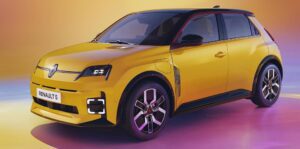
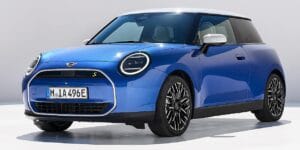
The Renault 5 E-Tech and the Mini Cooper Electric are both small premium electric hatchbacks sold primarily in European markets. The Renault 5 E-Tech is built by Renault and revives the iconic 5 nameplate as a fully electric vehicle on the brand’s new AmpR Small platform, developed specifically for affordable electric mobility. The Mini Cooper Electric is built by Mini, a brand under BMW Group, and is the third generation of Mini’s electric hatchback, now on a dedicated electric platform replacing the previous model’s adapted combustion architecture. Both vehicles target buyers who want a small, characterful electric hatchback with a strong design identity — urban professionals, younger buyers, and downsizers who are willing to pay a moderate premium over basic budget EVs for styling, brand personality, and a more engaging driving experience.
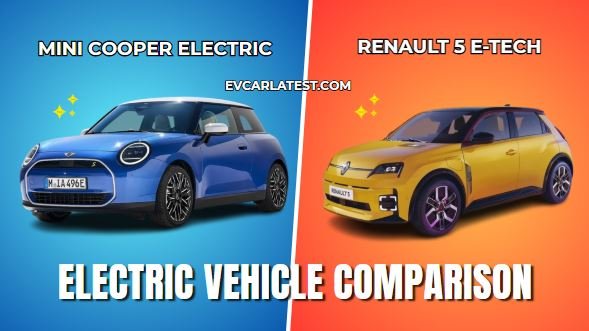
The Renault 5 E-Tech is available in two battery options. The standard 40 kWh version is rated at up to 312 km WLTP, while the long range 52 kWh version reaches approximately 400 km WLTP, giving it a meaningful range advantage at the top of the lineup. The Mini Cooper Electric is offered in two variants as well. The Cooper E carries a 40.7 kWh battery rated at up to 305 km WLTP, while the Cooper SE uses a 54.2 kWh battery rated at approximately 402 km WLTP. Range figures are closely matched across equivalent battery tiers between the two vehicles. On charging, the Renault 5 E-Tech supports up to 100 kW DC fast charging on the long range version and 80 kW on the standard range. The Mini Cooper Electric supports up to 95 kW DC fast charging on the Cooper SE and 75 kW on the Cooper E. Charging speeds are comparable across both lineups with no decisive advantage on either side, and both vehicles support standard AC charging at up to 11 kW for home and destination use.
The Renault 5 E-Tech starts at approximately €25,000 in France for the standard range version, with the long range variant sitting around €32,000 depending on trim. The Mini Cooper Electric starts at approximately €35,900 for the Cooper E in most European markets, with the Cooper SE reaching above €40,000 on higher specifications. The Mini commands a consistent price premium over the Renault 5 across comparable configurations, with the gap running between €5,000 and €10,000 depending on battery and trim selection. Both vehicles are sold across Western and Central Europe through their respective dealer networks. The Mini Cooper Electric is also available in select markets outside Europe including Australia and parts of Asia, where Renault’s presence is more limited. This page helps buyers in Europe decide whether the Mini’s brand positioning and BMW Group engineering justify its higher price over the Renault 5, given that both vehicles deliver comparable range and charging speeds in a similar physical footprint.
Renault’s broader electric lineup alongside the Renault 5 E-Tech includes the Renault 4 E-Tech, Megane E-Tech Electric, Scenic E-Tech, and the entry-level Dacia Spring under the Renault Group umbrella, with the 5 E-Tech sitting as one of the brand’s most prominent new electric nameplates. Mini’s other electric vehicles under the BMW Group include the Mini Aceman Electric, a small crossover on the same platform as the Cooper Electric, and the Mini Countryman Electric, a larger SUV option for buyers who need more space within the Mini family. Outside these two brands, the primary rivals in this segment are the Volkswagen ID.3, which competes on range and practicality at a broadly similar price point in Europe, and the Stellantis family of small EVs including the Citroën ë-C3, Opel Corsa Electric, and Peugeot e-208, which compete more directly with the Renault 5 on price in the affordable small EV category.
The Renault 5 E-Tech’s three main strengths are its lower starting price which undercuts the Mini Cooper Electric by a meaningful margin across equivalent configurations, its long range 52 kWh variant which delivers up to 400 km WLTP at a price point that remains below the Mini’s entry level, and its design, which carries strong retro appeal rooted in one of Europe’s most recognised automotive nameplates and gives it a distinct visual identity without relying on a premium price tag to communicate it. Its two weaknesses are its brand positioning, which sits below Mini in perceived premium status and may affect resale values in markets where badge recognition drives used car pricing, and its interior, which is well-executed for the price but does not match the tactile quality and material finish that Mini delivers inside the cabin at its higher price point. The Mini Cooper Electric’s three main strengths are its interior quality and build finish, which reflect BMW Group standards and deliver a more premium feel than the Renault 5 at every point of contact inside the cabin, its go-kart handling character which Mini has maintained through the transition to electric and which gives it a more engaging driving feel than most rivals in the small EV segment, and its broader international availability outside Europe, which matters for buyers who may relocate or want easier access to service in markets where Renault’s electric network is thinner. Its two weaknesses are its higher starting price, which places it above the Renault 5 by enough to be a genuine barrier for budget-conscious buyers who are comparing the two directly, and its limited rear seat and boot space relative to its exterior size, which makes it a tighter fit for buyers who occasionally need to carry more than two adults comfortably.
Quick Verdict: Both vehicles deliver comparable range and charging speeds, which narrows the decision to price, brand character, and interior quality. The Renault 5 E-Tech is the stronger choice for buyers who want a stylish, capable small EV at a lower cost and are not paying for a premium badge. The Mini Cooper Electric is worth its higher price for buyers who specifically want the interior quality, driving feel, and brand identity that Mini delivers and that the Renault 5 does not replicate at its price point. Buyers working within a tighter budget in Europe who want a design-forward small EV should look at the Renault 5 first. Buyers for whom the ownership experience inside and behind the wheel matters as much as the numbers on paper will find the Mini’s premium harder to argue against.
Related EV Comparsions
| |
| Price | $25,000.00 $30,000.00 |
| Our Rating | |
| Brand | RENAULT Mini |
| Category | Electric Cars Electric Cars |
MODEL
| Available Trims / Variants |
Renault 5 E-Tech 95 HP 40 kWh Renault 5 E-Tech 120 HP 40 kWh Renault 5 E-Tech 150 HP 52 kWh Mini Cooper E Electric Mini Cooper SE Electric |
PRICE & AVAILABILITY
| Base Price (USD) |
€ 25,000 € 28,000 € 33,000 £ 27,000 £ 30,000 - Mini Cooper E Electric € 36,900 £ 34,500 - Mini Cooper SE Electric |
| Availability Status |
Available to order. Released 2025, May Available to order. Released 2024, November Available to order. Released 2024, November Available to order. Released 2023, November |
BATTERY & CHARGING
| Battery Capacity |
40 kWh usable, 43 kWh total 40 kWh usable, 43 kWh total 52 kWh usable 40.7 kWh total -Mini Cooper E Electric 49.2 kWh usable, 54.2 kWh total - Mini Cooper SE Electric |
| Range (WLTP/CLTC/EPA) |
186 mi WLTP 186 mi WLTP 255 mi WLTP 190 mi WLTP - Mini Cooper E Electric 250 mi WLTP -Mini Cooper SE Electric |
| DC Charging (Max kW) |
No CCS 80 kW, 15-80% in 30 min CCS 100 kW, 15-80% in 30 min CCS 75 kW, 10-80% in 28 min - Mini Cooper E Electric CCS 95 kW, 10-80% in 30 min -Mini Cooper SE Electric |
| AC Charging (Max kW) |
Type 2 11 kW, 10-100% in 3 hours 30 min Type 2 11 kW, 10-100% in 3 hours 30 min Type 2 11 kW, 10-100% in 4 hours 30 min Type 2 11 kW, 0-100% in 4.5 h - Mini Cooper E Electric Type 2 11 kW, 0-100% in 5.25 h -Mini Cooper SE Electric |
| Energy Consumption |
233 Wh/mi WLTP 240 Wh/mi WLTP 222 Wh/mi WLTP - Mini Cooper E Electric 227 Wh/mi WLTP - Mini Cooper SE Electric |
PERFORMANCE
| Power Output (kW / hp) |
FWD 95 hp (70 kW) FWD 120 hp (90 kW) FWD 150 hp (110 kW) FWD 184 hp (135 kW) - Mini Cooper E Electric FWD 218 hp (160 kW) - Mini Cooper SE Electric |
| 0–100 km/h / 0-60 mph (seconds) The acceleration numbers are an easy way to compare car performance. We list either time from 0 to 100 km/h or time from 0 to 60mph, depending on which number(s) the manufacturers provide. The lower the acceleration time, the higher performance the car is. |
9 sec 0-62 mph 8 sec 0-62 mph 7.3 sec 0-62 mph - Mini Cooper E Electric 6.7 sec 0-62 mph - Mini Cooper SE Electric |
| Torque (Nm) |
215 Nm (159 lb-ft) 225 Nm (166 lb-ft) 245 Nm (181 lb-ft) 214 lb-ft (290 Nm) - Mini Cooper E Electric 330 Nm (243 lb-ft) - Mini Cooper SE Electric |
| Top Speed (km/h / mph) |
87 mph (140 km/h) 87 mph (140 km/h) 93 mph (150 km/h) 99 mph (160 km/h) |
BODY & DIMENSIONS
| Dimensions (L×W×H mm) | 3920 x 1770 x 1500 mm (154.3 x 69.7 x 59.1 in) 151.9 x 69.1 x 57.5 in (3858 x 1756 x 1460 mm) |
| Trunk/Boot Capacity (L) | EU: 326 l EU: 7.4 ft³, 28.3 ft³ max |
| Body Style | 5 door hatchback, 5 seats 3 door hatchback, 4 seats |
| Kerb Weight (kg) |
EU: 1350 kg unladen EU: 1350 kg unladen EU: 1450 kg unladen EU: 1615 kg unladen, 1990 kg gross - Mini Cooper E Electric EU: 1680 kg unladen, 2055 kg gross - Mini Cooper SE Electric |
| Ground Clearance (mm) | 145 mm (5.7 in) |
| Frunk/Bonnet Capacity (L) | No No |
SAFETY & DRIVER ASSISTANCE
COMFORT & SEATING
| Seating Capacity | Heated front seats Heated front seats |
DISPLAYS & CONNECTIVITY
| Centre Screen (inches) | 10" touchscreen 9.5" touchscreen |
| Driver's Display (inches) | 7" or 10.1" No |
| Head-Up Display (HUD) | No Yes |
TECHNOLOGY
ADDITIONAL SPECS
Note

|
Disclaimer Note
Specifications sourced from manufacturer data and may reflect WLTP, CLTC, or EPA test conditions. Import prices in your local are estimates based on grey-market landing costs and exclude duties, clearing fees, and local taxes. Figures are subject to change without notice. Always verify with your local importer before purchase. We can not guarantee that the information on this page is 100% correct