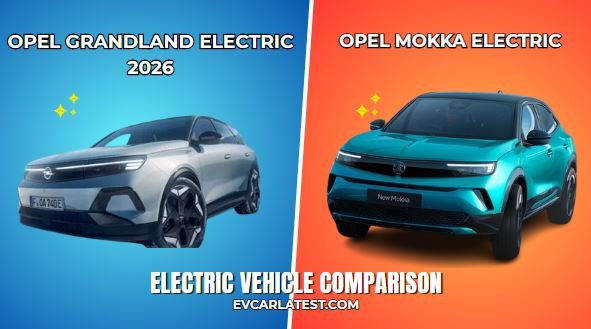
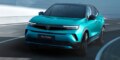
Opel’s two electric SUVs sit at opposite ends of the brand’s lineup: the Grandland Electric is a German-built, mid-size family SUV on Stellantis’ STLA Medium platform, while the Mokka Electric is a smaller B-segment urban crossover. The Grandland targets buyers who need space for long trips and growing families; the Mokka suits city drivers or second-car buyers who want electric running costs without a large footprint. The comparison matters now because the Grandland has gone fully electric for its second generation in 2026, while the Mokka recently got a price cut and a more powerful single-motor setup — pushing both deeper into direct competition on value.

Range & Charging. The base Grandland Electric runs a 73 kWh battery rated at up to 523 km WLTP, with a GS trim (82 kWh, 582 km) and a Long Range version (97 kWh, up to 694 km WLTP) also available. DC fast charging peaks at 160 kW, taking roughly 29 minutes from 20–80%, while the 11 kW onboard AC charger needs about 7 hours for a full home charge. The Mokka Electric uses a smaller 54 kWh pack rated at up to 403–406 km WLTP, charging at a maximum of 100 kW DC (around 30 minutes, 20–80%) and the same 11 kW AC rate. Real-world figures for the updated 2026 Mokka motor aren’t widely documented yet; earlier Mokka-e tests suggested real-world range drops noticeably at highway speeds.
Price, Availability & Market Fit. The Grandland Electric starts at €46,750 (≈₦73.2 million, EU RRP only, before import duty and freight) for the base Edition trim. The Mokka Electric starts at €36,740 (≈₦57.5 million, same caveat), with Edition and GS trims and a high-output GSE performance version arriving later in 2026. Both are sold through Opel’s network in Europe, with Germany first in line; Opel has no official dealership presence in Nigeria, Kenya, or South Africa, so any unit reaching these markets comes through grey-market import channels. For a reader deciding between them: this comes down to choosing SUV-class range and space against a lower entry price and smaller footprint.
Ecosystem & Rival Context. Within Opel’s own lineup, the Astra Electric and Corsa Electric sit below the Mokka on price, while the AWD and Long Range Grandland variants sit above the base SUV on range. Outside Opel, the Peugeot 2008 Electric shares the Mokka’s platform and pricing tier, and the Škoda Elroq competes with the Grandland on range and cabin space. The advantage of staying within the Opel pair is a shared service network and nearly identical software and ownership experience, leaving the decision mainly to size, range, and budget rather than differing ecosystems.
Pros & Cons. The Grandland Electric offers a longer WLTP range that suits intercity travel without frequent charging stops, a faster 160 kW DC ceiling that shortens highway charging breaks, and SUV-class cargo space (up to 1,645 litres) for family use. Its drawbacks are a starting price well above the Mokka’s and, as a newly electrified model, thin grey-market parts and service history outside Europe. The Mokka Electric’s strengths are its lower entry price, compact dimensions suited to tight city streets and parking, and efficient energy use (12.5 kWh/100 km WLTP) for short commutes. Its weaknesses are a smaller battery that limits long-distance use and a slower 100 kW charge rate that extends road-trip stops.
Quick Verdict: Choose the Grandland Electric if you prioritize range and family-size cargo space for longer trips. Choose the Mokka Electric if upfront cost and a compact urban footprint matter more to you. Both remain Europe-market vehicles with no confirmed official distribution in Nigeria, Kenya, or South Africa, so landed grey-market pricing will run above the EU figures listed here
Specifications sourced from manufacturer data and may reflect WLTP, CLTC, or EPA test conditions. Import prices in your local are estimates based on grey-market landing costs and exclude duties, clearing fees, and local taxes. Figures are subject to change without notice. Always verify with your local importer before purchase. We can not guarantee that the information on this page is 100% correct