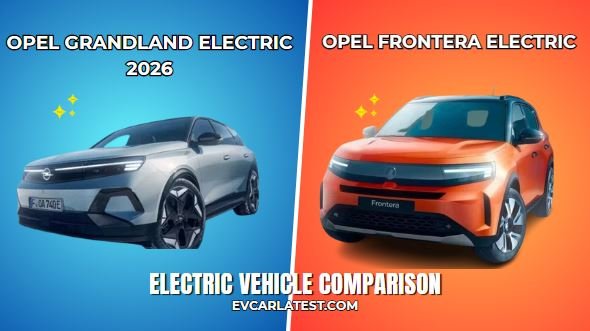
Opel Grandland Electric and Opel Frontera Electric are both German-engineered EV SUVs from Stellantis-owned Opel, but they serve different buyers. The Grandland Electric is a mid-size family SUV built for long-distance comfort, while the Frontera Electric is a smaller, budget-focused crossover aimed at first-time EV buyers and city commuters. The comparison matters now because both models hit full 2026 production, giving African buyers fresh pricing and range figures to weigh before considering a EU-sourced import.

Range & Charging: The Grandland Electric’s base 73 kWh pack rates 523 km WLTP, with an 82 kWh GS trim at 582 km and a 97 kWh Long Range version at 694 km WLTP. Real-world figures circulating online range loosely between 450-650 km depending on trim and conditions, and should be treated as unconfirmed pending independent testing. The Frontera Electric offers 305 km WLTP on its 44 kWh pack, or 408 km WLTP with the 54 kWh Extended Range option. DC charging tops out at 160 kW on the Grandland (20-80% in ~29 minutes) versus 100 kW on the Frontera (20-80% in 26-30 minutes). Both charge from empty on an 11 kW AC wallbox in roughly 6-7 hours.
Price, Availability & Market Fit: In Germany, Grandland Electric starts at €46,750 (≈₦73.4m), rising to €51,950 for the 82 kWh GS. Frontera Electric starts at €28,990 (≈₦45.5m), or €31,190 (≈₦49m) for the Extended Range. These are EU retail prices only — neither model is officially sold in Nigeria, Kenya, or South Africa, so a grey-market landed cost would sit well above these figures once shipping, duty, and clearing are added. For African buyers, this comes down to one trade-off: choose Frontera Electric if import cost is the limiting factor, or Grandland Electric if range and cabin space outweigh price.
Ecosystem & Rivals: Opel’s own Mokka Electric and Astra Electric sit below Frontera on price, while Grandland AWD and Long Range sit above the base Grandland for buyers wanting more power or range. Stellantis siblings worth checking are the Citroën ë-C3 Aircross (shares Frontera’s platform) and Peugeot e-3008 (shares Grandland’s STLA Medium platform). Outside Stellantis, the Hyundai Ioniq 5 and VW ID.4 sit near the Grandland’s price band. This pairing still wins on single-brand service consistency across both a budget and a family-SUV option.
Pros & Cons
Grandland Electric: Its WLTP range of 523-694 km gives long-distance drivers real breathing room between stops. 160 kW DC charging cuts a top-up to under 30 minutes, useful without reliable home charging. Its 1,645-litre cargo capacity suits family use. On the downside, a ₦73m+ starting price before import costs puts it out of reach for most buyers comparing it to Frontera, and it has no official African distribution or parts network.
Frontera Electric: Its lower price brings EV ownership within reach of buyers moving up from a petrol crossover. Its LFP battery tolerates frequent fast charging well, suiting buyers without home charging. A 1,600-litre cargo capacity is strong for its size. Its 305-408 km WLTP range is noticeably short for intercity travel, and 100 kW charging means longer, more frequent stops on long routes.
QUICK VERDICT
Choose Opel Frontera Electric if upfront cost and import affordability matter most to you. Choose Opel Grandland Electric if range, charging speed, and family cargo space matter more than price. Both face the same constraint in Africa: no official dealer network, so any purchase runs through grey-market import channels. Pricing in Naira is an estimate based on EU RRP and current exchange rates, not a landed African price.
Specifications sourced from manufacturer data and may reflect WLTP, CLTC, or EPA test conditions. Import prices in your local are estimates based on grey-market landing costs and exclude duties, clearing fees, and local taxes. Figures are subject to change without notice. Always verify with your local importer before purchase. We can not guarantee that the information on this page is 100% correct