- Home
- Electric Vehicles
- Compare Electric Cars
- Volkswagen ID.3 Neo vs Cupra Born
Volkswagen ID.3 Neo vs Cupra Born
The Volkswagen ID.3 Neo and Cupra Born sit in the same compact EV segment. Both come from the Volkswagen Group and share the MEB platform. The ID.3 targets buyers who want a simple, efficient daily car. The Born targets drivers who want a sportier feel with sharper design. This comparison matters now as more used imports enter African markets at lower prices.
The ID.3 Neo offers up to about 450 km WLTP depending on battery size. Real-world range sits around 350–400 km. The Born reaches up to about 540 km WLTP in higher trims, with real-world figures near 400–470 km. Both support 11 kW AC charging. DC charging on the ID.3 peaks around 120–170 kW depending on version, while the Born reaches up to 170 kW. A 10–80% charge takes about 30–35 minutes in the ID.3 and 25–30 minutes in the Born on fast chargers.
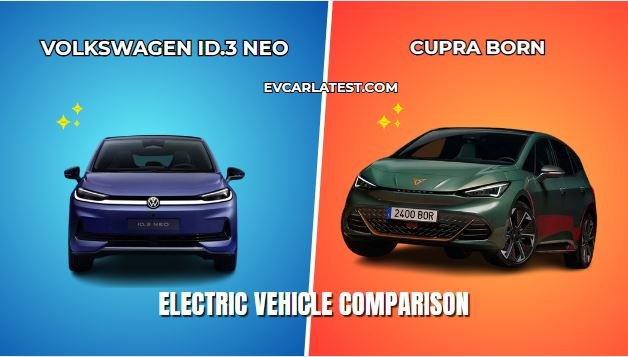
The ID.3 Neo starts around $35,000, which converts to roughly ₦50–55 million for imported units in Nigeria. The Born starts closer to $38,000, landing near ₦55–65 million depending on spec. ID.3 trims include Pure, Pro, and Pro S with different battery sizes. The Born offers V1, V2, V3, and e-Boost variants with more performance tuning. Both cars are sold in Europe and reach Africa through imports, mainly in Nigeria, Kenya, and South Africa. This page helps you decide between a comfort-focused EV and a sportier version built on the same base.
Within Volkswagen’s range, buyers can look at the Volkswagen ID.4 for more space. Cupra offers the Cupra Tavascan for a higher segment. Outside both brands, the BYD Dolphin and MG4 Electric compete in price and size. This comparison still stands because both cars share core hardware, so the choice comes down to tuning, design, and driving feel.
The ID.3 Neo offers a softer suspension setup, which improves comfort on rough roads and daily commutes. Its lower price helps buyers enter EV ownership with less cost. Its interior focuses on space and simplicity, which suits family use. On the downside, its performance feels less engaging, which matters if you enjoy spirited driving. Its software system has had mixed feedback, which affects ease of use.
The Born delivers sharper steering and stronger acceleration in e-Boost trims, which improves driving engagement. Its design stands out, which appeals to buyers who want a sportier look. It also supports faster DC charging in some versions, which reduces travel time. On the downside, it costs more, which impacts budget decisions. Its firmer suspension reduces comfort on uneven roads.
QUICK VERDICT
Choose the Volkswagen ID.3 Neo if you prioritize comfort and lower cost. Choose the Cupra Born if driving feel and styling matter more to you. Both offer similar core range and charging, so the decision comes down to comfort versus sportiness.
FAQ
Is Cupra Born better than Volkswagen ID.3 Neo?
The Born feels more dynamic due to sportier tuning and stronger performance options. The ID.3 focuses on comfort and simplicity. Your choice depends on driving style.
Which has better range, ID.3 Neo or Cupra Born?
The Born has a slight edge in higher trims with larger battery options. In real use, both deliver similar range in daily driving.
Is Cupra Born available in Africa?
It is not officially sold in most African markets. Buyers import units from Europe and rely on independent dealers for support.
Related EV Comparisons
- Cupra Tavascan vs Tesla Model Y
- Roewe D6 vs Volkswagen ID.3 2026
- Hyundai Ioniq 3 vs Volkswagen ID.3 2026
- Volkswagen ID.5 vs Ford Mustang Mach-E
- Volkswagen ID.4 vs Skoda Enyaq
| |
| Price | $39,000.00 $40,000.00 |
| Our Rating | |
| Brand | VOLKSWAGEN CUPRA |
| Category | Electric Cars Electric Cars |
MODEL
| Available Trims / Variants |
Volkswagen ID.3 Neo 50 kWh Volkswagen ID.3 Neo 58 kWh Volkswagen ID.3 Neo 79 kWh Cupra Born 58kWh 204hp Cupra Born 58kWh Cupra Born 77kWh Cupra Born VZ |
PRICE & AVAILABILITY
| Base Price (USD) |
€ 39,400 £ 36,500 - Cupra Born 58kWh 204hp € 41,000 £ 39,000 - Cupra Born 58kWh € 46,500 £ 42,000 - Cupra Born 77kWh € 52,800 £ 44,600 - Cupra Born VZ |
| Availability Status |
Coming soon. Expected release 2026, Q3
Available to order. Released 2021, October - Cupra Born 58kWh 204hp Available to order. Released 2022, April 01 - Cupra Born 58kWh Available to order. Released 2022, April 01 - Cupra Born 77kWh Available to order. Released 2024, June - Cupra Born VZ |
BATTERY & CHARGING
| Battery Capacity |
50 kWh usable - Volkswagen ID.3 Neo 50 kWh 58 kWh usable, 62 kWh total - Volkswagen ID.3 Neo 58 kWh 79 kWh usable, 82 kWh total - Volkswagen ID.3 Neo 79 kWh 58 kWh usable, 62 kWh total - Cupra Born 58kWh 204hp 58 kWh usable, 62 kWh total - Cupra Born 58kWh 77 kWh usable, 82 kWh total - Cupra Born 77kWh 79 kWh usable, 84 kWh total - Cupra Born VZ |
| Range (WLTP/CLTC/EPA) |
259 mi WLTP - Volkswagen ID.3 Neo 50 kWh 307 mi WLTP - Volkswagen ID.3 Neo 58 kWh 391 mi WLTP - Volkswagen ID.3 Neo 79 kWh 265 mi WLTP - Cupra Born 58kWh 204hp 260 mi WLTP - Cupra Born 58kWh 341 mi WLTP - Cupra Born 77kWh 329 mi WLTP - Cupra Born VZ |
| DC Charging (Max kW) |
CCS 105 kW, 10-80% in 29 min - Volkswagen ID.3 Neo 50 kWh CCS 105 kW, 10-80% in 29 min - Volkswagen ID.3 Neo 58 kWh CCS 183 kW, 10-80% in 26 min - Volkswagen ID.3 Neo 79 kWh CCS 125 kW - Cupra Born 58kWh 204hp CCS 125 kW - Cupra Born 58kWh CCS 125 kW - Cupra Born 77kWh CCS 185 kW, 5-80% in 26 min - Cupra Born VZ |
| AC Charging (Max kW) |
Type 2 7.2 kW Type 2 11 kW Type 2 11 kW Type 2 7.2 kW |
| Energy Consumption |
240 Wh/mi WLTP
249 Wh/mi WLTP - Cupra Born 58kWh 204hp 253 Wh/mi WLTP - Cupra Born 58kWh 254 Wh/mi WLTP - Cupra Born 77kWh 269 Wh/mi WLTP - Cupra Born VZ |
PERFORMANCE
| Power Output (kW / hp) |
RWD 170 hp (125 kW) - Volkswagen ID.3 Neo 50 kWh RWD 190 hp (140 kW) - Volkswagen ID.3 Neo 58 kWh RWD 231 hp (170 kW) - Volkswagen ID.3 Neo 79 kWh RWD 150 kW (204 hp) - Cupra Born 58kWh 204hp RWD 231 hp (170 kW) - Cupra Born 58kWh RWD 231 hp (170 kW) - Cupra Born 77kWh RWD 322 hp (240 kW) - Cupra Born VZ |
| 0–100 km/h / 0-60 mph (seconds) The acceleration numbers are an easy way to compare car performance. We list either time from 0 to 100 km/h or time from 0 to 60mph, depending on which number(s) the manufacturers provide. The lower the acceleration time, the higher performance the car is. |
7.3 sec 0-62 mph
7.3 sec 0-100 km/h - Cupra Born 58kWh 204hp 6.6 sec 0-62 mph - Cupra Born 58kWh 7 sec 0-62 mph - Cupra Born 77kWh 5.6 sec 0-62 mph - Cupra Born VZ |
| Torque (Nm) |
310 Nm (229 lb-ft) - Cupra Born 58kWh 204hp 310 Nm (229 lb-ft) - Cupra Born 58kWh 310 Nm (229 lb-ft) - Cupra Born 77kWh 545 Nm (545 lb-ft) - Cupra Born VZ |
| Top Speed (km/h / mph) |
99 mph (160 km/h)
160 km/h (99 mph) - Cupra Born 58kWh 204hp 160 km/h (99 mph) - Cupra Born 58kWh 160 km/h (99 mph) - Cupra Born 77kWh 124 mph (200 km/h) - Cupra Born VZ |
BODY & DIMENSIONS
| Dimensions (L×W×H mm) | 4265 x 1809 x 1554 mm (167.9 x 71.2 x 61.2 in) 4322 x 1809 x 1537 mm (170.2 x 71.2 x 60.5 in) |
| Trunk/Boot Capacity (L) | EU: 385 l, 1267 l max EU: 385 l, 1267 l max |
| Body Style | 5 door hatchback, 4/5 seats 5 door hatchback, 5 seats |
| Kerb Weight (kg) |
EU: 1811 kg unladen, 2260 kg gross - Cupra Born 58kWh 204hp EU: 1824 kg unladen - Cupra Born 58kWh EU: 1946 kg unladen - Cupra Born 77kWh EU: 1999 kg unladen, 2430 kg gross - Cupra Born VZ |
| Frunk/Bonnet Capacity (L) | No No |
SAFETY & DRIVER ASSISTANCE
| Crash Test Ratings | NCAP 2022: 5 stars |
COMFORT & SEATING
| Seating Capacity | Heated front seats, massage Heated front seats |
DISPLAYS & CONNECTIVITY
| Centre Screen (inches) | 12.9" touchscreen 12" touchscreen |
| Driver's Display (inches) | 10.25" 5.3" |
| Head-Up Display (HUD) | Yes, with augmented reality Yes, with augmented reality |
TECHNOLOGY
ADDITIONAL SPECS
Note


|
Disclaimer Note
Specifications sourced from manufacturer data and may reflect WLTP, CLTC, or EPA test conditions. Import prices in your local are estimates based on grey-market landing costs and exclude duties, clearing fees, and local taxes. Figures are subject to change without notice. Always verify with your local importer before purchase. We can not guarantee that the information on this page is 100% correct