

- Electric Vehicles
- Compare Electric Cars
- BYD Han vs BYD Seal (Atto 4)
BYD Han vs BYD Seal (Atto 4)
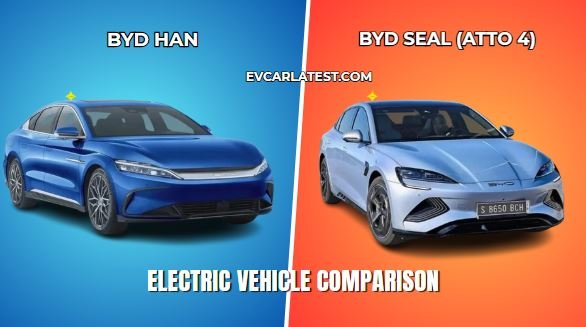
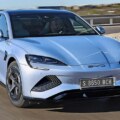
The BYD Han is a full-size executive sedan pitched at buyers who want a premium electric experience without the European price tag. The BYD Seal — marketed as the Atto 4 in some African and European markets — is a sportier, more compact mid-size sedan aimed at urban professionals and value-conscious buyers entering the EV space. Both are built on BYD’s e-Platform 3.0 and share the same blade battery technology. With BYD aggressively expanding into Nigeria, Kenya, and South Africa through 2025–2026, this comparison has become increasingly relevant for African buyers weighing their first serious EV purchase.
Range & Charging
The Han Long Range delivers approximately 521 km on the WLTP cycle, with real-world estimates around 420–450 km. The Seal (Atto 4) offers a WLTP range of 520 km in its long-range variant, with real-world figures around 400–430 km — making them broadly equal on paper. On charging, the Han supports up to 120 kW DC fast charging, while the Seal supports up to 150 kW DC, giving the Seal a slight edge in charging speed. Both support 11 kW AC on-board charging. The Seal reaches 10–80% in roughly 35 minutes on a compatible DC charger; the Han takes closer to 45 minutes.
Price, Availability & Market Fit
The BYD Han starts at approximately $37,000–$42,000 USD depending on trim and market, translating to roughly ₦60–68 million NGN at grey-market import rates. The Seal (Atto 4) starts lower, around $28,000–$33,000 USD (approximately ₦45–53 million NGN). Both are available through BYD’s official dealerships in South Africa and Kenya, with grey-market imports active in Nigeria. If your budget is firm and you need a practical daily EV, this page’s answer is straightforward: the Seal delivers more value per naira or shilling; the Han is the upgrade play for buyers who want flagship feel.
Ecosystem & Rival Context
Han buyers should also consider the BYD Tang (SUV format, similar pricing) and the Yangwang U7 if budget stretches further. Seal buyers sit naturally between the BYD Dolphin below and the Han above — the Atto 3 SUV is another alternative if cargo space matters more than driving dynamics. Outside BYD, the Hyundai Ioniq 6 and the Tesla Model 3 are the most credible rivals at this price and segment. However, BYD’s established African dealer presence and blade battery reliability give it a practical edge over both for buyers outside South Africa’s major metros.
Pros & Cons
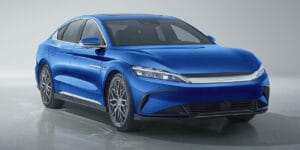
BYD Han: Its cabin quality is genuinely executive-grade, which matters if the car doubles as a client vehicle or long-distance ride. The longer wheelbase delivers rear-seat legroom that sedans at this price rarely match. Blade battery durability provides long-term reassurance on markets with limited service infrastructure. On the downside, its size makes urban parking and narrow Nigerian roads genuinely difficult. Parts availability outside major African cities remains limited.
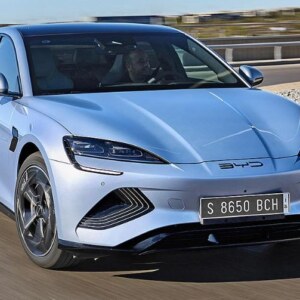
BYD Seal (Atto 4): The sportier suspension and lower roofline make it more rewarding to drive, which counts for buyers who commute daily in mixed traffic. Its lower entry price opens BYD’s best technology to a broader income bracket. Faster DC charging speed means less time planning around charging stops. That said, rear headroom is noticeably tighter than the Han, making it a harder sell for taller passengers. Boot space is adequate but not generous for families.
Quick Verdict
Choose the BYD Han if you want an executive sedan with rear-seat comfort, prestige presence, and are willing to pay a ₦15–20 million premium for it. Choose the BYD Seal (Atto 4) if you want comparable range and newer charging tech at a lower price point with better daily driving dynamics. For most Nigerian and Kenyan buyers entering BYD for the first time, the Seal is the stronger starting point.
Related EV Comparisons
- Volvo EX30 vs BYD Dolphin
- Geely EX5 (Galaxy E5) vs BYD Seal (Atto 4)
- BYD Seal 08 vs Tesla Model S
- BYD Seal 08 vs Mercedes-Benz EQE Sedan
- BYD Atto 3 vs MG MG4 EV
| |
| Price | $72,000.00 |
| Our Rating | |
| Brand | BYD BYD |
| Category | Electric Cars Electric Cars |
MODEL
| Available Trims / Variants |
BYD Seal (Atto 4) Standard Range BYD Seal (Atto 4) Long Range BYD Seal (Atto 4) Performance |
LAUNCH
| Reveal Date | 2022, September 28 2022, October 17 |
| Availability Status | Available to order. Released 2022, Q4 Available. Released 2023, September |
| Base Price (USD) | € 72,000 |
BATTERY
| Battery Capacity | 85.4 kWh total 61.4 kWh total |
| Battery Chemistry | Liquid-cooled Li-ion LFP battery Liquid-cooled Li-ion LFP battery |
| Range (WLTP/CLTC/EPA) | 324 mi WLTP |
| Regen Braking (Max kW) | Yes Yes |
| Heat Pump | |
| AC Charging (Max kW) |
Type 2 7 kW Type 2 11 kW Type 11 kW |
| DC Charging (Max kW) |
CCS 150 kW, 30-80% in 30 min Vehicle to load (V2L) CCS 110 kW, 30-80% in 26 min |
PERFORMANCE
| Power Output (kW / hp) | AWD 509 hp (380 kW) RWD 204 hp (150 kW) |
| Torque (Nm) | 516 lb-ft (700 Nm) 310 Nm (229 lb-ft) |
| 0–100 km/h / 0-60 mph (seconds) The acceleration numbers are an easy way to compare car performance. We list either time from 0 to 100 km/h or time from 0 to 60mph, depending on which number(s) the manufacturers provide. The lower the acceleration time, the higher performance the car is. | 3.9 sec 0-62 mph 7.5 sec 0-62 mph |
| Top Speed (km/h / mph) | 112 mph (180 km/h) 112 mph (180 km/h) |
BODY
| Body Style | 4 door sedan, 5 seats 4 door sedan, 5 seats |
| Platform / Architecture | e-platform 3.0 e-platform 3.0 |
| Dimensions (L×W×H mm) | 196.7 x 75.2 x 58.9 in (4995 x 1910 x 1495 mm) 4800 x 1875 x 1460 mm (189.0 x 73.8 x 57.5 in) |
| Drag Coefficient (Cd) | 0.233 Cd 0.219 Cd |
| Wheelbase (mm) | 115.0 in (2920 mm) 2920 mm (115.0 in) |
| Ground Clearance (mm) | 5.1 in (130 mm) |
| Kerb Weight (kg) | EU: 4960 lb unladen |
| Suspension (Front / Rear) | Front MacPherson struts, rear multi-link Front double wishbone, rear multi-link |
| Wheel Size (inches) | R19 R18, R19 |
| Trunk/Boot Capacity (L) | EU: 14.5 ft³ EU: 402 l |
| Frunk/Bonnet Capacity (L) | No 53 l |
| Towing Capacity (kg) | No No |
SAFETY
| Airbags (count) | 11 airbags: front, side, rear, including head airbag system Front, side, rear, head airbag system, front seats knee airbags |
| Driver Assistance (ADAS) | Multiple radars, 6 cameras, 12 sensors. Blind Spot Warning, High Beam Assist, Advanced Driver Assistance System, Lane departure Warning, Predictive Collision Warning, Automatic Emergency Braking, Traffic Sign Recognition 2 front radars, 4 rear radars, multiple cameras, 12 sensors. Blind Spot Warning, High Beam Assist, Lane departure Warning, Lane Keep Assist, Front/Rear Cross Traffic Alert, Front/Rear Cross Traffic Brake, Traffic Sign Recognition, Automatic Emergency Braking System, Door Open Warning |
COMFORT
| Seating Capacity | Heated and ventilated front seats Heated and ventilated front seats |
| Roof Type | Panoramic glass roof Panoramic glass roof, fixed |
| Bluetooth / Wi-Fi | Android Auto and Apple CarPlay Android Auto and Apple CarPlay |
| Parking Aids | Front and rear sensors, 360 camera, reversing camera Front and rear sensors, 360 camera, reversing camera |
| Additional Notes | Multifunctional pad in the rear seat armrest |
DISPLAYS
| Centre Screen (inches) | 15.6" rotating touchscreen 15.6" rotating touchscreen |
| Driver's Display (inches) | 12.3" 10.25" |
| Head-Up Display (HUD) | Yes, projector type Yes |
LIGHTING
INFOTAINMENT & AUDIO
TECHNOLOGY
OWNERSHIP
Note
| Additional Notes |
For European market
Digital Video Recorder 40500 Nm/degree torsional stiffness |
| Disclaimer | We can not guarantee that the information on this page is 100% correct |
|
Disclaimer Note
Specifications sourced from manufacturer data and may reflect WLTP, CLTC, or EPA test conditions. Import prices in your local are estimates based on grey-market landing costs and exclude duties, clearing fees, and local taxes. Figures are subject to change without notice. Always verify with your local importer before purchase. We can not guarantee that the information on this page is 100% correct