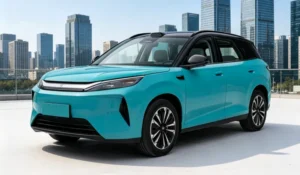
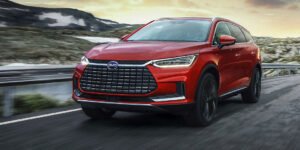
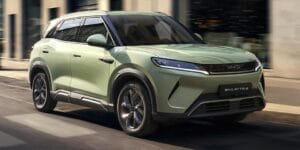
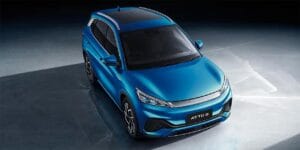
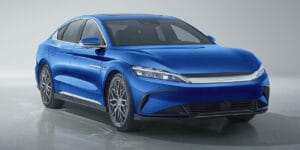
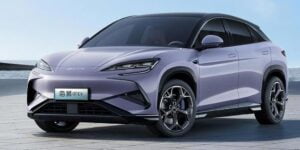
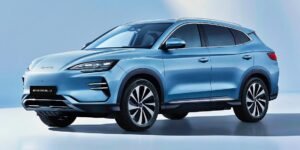
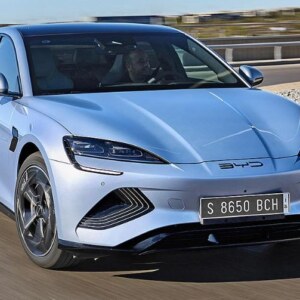
The BYD Seal 08 is a plug-in hybrid mid-size SUV from China, built for buyers who want premium family space without depending entirely on charging infrastructure. The Tesla Model S is a full-electric luxury performance sedan from the US, aimed at buyers who want top-tier range and status in a pure EV. The comparison is relevant now as BYD accelerates its push into African and global markets, offering similar segment appeal at a fraction of the Tesla price.

Range & Charging
The Seal 08 DM-i delivers roughly 150 km of electric-only range (CLTC cycle), with a combined petrol-plus-electric range of around 1,200 km — practical where charging access is limited. The Tesla Model S Long Range hits 652 km (WLTP), with real-world estimates around 550–580 km. On DC charging, the Model S pulls up to 250 kW via Supercharger, reaching 10–80% in about 20 minutes. The Seal 08 supports up to 50 kW DC for its battery pack, taking closer to 35–40 minutes for the same range. AC charging on both is standard overnight via home wall box.
Price, Availability & Market Fit
The BYD Seal 08 starts at approximately CNY 209,800 (~$29,000 USD), with grey-market import to Nigeria estimated at ₦45–55 million depending on specs and logistics. The Tesla Model S Long Range starts at $74,990 USD — grey-market landed cost in Nigeria runs ₦120–150 million. BYD has growing official presence in South Africa and Kenya; Tesla has no official African dealer network. If your question is which premium EV delivers the most value within reach of the African market today, the Seal 08 answers it more directly.
Ecosystem & Rival Context
Within BYD’s range, the Seal 06 DM-i is a more compact PHEV sedan option, while the Han EV suits buyers who want a full-electric premium alternative. Tesla’s Model 3 Long Range covers the same luxury EV space at a lower price. Outside both brands, the BMW i5 and Mercedes EQE are worth considering for buyers who want European badge value at comparable price points. Still, the BYD-Tesla comparison covers the widest cost and powertrain contrast in this segment, which is why it remains the more useful starting point.
Pros & Cons
BYD Seal 08 The hybrid powertrain removes range anxiety for buyers in cities with thin charging infrastructure — you run on petrol when needed. The lower price point makes premium SUV features genuinely accessible without stretching into luxury territory. Seven seats suit family buyers who need usable space alongside efficiency.
On the downside, 150 km CLTC of electric range is not enough for buyers who want meaningful daily EV driving without frequent top-ups. After-sales support outside South Africa and Kenya is still patchy across the continent.
Tesla Model S Over 650 km WLTP range puts real-world range anxiety almost completely out of the picture. Supercharger access — where available — offers the fastest and most consistent DC charging experience of any brand. The Long Range variant hits 0–100 km/h under 3.5 seconds, which matches dedicated performance cars.
The starting price of $74,990 USD makes grey-market import costs in Africa prohibitive for most buyers. No official African service network means repairs and warranty claims depend on independent workshops.
Quick Verdict
Choose the BYD Seal 08 if hybrid flexibility and family space matter more than pure EV driving, and your budget sits closer to the ₦50 million range. Choose the Tesla Model S if long-range pure-EV performance is non-negotiable and you can absorb the premium import cost. For most African buyers today, the Seal 08 is the more practical choice.
Related EV Comparisons
| |
| Price | $28,000.00 $73,000.00 |
| Our Rating | |
| Brand | BYD TESLA |
| Category | Electric Cars Electric Cars |
| Full Model Name | BYD Seal 08 |
| Generation | 1st generation (new model) |
| Segment / Class | Full-size executive sedan (D-segment), fastback body |
| Available Trims / Variants |
RWD 255 kW, RWD 320 kW, AWD dual-motor 510 kW (electric); DM-i plug-in hybrid
Tesla Model S Long Range Tesla Model S Plaid |
| Powertrain Options | Battery-electric (RWD/AWD), Plug-in hybrid (DM-i) |
| Additional Notes | Flagship of BYD's Ocean Network / Ocean 8 series, alongside the Sealion 08 SUV |
| Reveal Date | March 5, 2026 (previewed by Ocean-S concept, Shanghai Auto Show 2025) 2021 |
| Launch Year | 2026 |
| Availability Status | On sale in China Available to order. Released 2021 |
| Brand / Manufacturer | BYD Auto |
| Country of origin | China United States |
| Assembly Country | China |
| Markets Available | China only |
| Grey Market Import | Yes — only route currently available for African buyers |
| Base Price (USD) |
~$28,980 (196,900 CNY, entry configuration)
$ 73,000 € 95,000 - Tesla Model S Long Range $ 88,000 € 110,000 - Tesla Model S Plaid |
| Additional Notes | No confirmed launch date for Africa, Europe, or other export markets |
| Battery Capacity |
92 kWh PHEV variant confirmed at 45.36 kWh 92.6 kWh usable, 100 kWh total |
| Battery Chemistry | Blade Battery 2.0 lithium iron phosphate Liquid-cooled Li-ion 350V |
| Battery Architecture | 800V high-voltage platform |
| Thermal Management | Advanced thermal management system |
| Range (WLTP/CLTC/EPA) |
Up to 905 km CLTC (top EV trim); PHEV: 400 km EV-only / 1,660 km combined CLTC
405 mi EPA (449 mi WLTP) - Tesla Model S Long Range 432 mi WLTP (359 mi EPA) - Tesla Model S Plaid |
| Energy Consumption |
16–18 kWh per 100 km
280 Wh/mi EPA (282 Wh/mi WLTP) - Tesla Model S Long Range 301 Wh/mi WLTP (330 Wh/mi EPA) - Tesla Model S Plaid |
| Regen Braking (Max kW) | Regenerative braking system 1 level, no coasting, no regen when pedal braking |
| Heat Pump | |
| AC Charging (Max kW) |
11 kW AC Full charge about 8.5 hours Type 2 11 kW, 0-100% in 10 hours |
| DC Charging (Max kW) |
Megawatt-level "flash charging"
CCS Supercharger V3 250 kW max, 10-80% in 30 min |
| Charging Time (10–80%) | 10–70% charge and 400 km added in ~5 minutes |
| Cell Brand | BYD in-house (FinDreams Battery) |
| Additional Notes | First full-size sedan to combine Blade Battery 2.0 with flash charging |
| Motor Type | Permanent magnet synchronous |
| Motor Configuration | Single motor RWD or dual-motor AWD |
| Front Motor Output (kW / HP) | 190 kW (AWD variant) |
| Rear Motor Output (kW / HP) | 320 kW |
| Power Output (kW / hp) |
RWD 255 kW or 320 kW; AWD combined 510 kW (684 hp)
AWD 670 hp (415 kW) - Tesla Model S Long Range AWD 1020 hp (760 kW) - Tesla Model S Plaid |
| Peak Power (kW / hp) | 510 kW / 684 hp (top AWD trim) |
| Torque (Nm) |
360 Nm (RWD)
557 lb-ft (755 Nm) - Tesla Model S Long Range 1420 Nm (1047 lb-ft) - Tesla Model S Plaid |
| 0–100 km/h / 0-60 mph (seconds) The acceleration numbers are an easy way to compare car performance. We list either time from 0 to 100 km/h or time from 0 to 60mph, depending on which number(s) the manufacturers provide. The lower the acceleration time, the higher performance the car is. |
5.9 sec 3.3 seconds (top AWD trim) 3.1 sec 0-60 mph (3.2 sec 0-62 mph) - Tesla Model S Long Range 2 sec 0-60 mph (2.1 sec 0-62 mph) - Tesla Model S Plaid |
| Top Speed (km/h / mph) |
240 km/h
155 mph (250 km/h) - Tesla Model S Long Range 200 mph (322 km/h) - Tesla Model S Plaid |
| Transmission / Drive | RWD / AWD Single-speed |
| Rear-Wheel Steering | Yes, standard |
| Torque Vectoring | dual-motor AWD layout |
| Body Style | 4-door fastback sedan 5 door Liftback, 5 seats |
| Body Colour Options | Two-tone exteriors |
| Platform / Architecture | BYD 800V platform, Ocean-S design language |
| Dimensions (L×W×H mm) | 5,150 × 1,999 × 1,505 mm 195.7 x 77.3 x 56.9 in (4970 x 1964 x 1445 mm) |
| Drag Coefficient (Cd) | 0.21 Cd 0.208 Cd |
| Wheelbase (mm) | 3030 mm 116.5 in (2960 mm) |
| Ground Clearance (mm) | 4.6 - 6.2 in (117 - 158 mm) |
| Kerb Weight (kg) | 2,040 kg EU: 4784 lb unladen |
| Suspension (Front / Rear) | DiSus-A closed dual-chamber air suspension, both axles Adaptive Air suspension |
| Wheel Size (inches) | 19-inch or 20-inch R19, R21 |
| Trunk/Boot Capacity (L) | 450 L EU: 25.0 ft³, 61.4 ft³ max |
| Frunk/Bonnet Capacity (L) | Small front storage 3.1 ft³ |
| Towing Capacity (kg) | Yes |
| Turning Circle (m) | 4.95 m |
| Additional Notes | Roof-mounted LiDAR housing visible on exterior |
| Airbags (count) | Front, side, curtain airbags 8 airbags: front, side, rear, head airbag system, front seats knee airbags |
| Anti-lock Braking System (ABS) | Standard |
| Driver Assistance (ADAS) | God's Eye B (DiPilot 300) 7 cameras: front, side and rear, 6 front and 6 rear sensors (up to 250m object detection). Automatic Emergency Braking, Dynamic Brake Lights, Lane Assist, Collision Avoidance Assist, Speed Assist, Lane Departure Avoidance, Traffic Light and Stop Sign Control |
| ADAS Features | LiDAR-based assisted driving suite |
| Autonomous Driving Level | BYD “God’s Eye” assisted driving system with LiDAR Autopilot with full Self-Driving capability |
| Autonomous Driving System Name | God's Eye B / DiPilot 300 |
| Autonomous Driving Hardware | Roof-mounted LiDAR unit |
| Crash Test Ratings | NCAP 2022: 5 stars, NHTSA 2013-2022: 5 stars |
| Seating Capacity | 5 Heated and ventilated front seats, heated rear seats, heated third row seats |
| Driver Seat Adjustment | Power-adjustable |
| Passenger Seat Adjustment | Power-adjustable |
| Power Seats | Yes |
| Seat Ventilation | Yes — front seats confirmed |
| Massage Function | Yes — all occupants (front zero-gravity seats confirmed with massage) |
| Roof Type | Panoramic glass roof All-glass roof |
| Bluetooth / Wi-Fi | 5G, OTA updates, smartphone integration |
| Parking Aids | 360° camera and automatic parking 6 front and rear sensors, reversing camera, Parking Assist |
| Additional Notes | Zero-gravity front seats are a headline comfort feature Three-zone climate control |
| Centre Screen (inches) | 15.6-inch 17" swivel touchscreen |
| Driver's Display (inches) | 12.3-inch 12.3" |
| Head-Up Display (HUD) | 26-inch augmented reality display (functions as AR HUD) |
| Operating System | BYD DiLink |
| Additional Notes | 26-inch AR display is a distinguishing feature versus rival sedans 9.4" rear passenger touchscreen |
| Headlight Type (LED/Matrix/Laser) | LED, described as "slim" |
| Official Dealer Network | China only; none in Africa |
| Spare Parts Availability | Limited to China/grey-market channels |
| Import Duty Class | Full-size EV import — subject to individual country EV/import duty schedules |
| Grey Market Support | No official manufacturer backing for imported units |
| Resale Value | Unestablished — too new for market data |
| Roadside Assistance | China only |
| Data Source | BYD regulatory filings, official launch materials (CarNewsChina, Electrek, ArenaEV, Wikipedia) |
| Last Updated | July 3, 2026 |
| Additional Notes |
Vehicle launched in China on July 2, 2026; specs above reflect China-market launch trim. No WLTP, EPA, or African-market pricing exists yet.
Tesla Model S Long Range price history: 19 April 2024: price decrease to 72,990 USD, old price 74,990 USD 01 September 2023: price decrease to 74,990 USD, old price 88,490 USD August 2023: Initial release price 94,990 EUR 12 May 2023: price increase to 88,490 USD, old price 87,490 USD 21 April 2023: price increase to 87,490 USD, old price 84,990 USD 08 April 2023: price decrease to 84,990 USD, old price 89,990 USD 06 March 2023: price decrease to 89,990 USD, old price 94,990 USD 09 March 2023: Added Hardware 4 with the upgraded set of cameras and the Phoenix radar; optional Ultra Red color; improved brake pads with much higher thermal capacity; new high-visibility glass roof with 5x more light and same UV protection |
| Editor's Note | All range and charging figures are CLTC-derived. Treat unconfirmed entries as subject to change until BYD publishes full production specifications. |
|
Specifications sourced from manufacturer data and may reflect WLTP, CLTC, or EPA test conditions. Import prices in your local are estimates based on grey-market landing costs and exclude duties, clearing fees, and local taxes. Figures are subject to change without notice. Always verify with your local importer before purchase. We can not guarantee that the information on this page is 100% correct