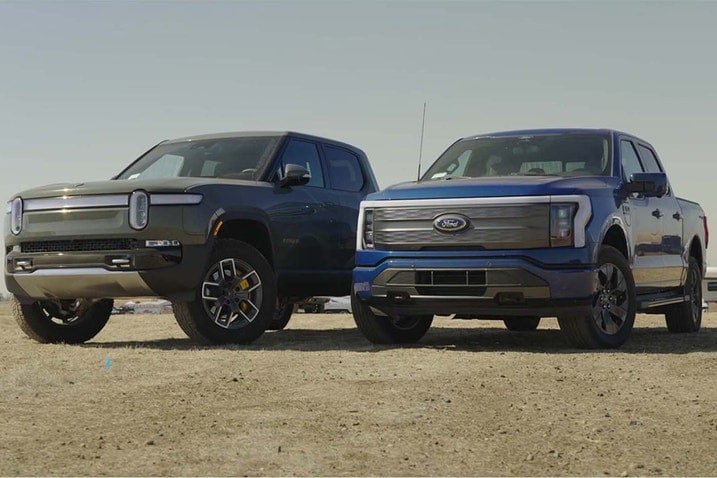
If budget and dealer-network familiarity matter most, the Ford F-150 Lightning wins on price, starting near $56,975 before options. If range, performance, and interior tech matter more than the sticker price, the Rivian R1T wins on capability, with up to 420 miles of EPA-estimated range in its longest-range Dual configuration and dramatically quicker acceleration across the lineup. Neither truck is a clear win in every category — the right pick depends on whether you’re buying a work truck with an EV drivetrain, or an EV built from scratch that happens to look like a truck. The full breakdown, including towing, charging, and pricing across every trim, is below.
Quick Summary Box
- Price: Lightning starts around $56,975; R1T starts around $70,990–$72,990 — a gap of roughly $15,000 at the base trim.
- Range: Lightning tops out near 320 miles EPA-estimated on its Extended Range battery; R1T’s Max battery pack reaches up to 420 miles (figure varies by trim and wheel size; treat as configuration-dependent).
- Power: Lightning offers 536–580 hp; R1T ranges from 533 hp (Dual) to 1,025 hp (Quad-Motor).
- Towing: Lightning is rated up to 8,600–10,000 lbs depending on trim/package; R1T is rated up to 11,000 lbs across its lineup.
- Charging: Lightning uses a CCS port; R1T switched to a Tesla-style NACS port starting with its 2025 model-year refresh.
Vehicle Identity
The F-150 Lightning is, in essence, Ford’s best-selling gas truck reengineered around a battery and electric motors. It keeps the same SuperCrew cab, 5.5-foot bed, and general dimensions buyers already recognize from the combustion F-150 lineup. That familiarity is deliberate — Ford is selling the Lightning to existing F-150 owners and fleets as a drop-in electric alternative, not as a novelty.
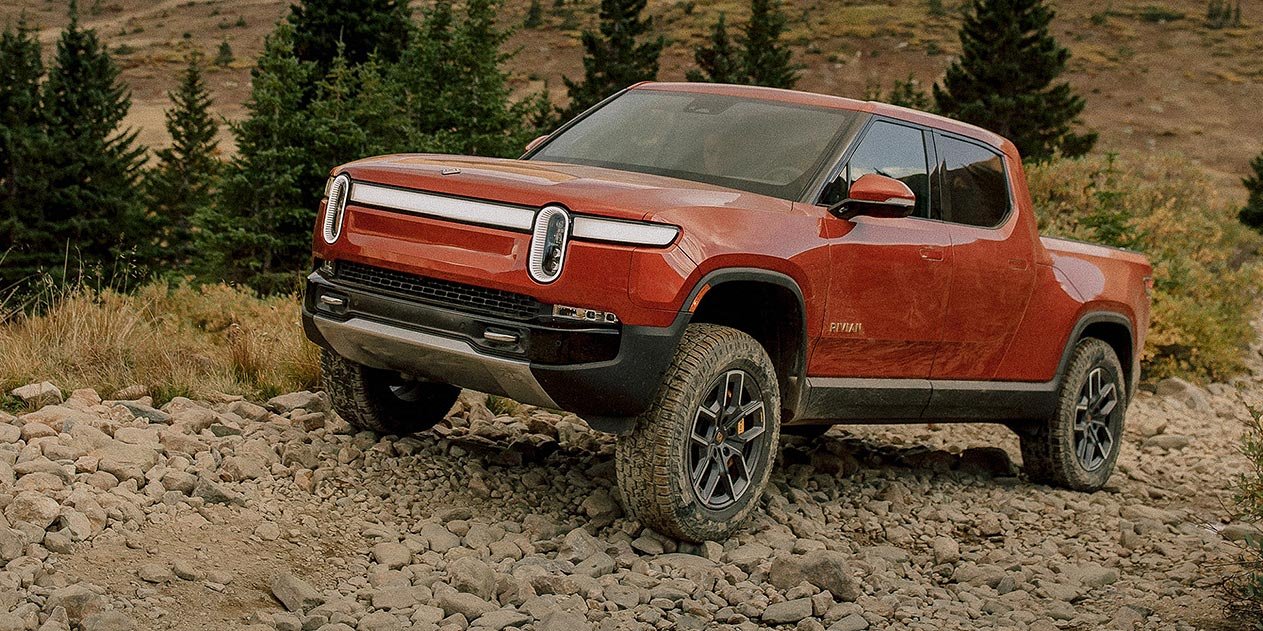
The Rivian R1T started from a blank sheet. It shares its skateboard platform with the R1S SUV, and every dimension, from its 217-inch length to its 54-inch bed, was designed around battery packaging and off-road capability rather than around an existing gas-truck silhouette. It positions itself less as a “truck with a battery” and more as a lifestyle and adventure vehicle that happens to have a bed.
Who Each Truck Is Built For
Ford’s positioning leans toward fleet buyers, contractors, and everyday truck owners who want lower running costs without changing their workflow. Rivian’s positioning leans toward outdoor-focused buyers who value off-road hardware, a premium cabin, and a more distinct design identity.
Powertrain & Charging
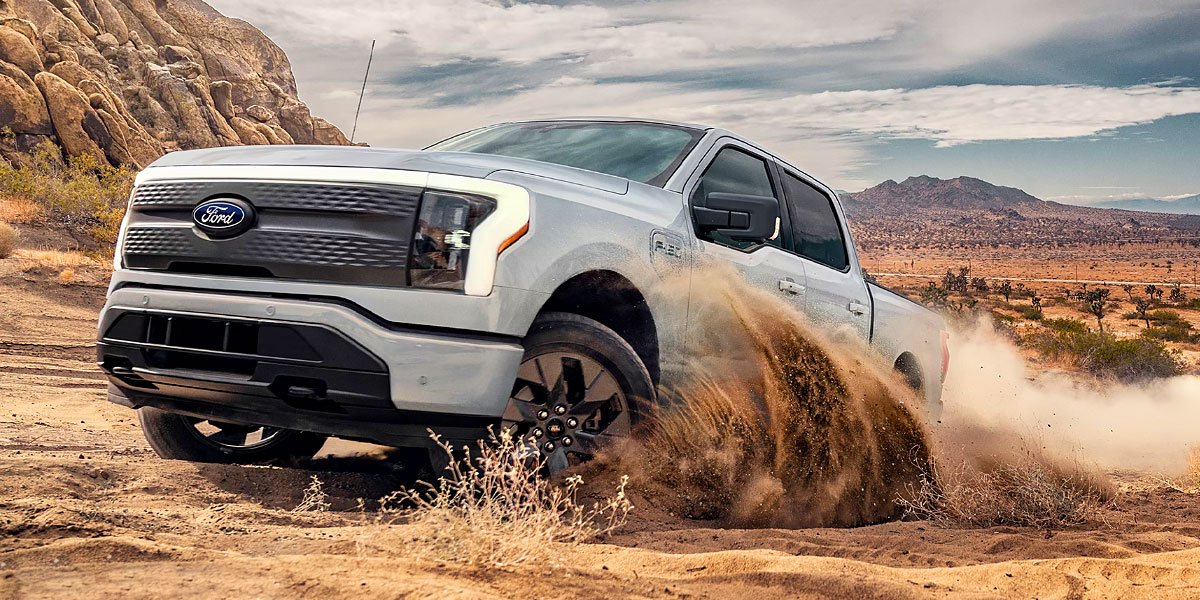
Ford F-150 Lightning
For 2026, Ford standardized the 123 kWh Extended Range battery across all retail trims, discontinuing the smaller 98 kWh Standard Range pack. Depending on trim and wheel size, EPA-estimated range runs from about 240 to 320 miles, with most trims landing around 300 miles. Dual-motor AWD is standard across the board, producing 536 hp / 775 lb-ft of torque on lower trims and 580 hp / 775 lb-ft on upper trims. AC home charging is rated at 11.5 kW, which Ford estimates takes roughly 12 hours for a full charge. DC fast-charging peak rate for the 2026 model year was not confirmed in the sources reviewed for this post.
Rivian R1T
Rivian offers the R1T in Dual-, Tri-, and Quad-motor configurations, paired with Standard, Large, or Max battery packs. The base Dual Standard trim is EPA-rated around 258 miles, while the Dual with the Max battery pack can reach as much as 420 miles according to some outlets — a figure that should be treated as trim-dependent rather than a lineup-wide number. The Tri-motor variant is rated at 371 miles with 850 hp / 1,103 lb-ft of torque, and the Quad-motor variant lands around 374 miles with 1,025 hp. Acceleration scales sharply with trim: the Dual does 0–60 mph in 4.5 seconds, the Tri in 2.9 seconds, and the Quad in 2.5–2.6 seconds. Rivian moved to a Tesla-style NACS charging port starting with its 2025 refresh, which carries over for 2026, giving R1T owners direct access to the Tesla Supercharger network without an adapter.
Pricing & Trim Structure
Ford F-150 Lightning (2026 MSRP, before destination)
| Trim | Starting MSRP | Motor Output | EPA Range |
|---|---|---|---|
| Pro | ~$56,975 | 536 hp | ~300 mi |
| STX | ~$65,540 (incl. destination) | 536 hp | ~300 mi |
| Flash | — | 536 hp | ~300 mi |
| Lariat | — | 536 hp | ~320 mi |
| Platinum | ~$84,995–$87,190 | 580 hp | ~300 mi |
Rivian R1T (2026 MSRP)
| Trim | Starting MSRP | Motor Output | EPA Range |
|---|---|---|---|
| Dual Standard | ~$70,990–$72,990 | 533 hp | ~258 mi |
| Dual (Large/Max battery) | ~$79,990+ | 533–665 hp | up to ~420 mi |
| Tri-Motor | ~$100,990 | 850 hp | ~371 mi |
| Quad-Motor | ~$115,990 | 1,025 hp | ~374 mi |
| Quad Launch Edition | ~$121,885–$124,000 | 1,025 hp | ~338–374 mi |
Note: Pricing excludes destination fees where marked and reflects manufacturer-published figures at time of writing; regional and incentive-adjusted pricing will vary.
Pros & Cons
- ✅ Lower entry price by roughly $15,000 at base trim
- ✅ Familiar F-150 cab, bed, and towing gear compatibility
- ✅ Standard 123 kWh battery across all 2026 retail trims
- ❌ Lower peak power ceiling (580 hp max) than R1T’s top trims
- ❌ Towing capacity trails the R1T at comparable trims
- ✅ Higher range ceiling and significantly stronger performance at Tri/Quad trims
- ✅ NACS charging port gives direct Supercharger network access
- ✅ Off-road hardware (adaptive air suspension, gear tunnel) standard across the lineup
- ❌ Meaningfully higher starting price
- ❌ Smaller service and dealer network than Ford’s
Comparison Table: Head-to-Head at Base Trim
| Spec | Ford F-150 Lightning (Pro) | Rivian R1T (Dual Standard) |
|---|---|---|
| Starting MSRP | ~$56,975 | ~$70,990–$72,990 |
| Battery | 123 kWh | ~92.5–108.5 kWh (Standard) |
| EPA Range | ~300 mi | ~258 mi |
| Horsepower | 536 hp | 533 hp |
| Torque | 775 lb-ft | Not disclosed for base trim |
| Towing Capacity | up to 7,700 lbs (base) | up to 11,000 lbs |
| Charging Port | CCS | NACS |
| 0–60 mph | Not disclosed for base trim | 4.5 sec |
Bottom Line
The F-150 Lightning is the more affordable, more familiar choice for buyers who want an electric truck that slots into an existing fleet or towing setup without a steep learning curve. The Rivian R1T is the better choice for buyers prioritizing range, off-road capability, and raw performance, and who are willing to pay a premium for it. Neither truck is objectively “better” — the Lightning wins on accessibility, the R1T wins on capability, and the right pick comes down to which of those two priorities matters more to you.
Specs reflect 2026 model-year data available at time of publication and are subject to change by the manufacturer.