- Electric Vehicles
- DongFeng
- Epicland X9
Epicland X9
- Drive Type: RWD, AWD
- Body Type: 5-door, 3-row SUV
- Self Driving:
- Airbags: Yes
PROS
- First production vehicle to integrate Huawei's full Qiankun stack (ADS 5 driving assist, HarmonySpace 6 cockpit, LiDAR) in one model
- 465 km CLTC electric-only range with over 1,500 km CLTC combined range via the range extender
- Pre-sale pricing undercuts similarly sized rivals like the AITO M9
CONS
- AC/DC charging rates and 10–80% charge time remain unconfirmed
- Currently sold only in China, with no confirmed international launch or pricing
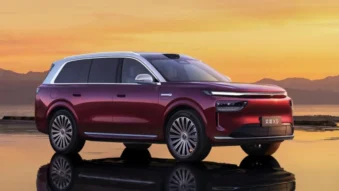
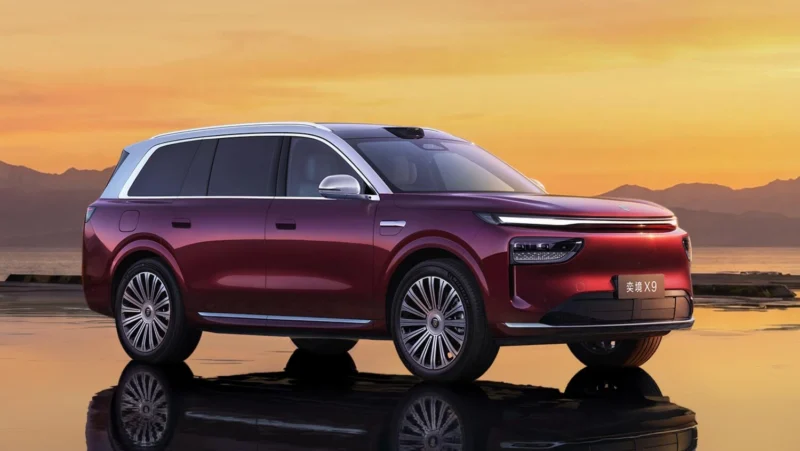
The Epicland X9 is the debut model from Epicland, a new brand launched by Dongfeng Motor Corporation in partnership with Huawei. It’s positioned as a flagship offering, built to sit between Dongfeng’s Voyah luxury lineup and its mass-market eπ (Yipai) brand. The X9 is a full-size luxury SUV with a three-row, six-seat layout, offered in both rear-wheel-drive and all-wheel-drive configurations. What sets it apart isn’t styling or badge prestige — it’s the fact that this is the first production vehicle to carry Huawei’s complete Qiankun technology stack in one package, spanning driver assistance, cockpit software, and connectivity, rather than a single licensed component.
On the powertrain side, the X9 uses an extended-range electric (EREV) setup rather than a pure battery-electric drivetrain. A 74.29 kWh CATL LFP battery sits on an 800V platform, delivering an electric-only range of 465 km on the CLTC cycle. A 1.5-liter turbocharged range extender (95 kW) tops up the battery on longer trips, pushing combined range past 1,500 km CLTC. The AWD dual-motor variant produces a combined 420 kW and reaches 100 km/h in 5.1 seconds. AC onboard charging rate, DC peak charging rate, and 10–80% charge time have not been officially disclosed at the time of pre-sale, so these figures should be treated as unconfirmed until Epicland publishes full charging specs.
Pre-sale pricing in China runs from 299,800 yuan to 379,800 yuan, roughly $44,100 to $55,900 USD, across three trims: Max Edition, 4WD Ultra+ Long Range, and 4WD Ultra+ Flagship Long Range. International pricing has not yet been announced. The X9 realistically suits larger families who want three-row seating with the flexibility of a range extender rather than committing to a pure EV, plus buyers who prioritize in-car tech over outright brand pedigree. Within Dongfeng’s own portfolio, it slots below Voyah’s flagship models but above the eπ (Yipai) range, giving the group a mid-to-high price tier it didn’t previously cover. Outside the brand, its closest rivals are the AITO M9 and the Li Auto L9, both EREV full-size SUVs competing on similar tech-and-space propositions. For a direct spec-and-price comparison, the AITO M9 is the closest match — similar dimensions, similar Huawei-linked ecosystem, and overlapping target buyer.
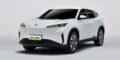
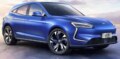
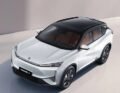
Epicland X9 Photos
Full Electric Vehicle Specifications
MODEL
| Full Model Name | Epicland X9 (Yijing X9 / 奕境X9) |
| Generation | 1st generation (debut model) |
| Segment / Class | Full-size luxury SUV (F-segment) |
| Available Trims / Variants | Max Edition, 4WD Ultra+ Long Range, 4WD Ultra+ Flagship Long Range |
| Powertrain Options | EREV (extended-range electric); BEV version |
| Additional Notes | First model from Epicland, a joint Dongfeng–Huawei brand positioned between Voyah and eπ (Yipai) |
LAUNCH
| Reveal Date | April 23–24, 2026 (Huawei Qiankun Ecosystem Conference / Beijing Auto Show) |
| Launch Year | 2026 |
| Availability Status | Pre-sales open |
| Brand / Manufacturer | Epicland (Dongfeng Motor Corporation, co-developed with Huawei) |
| Country of origin | China |
| Assembly Country | China |
| Markets Available | China Only |
| Grey Market Import | None reported |
| Base Price (USD) | 299,800 CNY (~$44,100 USD), pre-sale |
BATTERY
| Battery Capacity | 74.29 kWh |
| Battery Chemistry | LFP (Lithium Iron Phosphate) |
| Battery Architecture | 800V platform |
| Range (WLTP/CLTC/EPA) | 465 km CLTC (EV-only); 1,500+ km CLTC (combined, with range extender) |
| Heat Pump | |
| Cell Brand | CATL |
PERFORMANCE
| Motor Type | Dual-motor (AWD trims); single-motor RWD available |
| Motor Configuration | Front + rear motor (AWD) |
| Power Output (kW / hp) | 420 kW combined (AWD) |
| Peak Power (kW / hp) | 420 kW (AWD) |
| 0–100 km/h / 0-60 mph (seconds) The acceleration numbers are an easy way to compare car performance. We list either time from 0 to 100 km/h or time from 0 to 60mph, depending on which number(s) the manufacturers provide. The lower the acceleration time, the higher performance the car is. | 5.1 sec (AWD) |
| Transmission / Drive | RWD and AWD (dual-motor) |
| Rear-Wheel Steering | Yes, up to 14° |
| Additional Notes | Range extender is a 1.5L turbo unit (95 kW) driving a generator, not the wheels |
BODY
| Body Style | 5-door, 3-row SUV |
| Platform / Architecture | Dongfeng–Huawei 800V EREV platform |
| Dimensions (L×W×H mm) | 5,301 × 2,015 × 1,820 mm (RWD) / 1,805 mm (AWD) |
| Wheelbase (mm) | 3,120 mm |
| Suspension (Front / Rear) | Dual-chamber air suspension with continuous damping control |
| Trunk/Boot Capacity (L) | 484 L (5-seat config); 1,368 L with rear seats folded |
| Turning Circle (m) | 5.3 m |
| Additional Notes | Third-row seat cushion width is 1,101 mm |
SAFETY
| Low-Speed Pedestrian Warning | front has 412 pedestrian-facing signal LEDs, separate from an audible warning system |
| Structural Safety | 2,400 MPa ultra-high-strength steel body |
| Driver Assistance (ADAS) | Huawei Qiankun ADS 5 (ADS 5 Max on higher trims) |
| ADAS Features | 896-line dual-optical-path LiDAR standard; up to 4 LiDAR units total on ADS 5 Max, plus millimeter-wave radar and camera sensors |
| Autonomous Driving System Name | Huawei Qiankun ADS 5 / ADS 5 Max |
| Autonomous Driving Hardware | 896-line LiDAR + up to 3 additional solid-state LiDAR units, millimeter-wave radar, camera array |
COMFORT
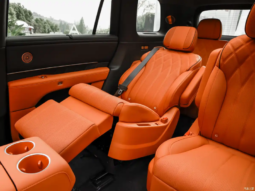
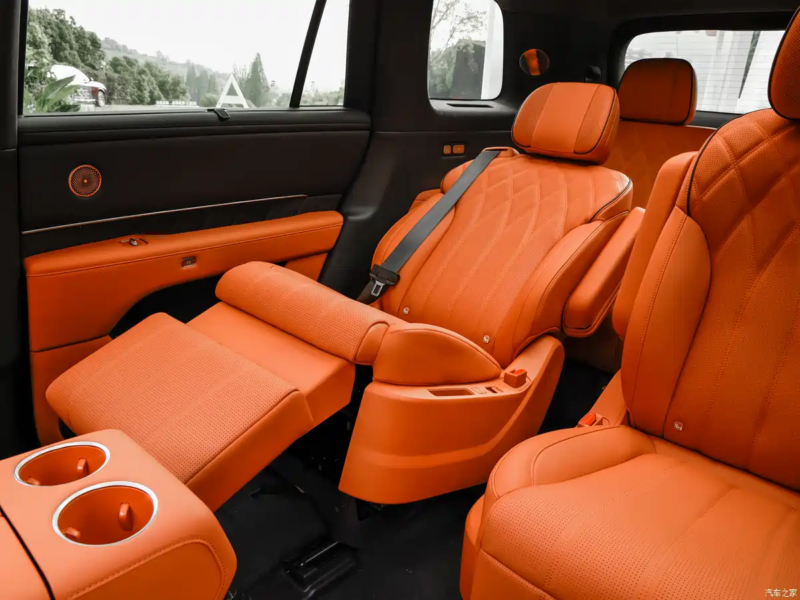
| Seating Capacity | 6 (three rows, 2+2+2) |
| Passenger Seat Adjustment | Front passenger "Queen's Seat" (reclining/extendable) |
| Climate Control | Multi-zone implied; onboard fridge operates from −6°C to 50°C |
| Bluetooth / Wi-Fi | Yes (HarmonyOS connectivity) |
| Additional Notes | Second row has two zero-gravity seats; AI companion robot "Hamomo" onboard |
DISPLAYS
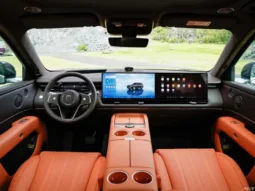
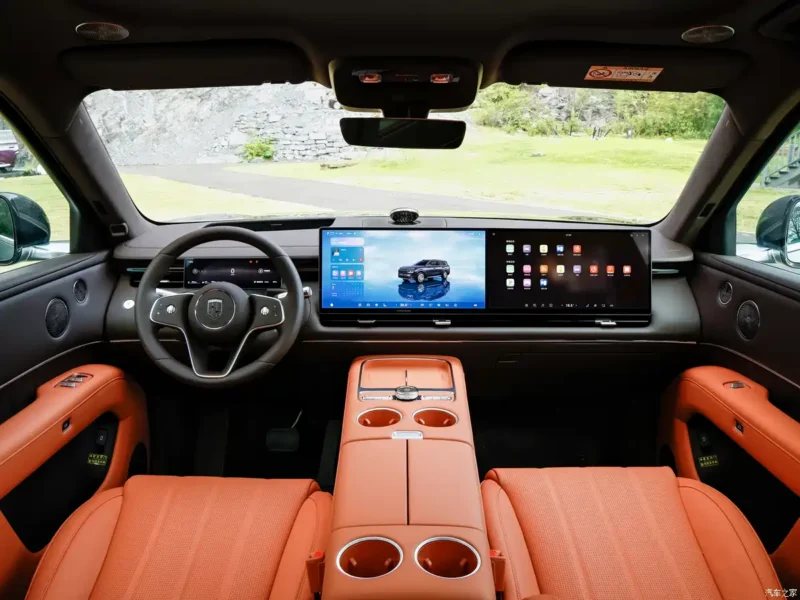
| Centre Screen (inches) | 17.2-inch "Butterfly Wing" dual-linked display |
| Head-Up Display (HUD) | 75-inch Huawei XHUD |
| Display Resolution | 3.4K, 98% DCI-P3 gamut, 21:10 aspect ratio |
| Operating System | HarmonySpace 6 (HarmonyOS-based) |
| Voice Control | Implied via HarmonyOS AI assistant, not explicitly detailed |
| Additional Notes | AMS AI multi-modal perception system (8MP RGB camera, 2MP infrared camera, SparkLink NFC sensors) for gesture/position recognition |
LIGHTING
| Headlight Type (LED/Matrix/Laser) | : Intelligent projection headlights (1-million-pixel resolution) |
| Daytime Running Lights (DRL) | Full-width light bar (split-headlight design) |
| Adaptive Headlights | Implied by projection system |
| Welcome Lighting | Yes — ground-projection welcome sequence |
| Tail Light Design | 1.83 m rear light strip, 1,172 LEDs ("river of stars" effect) |
| Underglow / Exterior Lighting | 412 dual ISD LEDs for pedestrian/driver signaling |
INFOTAINMENT & AUDIO
| Sound System Brand | Huawei Sound |
| Speaker Count | 21 speakers |
| Navigation System | HarmonyOS-integrated |
| Gaming / App Store | HarmonyOS app ecosystem implied |
TECHNOLOGY
| Face Recognition | AMS AI multi-modal camera system |
| AI Assistant | "Hamomo" AI companion robot |
| Additional Notes | SparkLink NFC sensors support gesture and position recognition |
OWNERSHIP
| Official Dealer Network | China only (Epicland/Dongfeng network) |
| Import Duty Class | Not applicable (China-market only) |
Note
| Data Source | CarNewsChina, CnEVPost, The Electric Viking, ChinaEVHome, Wikipedia |
| Last Updated | August 20, 2026 |
User Reviews
Disclaimer Note
Specifications sourced from manufacturer data and may reflect WLTP, CLTC, or EPA test conditions. Import prices in your local are estimates based on grey-market landing costs and exclude duties, clearing fees, and local taxes. Figures are subject to change without notice. Always verify with your local importer before purchase. We can not guarantee that the information on this page is 100% correct