

- Electric Vehicles
- Compare Electric Cars
- Ferrari Luce vs Rimac Nevera
Ferrari Luce vs Rimac Nevera
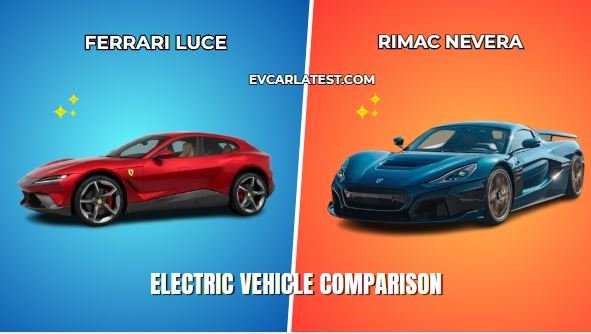
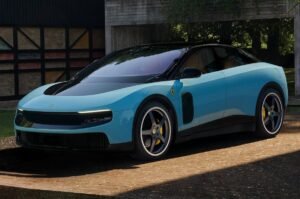
The Ferrari Luce and Rimac Nevera both sit at the extreme end of electric performance, but they are fundamentally different vehicles. The Luce is a 5-door full-size luxury sedan from Maranello with quad-motor AWD, Ferrari’s first production EV. The Nevera is a Croatian-built two-door electric hypercar with butterfly doors and a carbon-fiber monocoque — a pure speed machine with no pretense of everyday comfort. The Luce targets wealthy collectors who want Ferrari prestige in electric form; the Nevera is built for track-obsessed buyers chasing record-breaking performance. With Ferrari’s full exterior reveal happening this month and production set for 2026, this is the first time buyers can meaningfully compare both cars side by side.
Range & Charging
The Ferrari Luce carries a 122 kWh battery with a claimed range of 330 miles, supported by an 880V system and 350 kW DC charging. Official WLTP certification is pending. The Rimac Nevera offers 342 miles of WLTP range from its 120 kWh battery, with DC charging peaking at 500 kW and a 0–80% charge taking under 25 minutes. The Nevera holds the edge on both certified range and charging speed. Real-world range on either car will drop significantly under hard driving — the Nevera’s figures assume restrained use, which is rarely how owners drive it. AC charging specs for both are limited by their hypercar positioning; neither is designed for overnight top-ups as a priority.
Price, Availability & Market Fit
The Rimac Nevera starts at around $2.2 million USD, with only 150 units being produced worldwide. The Ferrari Luce is estimated to exceed €500,000 — placing it from roughly $535,000 and rising depending on specification and the Tailor Made programme. Both cars are available only through select dealerships in Europe, the US, and the Middle East. Neither has an official African presence, though grey-market import into Nigeria or South Africa is possible for the Luce at a realistic stretch. This comparison answers one question: if you have budget for either, do you prioritise Ferrari heritage or Croatian hypercar rarity?
Ecosystem & Rival Context
Ferrari’s wider electric plans remain limited to the Luce for now, with the SF90 and Purosangue serving hybrid and ICE buyers. Rimac’s consumer portfolio is essentially just the Nevera and its R variant — the Nevera R raises power beyond 2,100 hp and is limited to 40 units. Rival EVs worth considering at these prices include the Bugatti Tourbillon and Pininfarina Battista — both offer a similar ultra-premium positioning. Neither, however, carries Ferrari’s brand recognition or Rimac’s outright performance record, which is why this matchup remains the most relevant one in the segment.
Pros & Cons
The Ferrari Luce’s biggest strength is its brand name — no electric car carries more cultural weight for a collector. Its Jony Ive-designed analog interior sets it apart from every screen-heavy rival. And as a four-door sedan, it offers space and daily usability that the Nevera simply cannot. Its weaknesses: deliveries won’t begin until 2027 at the earliest, and at its price, buyers are purchasing a car they cannot yet fully evaluate. The Rimac Nevera’s performance is immediately verifiable — 0–60 mph in 1.85 seconds and a WLTP range of 340 miles are confirmed, real-world figures. Its exclusivity is locked in with just 150 units ever built, meaning resale value holds firmly. Its downsides are the two-seat layout limiting practicality, and a price that puts it beyond even the Luce’s territory.
Quick Verdict
Choose the Ferrari Luce if you want a grand tourer that carries the Prancing Horse badge, seats four, and will function as both a driveable car and a long-term collectible. Choose the Rimac Nevera if maximum performance, certified range, and hypercar rarity matter more than brand heritage or passenger space. The Nevera is faster and available now. The Luce is more liveable and arrives later. Neither is a practical buy — the difference is what you value more.
Related EV Comparisons
- Ferrari Luce vs Rolls-Royce Spectre
- Ferrari Luce vs Tesla Model S
- Ferrari Luce vs Porsche Taycan
- Ferrari Luce vs Lucid Air
- Ferrari Luce vs Audi e-tron GT

| |
| Price | $640,000.00 $2,000,000.00 |
| Our Rating | |
| Brand | Ferrari RIMAC |
| Category | Electric Cars Electric Cars |
MODEL
| Full Model Name | Ferrari Luce |
| Generation | 1st Generation |
| Segment / Class | Full-size Luxury Liftback Sedan |
| Available Trims / Variants | Single variant at launch Rimac Nevera 120kWh |
| Powertrain Options | Quad-motor AWD (only option) |
| Additional Notes | Model code F222. Internally referred to as "Elettrica" before the name Luce was confirmed on February 9, 2026. |
LAUNCH
| Reveal Date | May 25, 2026 (Rome) 2021, June 01 |
| Launch Year | 2026 |
| Availability Status | Announced; deliveries from Q4 2026 Available to order. Released 2021, December |
| Brand / Manufacturer | Ferrari |
| Country of origin | Italy Croatia |
| Assembly Country | Italy (E-Building, Maranello) |
| Markets Available | Global (limited volume) |
| Grey Market Import | Possible but not officially supported |
| Base Price (USD) | ~$640,000 (€550,000) € 2,000,000 |
| Additional Notes | Ferrari is keeping production relatively limited, consistent with its long-standing exclusivity strategy. Already oversubscribed at launch. |
BATTERY
| Battery Capacity | 122 kWh gross / 117 kWh usable 120 kWh total |
| Battery Chemistry |
NMC (Nickel Manganese Cobalt)
Liquid-cooled 730V (800V-type), Lithium Nickel Manganese Cobalt Oxide |
| Battery Architecture | 880V |
| Range (WLTP/CLTC/EPA) | ~530 km (329 miles EPA approx.) WLTP 340 mi WLTP, 402 mi NEDC |
| Energy Consumption | ~25 kWh/100 km (est.) |
| Regen Braking (Max kW) | Yes, up to 300 kW |
| Heat Pump | |
| AC Charging (Max kW) | Type 2 22 kW |
| DC Charging (Max kW) | 350 kW CCS 500 kW max, 0-80% in 22 min |
| Charging Time (10–80%) | ~19 minutes at 350 kW, with an average charging speed of 253 kW |
| Cell Brand | SK On |
| Additional Notes | Battery pack developed in-house by Ferrari; cells supplied by SK On. |
PERFORMANCE
| Motor Type | Radial-flow Permanent Synchronous (Halbach array) |
| Motor Configuration | Quad-motor, one per wheel, AWD |
| Front Motor Output (kW / HP) | 105 kW / 141 hp each (×2) |
| Rear Motor Output (kW / HP) | 310 kW / 416 hp each (×2) |
| Power Output (kW / hp) | 772 kW / 1,035 hp AWD 1914 hp (1427 kW) |
| Peak Power (kW / hp) | 830 kW / 1,113 hp |
| Torque (Nm) | 990 Nm combined 2360 Nm (1741 lb-ft) |
| 0–100 km/h / 0-60 mph (seconds) The acceleration numbers are an easy way to compare car performance. We list either time from 0 to 100 km/h or time from 0 to 60mph, depending on which number(s) the manufacturers provide. The lower the acceleration time, the higher performance the car is. | 2.5 seconds 1.7 sec 0-60 mph (1.8 sec 0-62 mph) |
| Top Speed (km/h / mph) | 310 km/h (192 mph) 256 mph (412 km/h) |
| Transmission / Drive | Single-speed, AWD |
| Rear-Wheel Steering | Yes (four-wheel steering) |
| Drive Mode | Yes |
| Launch Control | Yes |
| Torque Vectoring | Yes, on both axles |
| Simulated Sound | Yes — described as resembling an electric guitar |
| Additional Notes | During cruising, front motors disconnect to maximize range. The Halbach array directs magnetic flux toward the stator to maximize torque density — a setup adapted from Ferrari's Formula One powertrains. Weight distribution is 47:53 (front:rear). |
BODY
| Body Style | 5-door Liftback Sedan 2 door coupe, 2 seats |
| Platform / Architecture | Bespoke Ferrari EV platform (880V) |
| Dimensions (L×W×H mm) | ~5,019 × 1,999 × 1,539 mm 4750 x 1986 x 1208 mm (187.0 x 78.2 x 47.6 in) |
| Drag Coefficient (Cd) | Lowest of any Ferrari road car ever built 0.3 Cd |
| Wheelbase (mm) | 2,959 mm 2745 mm (108.1 in) |
| Kerb Weight (kg) | 2,260 kg EU: 2150 kg unladen |
| Suspension (Front / Rear) | 48V active suspension front and rear — reaction time so fast that anti-roll bars are not required Double wishbone, electronically controlled dampers, active ride height adjustment |
| Wheel Size (inches) | R20 |
| Trunk/Boot Capacity (L) | EU: 100 l |
| Frunk/Bonnet Capacity (L) | No |
| Towing Capacity (kg) | No |
| Aerodynamics | Front suspension can lower the car by 10 mm at speed to improve efficiency and stability. |
| Additional Notes | ~5 cm shorter in height than the Purosangue but roughly the same footprint. |
SAFETY
| Airbags (count) | Front, side, head airbag system |
| Anti-lock Braking System (ABS) | Yes |
| Electronic Brakeforce Distribution (EBD) | Yes |
| Electronic Stability Control (ESC) | Yes |
| Traction Control System (TCS) | Yes |
| Tyre Pressure Monitoring (TPMS) | Yes |
| Child Seat Anchors (ISOFIX / LATCH) | Yes |
| Reversing Camera | Yes |
| Hill Start Assist | Yes |
| Driver Assistance (ADAS) | 6 radars, 13 cameras, 12 sensors (up to 160m object detection) |
| Autonomous Driving Level | Autopilot with full Self-Driving capability |
| Additional Notes | Ferrari debuts a new Vehicle Control Unit architecture in the Luce. |
COMFORT
| Seating Capacity | 5 Heated front seats |
| Seat Material | Leather (premium) |
| Power Seats | Yes |
| Climate Control | Yes (multi-zone expected) |
| Steering Wheel | Custom Ferrari unit |
| Roof Type | Fixed No glass roof |
| Ambient Lighting | Yes |
| Gear Selector | Glass construction |
| Noise Insulation | High (acoustic priority) |
| Bluetooth / Wi-Fi | Yes |
| Wireless Charging | Yes |
| Parking Aids |
360 degree cameras Automated parking Front and rear sensors, 360 camera, reversing camera |
| Additional Notes | Interior designed by LoveFrom (Jony Ive and Marc Newson) in collaboration with Centro Stile Ferrari. Ferrari describes propulsion options as "power levels" rather than conventional gears. |
DISPLAYS
| Centre Screen (inches) | Yes Yes |
| Driver's Display (inches) | Yes Yes |
| Head-Up Display (HUD) | No |
| Operating System | Ferrari proprietary |
| Physical Controls | Jony Ive deliberately reintroduced physical/tactile controls below the central touchscreen — a departure from his touchscreen-first Apple philosophy. |
| Additional Notes | Passenger display screen |
LIGHTING
| Headlight Type (LED/Matrix/Laser) | LED / Matrix |
| Daytime Running Lights (DRL) | Yes |
| Interior Ambient Lighting | Yes |
INFOTAINMENT & AUDIO
| Navigation System | Yes |
TECHNOLOGY
| Smartphone App Control | Yes |
| Keyless Entry / Start | Yes |
| Over-the-Air Map Updates | Yes |
| Additional Notes | Ferrari claims the Luce features one of the most advanced dynamic control systems ever installed in a production car. |
OWNERSHIP
| Official Dealer Network | Ferrari authorized dealers globally |
| Spare Parts Availability | Limited (low-volume production) |
| Resale Value | Expected to be very high (oversubscribed at launch) |
| Roadside Assistance | Yes (Ferrari official) |
Note
| Data Source | Ferrari official reveal (May 25, 2026), Wikipedia, InsideEVs, Top Gear, EVKX.net, Motor1, Autobics |
| Last Updated | May 27, 2026 |
| Additional Notes | TBC fields reflect information not yet officially confirmed by Ferrari. Some figures (e.g. peak vs. rated power) vary slightly across sources — Wikipedia cites 1,113 hp peak; most outlets report 1,035 hp rated. Carbon-fiber monocoque body (70000 Nm/degree torsional stiffness) |
| Editor's Note | The Ferrari Luce is a landmark car but has zero official presence in Africa. For evcarlatest.com, the key angles are: price in NGN (~₦1 billion+), grey market feasibility, comparison to Porsche Taycan Turbo S, and what it signals about ultra-luxury EV direction globally. |
| Disclaimer | We can not guarantee that the information on this page is 100% correct |
|
Disclaimer Note
Specifications sourced from manufacturer data and may reflect WLTP, CLTC, or EPA test conditions. Import prices in your local are estimates based on grey-market landing costs and exclude duties, clearing fees, and local taxes. Figures are subject to change without notice. Always verify with your local importer before purchase. We can not guarantee that the information on this page is 100% correct