

- Electric Vehicles
- Compare Electric Cars
- Ferrari Luce vs Rolls-Royce Spectre
Ferrari Luce vs Rolls-Royce Spectre
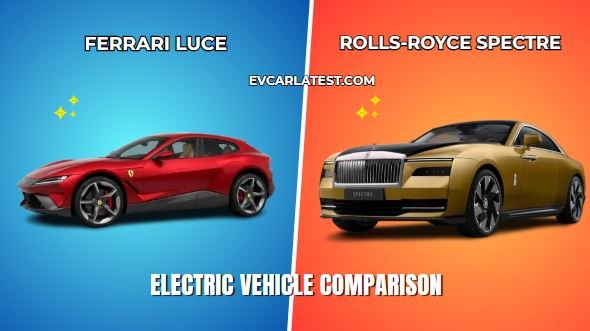
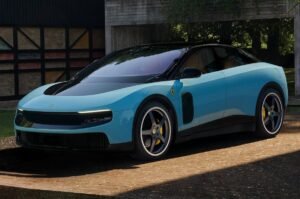
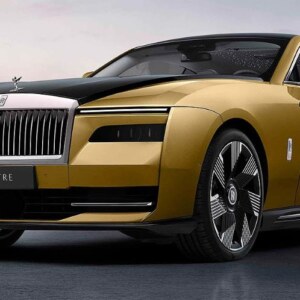
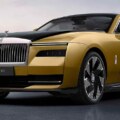
The Ferrari Luce is Ferrari’s first production battery-electric vehicle — a full-size luxury sedan with a quad-motor all-wheel-drive layout, built in Maranello, Italy, and designed in collaboration with Jony Ive’s LoveFrom studio. It targets performance-oriented collectors who want Ferrari DNA without a combustion engine. The Rolls-Royce Spectre is a two-door electric grand tourer from Goodwood, England, built for buyers who prize supreme refinement and coach-crafted exclusivity over outright speed. Ferrari’s full exterior reveal for the Luce is happening today, May 25, 2026, in Rome — making this comparison more relevant than ever for ultra-luxury EV buyers watching the segment evolve.
Range & Charging
The Luce carries a 122 kWh battery and an estimated range of approximately 330 miles (530 km) — figures described as preliminary, with official WLTP certification pending. It supports up to 350 kW DC fast charging, which puts 10–80% well under 20 minutes under ideal conditions. The Rolls-Royce Spectre uses a 102 kWh pack; the EPA estimates range at 277 miles for the standard 2025 model, dropping to 251–266 miles on the higher-performance Black Badge variant. The Spectre supports up to 195 kW DC charging, putting 10–80% at roughly 34 minutes. For AC home charging, both cars offer 11 kW, making overnight top-ups the practical daily reality for both.
Price, Availability & Market Fit
The Spectre starts around $397,000 USD, with the Black Badge trim beginning near $470,000 — roughly ₦600–700 million NGN at grey-market import rates, before duties. The Luce is priced north of $535,000 USD — approximately ₦800 million+ NGN landed, making it one of the most expensive production EVs ever offered. Neither car has an official African dealer network; both arrive via specialist grey-market importers in Lagos or Johannesburg. This page helps you answer one question: do you want a grand tourer built around silence and craftsmanship, or a four-door performance sedan that pushes past 1,000 horsepower?
Ecosystem & Rival Context
Ferrari buyers considering the Luce might also look at the Ferrari Purosangue (V12 SUV) or the 296 GTB hybrid if they want to stay within the brand’s existing combustion or hybrid lineup. Rolls-Royce buyers have the Phantom VIII (ICE) and the Ghost (ICE/hybrid) as alternatives within the house. Outside both brands, the Lucid Air Sapphire ($249,000 USD) offers serious performance range at roughly half the price, and the upcoming Bentley electric grand tourer will be the closest rival on refinement. Neither, however, offers the brand prestige or collector positioning that makes this comparison worth having.
Pros & Cons
Ferrari Luce: The 1,000+ hp quad-motor powertrain delivers hypercar acceleration in a four-seat body, which no rival at this price can match. The 350 kW charging architecture means the Luce recharges faster than almost any production luxury EV on the market, reducing range anxiety on longer drives. The Jony Ive interior represents a genuinely original design language rather than a carried-over luxury formula. On the downside, exterior specs and final WLTP figures remain unconfirmed at launch, so early buyers carry some specification risk. Production volumes will be extremely limited, meaning resale pricing will be opaque and delivery timelines unpredictable.
Rolls-Royce Spectre: The Spectre’s interior refinement and ride isolation are unmatched by any electric rival currently on sale, making it the right choice for buyers who want the quietest possible experience. The brand’s bespoke Bespoke customisation program means no two cars are identical, which matters deeply to this buyer profile. At around $397,000, the Spectre is meaningfully cheaper than the Luce while still occupying the same ultra-luxury tier. Its 277-mile EPA range is respectable but trails the Luce’s estimated figure. The two-door format also limits rear-seat practicality compared to the Luce’s four-door layout.
Quick Verdict
Choose the Ferrari Luce if performance, charging speed, and owning the first electric Ferrari matter most to you — this car is for collectors and enthusiasts who want the badge and the numbers to back it up. Choose the Rolls-Royce Spectre if ride refinement, interior craftsmanship, and a more established delivery and ownership experience are your priorities. The Spectre is available now; the Luce is beginning production in 2026 with limited early allocation. At these prices, neither is a rational purchase — but they serve two clearly different ideas of what an ultra-luxury EV should feel like.
Related EV Comparisons
- Ferrari Luce vs Tesla Model S
- Ferrari Luce vs Porsche Taycan
- Ferrari Luce vs Lucid Air
- Ferrari Luce vs Audi e-tron GT
- Rolls-Royce Spectre vs Tesla Cybertruck
| |
| Price | $640,000.00 $350,000.00 |
| Our Rating | |
| Brand | Ferrari ROLLS-ROYCE |
| Category | Electric Cars Electric Cars |
MODEL
| Full Model Name | Ferrari Luce |
| Generation | 1st Generation |
| Segment / Class | Full-size Luxury Liftback Sedan |
| Available Trims / Variants | Single variant at launch Rolls-Royce Spectre AWD |
| Powertrain Options | Quad-motor AWD (only option) |
| Additional Notes | Model code F222. Internally referred to as "Elettrica" before the name Luce was confirmed on February 9, 2026. |
LAUNCH
| Reveal Date | May 25, 2026 (Rome) 2022, October 18 |
| Launch Year | 2026 |
| Availability Status | Announced; deliveries from Q4 2026 Available to order. Released 2023, October |
| Brand / Manufacturer | Ferrari |
| Country of origin | Italy |
| Assembly Country | Italy (E-Building, Maranello) |
| Markets Available | Global (limited volume) |
| Grey Market Import | Possible but not officially supported |
| Base Price (USD) | ~$640,000 (€550,000) € 379,000 £ 330,000 |
| Additional Notes | Ferrari is keeping production relatively limited, consistent with its long-standing exclusivity strategy. Already oversubscribed at launch. |
BATTERY
| Battery Capacity | 122 kWh gross / 117 kWh usable 101.7 kWh usable, 105.7 kWh total |
| Battery Chemistry | NMC (Nickel Manganese Cobalt) Li-ion |
| Battery Architecture | 880V |
| Range (WLTP/CLTC/EPA) |
~530 km (329 miles EPA approx.) WLTP
291 mi EPA (313 mi WLTP) |
| Energy Consumption | ~25 kWh/100 km (est.) 410 Wh/mi EPA (377 Wh/mi WLTP) |
| Regen Braking (Max kW) | Yes |
| Heat Pump | |
| AC Charging (Max kW) | Type 2 22 kW |
| DC Charging (Max kW) | 350 kW CCS 200 kW |
| Charging Time (10–80%) | ~19 minutes at 350 kW, with an average charging speed of 253 kW |
| Cell Brand | SK On |
| Additional Notes | Battery pack developed in-house by Ferrari; cells supplied by SK On. |
PERFORMANCE
| Motor Type | Radial-flow Permanent Synchronous (Halbach array) |
| Motor Configuration | Quad-motor, one per wheel, AWD |
| Front Motor Output (kW / HP) | 105 kW / 141 hp each (×2) |
| Rear Motor Output (kW / HP) | 310 kW / 416 hp each (×2) |
| Power Output (kW / hp) | 772 kW / 1,035 hp AWD 585 hp (430 kW) |
| Peak Power (kW / hp) | 830 kW / 1,113 hp |
| Torque (Nm) | 990 Nm combined 900 Nm (664 lb-ft) |
| 0–100 km/h / 0-60 mph (seconds) The acceleration numbers are an easy way to compare car performance. We list either time from 0 to 100 km/h or time from 0 to 60mph, depending on which number(s) the manufacturers provide. The lower the acceleration time, the higher performance the car is. | 2.5 seconds 4.4 sec 0-60 mph (4.5 sec 0-62 mph) |
| Top Speed (km/h / mph) | 310 km/h (192 mph) 155 mph (250 km/h) |
| Transmission / Drive | Single-speed, AWD |
| Rear-Wheel Steering | Yes (four-wheel steering) |
| Drive Mode | Yes |
| Launch Control | Yes |
| Torque Vectoring | Yes, on both axles |
| Simulated Sound | Yes — described as resembling an electric guitar |
| Additional Notes | During cruising, front motors disconnect to maximize range. The Halbach array directs magnetic flux toward the stator to maximize torque density — a setup adapted from Ferrari's Formula One powertrains. Weight distribution is 47:53 (front:rear). |
BODY
| Body Style | 5-door Liftback Sedan 2 door, coupe, 4 seats |
| Platform / Architecture | Bespoke Ferrari EV platform (880V) Architecture of Luxury |
| Dimensions (L×W×H mm) | ~5,019 × 1,999 × 1,539 mm 5453 x 2080 x 1559 mm (214.7 x 81.9 x 61.4 in) |
| Drag Coefficient (Cd) | Lowest of any Ferrari road car ever built 0.25 Cd |
| Wheelbase (mm) | 2,959 mm 3210 mm (126.4 in) |
| Kerb Weight (kg) | 2,260 kg EU: 2965 kg unladen, 3400 kg gross |
| Suspension (Front / Rear) | 48V active suspension front and rear — reaction time so fast that anti-roll bars are not required Planar suspension, anti-roll bars (decouple option), four-wheel steering system |
| Wheel Size (inches) | R22, R23 |
| Trunk/Boot Capacity (L) | EU: 380 l |
| Frunk/Bonnet Capacity (L) | No |
| Towing Capacity (kg) | No |
| Aerodynamics | Front suspension can lower the car by 10 mm at speed to improve efficiency and stability. |
| Additional Notes | ~5 cm shorter in height than the Purosangue but roughly the same footprint. |
SAFETY
| Airbags (count) | Front, side, rear, center, head airbag system, front seats knee airbags |
| Anti-lock Braking System (ABS) | Yes |
| Electronic Brakeforce Distribution (EBD) | Yes |
| Electronic Stability Control (ESC) | Yes |
| Traction Control System (TCS) | Yes |
| Tyre Pressure Monitoring (TPMS) | Yes |
| Child Seat Anchors (ISOFIX / LATCH) | Yes |
| Reversing Camera | Yes |
| Hill Start Assist | Yes |
| Driver Assistance (ADAS) | Front radar, cameras, 12 sensors. Vision Assist, Nightlife & Pedestrian warning, Alertness Assistant, Cross-Traffic Warning, Lane Departure Warning, Lane Change Warning, High-beam assist, Blind Spot Detection |
| Additional Notes | Ferrari debuts a new Vehicle Control Unit architecture in the Luce. |
COMFORT
| Seating Capacity | 5 Heated and ventilated front seats, heated rear seats |
| Seat Material | Leather (premium) |
| Power Seats | Yes |
| Climate Control | Yes (multi-zone expected) |
| Steering Wheel | Custom Ferrari unit |
| Roof Type | Fixed No glass roof |
| Ambient Lighting | Yes |
| Gear Selector | Glass construction |
| Noise Insulation | High (acoustic priority) |
| Bluetooth / Wi-Fi | Yes |
| Wireless Charging | Yes |
| Parking Aids |
360 degree cameras Automated parking Front and rear sensors, 360 camera, reversing camera |
| Additional Notes | Interior designed by LoveFrom (Jony Ive and Marc Newson) in collaboration with Centro Stile Ferrari. Ferrari describes propulsion options as "power levels" rather than conventional gears. |
DISPLAYS
| Centre Screen (inches) | Yes Yes |
| Driver's Display (inches) | Yes Yes |
| Head-Up Display (HUD) | Yes |
| Operating System | Ferrari proprietary |
| Physical Controls | Jony Ive deliberately reintroduced physical/tactile controls below the central touchscreen — a departure from his touchscreen-first Apple philosophy. |
| Additional Notes | Passenger display screen |
LIGHTING
| Headlight Type (LED/Matrix/Laser) | LED / Matrix |
| Daytime Running Lights (DRL) | Yes |
| Interior Ambient Lighting | Yes |
INFOTAINMENT & AUDIO
| Navigation System | Yes |
TECHNOLOGY
| Smartphone App Control | Yes |
| Keyless Entry / Start | Yes |
| Over-the-Air Map Updates | Yes |
| Additional Notes | Ferrari claims the Luce features one of the most advanced dynamic control systems ever installed in a production car. |
OWNERSHIP
| Official Dealer Network | Ferrari authorized dealers globally |
| Spare Parts Availability | Limited (low-volume production) |
| Resale Value | Expected to be very high (oversubscribed at launch) |
| Roadside Assistance | Yes (Ferrari official) |
Note
| Data Source | Ferrari official reveal (May 25, 2026), Wikipedia, InsideEVs, Top Gear, EVKX.net, Motor1, Autobics |
| Last Updated | May 27, 2026 |
| Additional Notes | TBC fields reflect information not yet officially confirmed by Ferrari. Some figures (e.g. peak vs. rated power) vary slightly across sources — Wikipedia cites 1,113 hp peak; most outlets report 1,035 hp rated. |
| Editor's Note | The Ferrari Luce is a landmark car but has zero official presence in Africa. For evcarlatest.com, the key angles are: price in NGN (~₦1 billion+), grey market feasibility, comparison to Porsche Taycan Turbo S, and what it signals about ultra-luxury EV direction globally. |
| Disclaimer | We can not guarantee that the information on this page is 100% correct |
|
Disclaimer Note
Specifications sourced from manufacturer data and may reflect WLTP, CLTC, or EPA test conditions. Import prices in your local are estimates based on grey-market landing costs and exclude duties, clearing fees, and local taxes. Figures are subject to change without notice. Always verify with your local importer before purchase. We can not guarantee that the information on this page is 100% correct