- Home
- Electric Vehicles
- Compare
- Ford Explorer vs Lexus UX 300e
Ford Explorer vs Lexus UX 300e
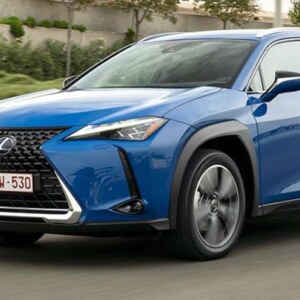
Ford Explorer EV and Lexus UX 300e target different parts of the EV SUV space. The Explorer EV sits in the mid-size segment for families needing space and flexibility. The UX 300e is a compact premium SUV aimed at urban users who value brand, comfort, and smaller dimensions.
Range differs clearly. The Explorer EV reaches up to around 600 km WLTP depending on version, while the UX 300e ranges between roughly 280 to 450 km WLTP depending on battery update. Charging shows a bigger gap. The Explorer EV uses a modern CCS setup with up to around 135 to 185 kW DC fast charging. The UX 300e relies on CHAdeMO with only 35 to 50 kW peak, leading to longer charging times and fewer compatible fast chargers.
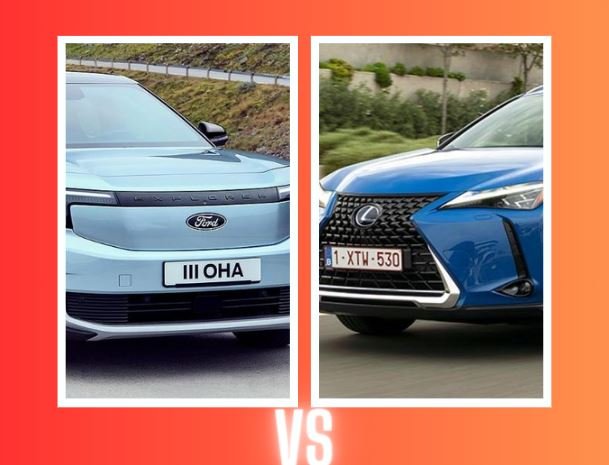
Price positioning reflects segment. The Explorer EV sits in the mid-range SUV bracket, while the UX 300e sits higher per size due to its premium badge. Market availability differs. The Explorer EV is expanding across Europe, while the UX 300e has been phased out in some markets like the UK. This comparison helps you decide between space and modern EV tech versus compact size and premium positioning.
Within Ford, other EVs include the Ford Mustang Mach-E and upcoming crossovers. Within Lexus, the lineup includes the Lexus RZ and hybrid UX variants, with the RZ acting as the main EV successor.
The Explorer EV offers longer range, faster charging, and more cabin space, but interior quality varies by trim and size makes city driving harder; the UX 300e offers compact size, premium build, and smooth ride, but range is lower and charging is outdated with limited infrastructure support.
QUICK VERDICT; Pick the Explorer EV if you need space, range, and modern charging. Pick the UX 300e if you want a compact premium SUV for short urban use.
Related EV Comparisons
- Kia EV3 vs Ford Explorer
- Ford Explorer vs Volkswagen ID.3
- Ford Explorer vs Tesla Model Y
- Ford Explorer vs Tesla Model X
- Ford Explorer vs Rivian R2

MODEL
| Models |
Ford Explorer Standard Range Ford Explorer Extended Range Ford Explorer Extended Range AWD Lexus UX 300e 73kWh |
LAUNCH
| Announced |
2023, March 21
2022, October 12 |
| Status |
Available to order. Released 2024, November - Ford Explorer Standard Range Available to order. Released 2024, March -Ford Explorer Extended Range Available to order. Released 2024, March - Ford Explorer Extended Range AWD Available to order. Released 2023, April |
| Country of origin | United States Japan |
| Base Price |
€ 42,500 £ 40,000 - Ford Explorer Standard Range € 49,500 £ 46,000 - Ford Explorer Extended Range € 53,500 £ 54,000 - Ford Explorer Extended Range AWD £ 47,500 |
PERFORMANCE
| Power |
RWD 168 hp (125 kW) - Ford Explorer Standard Range RWD 286 hp (210 kW) - Ford Explorer Extended Range AWD 335 hp (250 kW) - Ford Explorer Extended Range AWD FWD 150 kW (204 hp) |
| Torque |
310 Nm (229 lb-ft) - Ford Explorer Standard Range 545 Nm (402 lb-ft) - Ford Explorer Extended Range 679 Nm (501 lb-ft) - Ford Explorer Extended Range AWD 300 Nm (221 lb-ft) |
| Acceleration The acceleration numbers are an easy way to compare car performance. We list either time from 0 to 100 km/h or time from 0 to 60mph, depending on which number(s) the manufacturers provide. The lower the acceleration time, the higher performance the car is. |
9 sec 0-62 mph - Ford Explorer Standard Range 6.4 sec 0-62 mph - Ford Explorer Extended Range 5.3 sec 0-62 mph - Ford Explorer Extended Range AWD 7.5 sec 0-100 km/h |
| Max Speed |
99 mph (160 km/h) - Ford Explorer Standard Range 112 mph (180 km/h) - Ford Explorer Extended Range 112 mph (180 km/h) - Ford Explorer Extended Range AWD 160 km/h (99 mph) |
| transmission | Single-speed Single-speed |
BATTERY
| Capacity |
52 kWh usable, 55 kWh total - Ford Explorer Standard Range 77 kWh usable, 82 kWh total - Ford Explorer Extended Range 79 kWh usable, 82 kWh total - Ford Explorer Extended Range AWD 72.8 kWh total |
| Tech | Li-ion (400V type) Air-cooled Li-ion (400V type) |
| Range |
236 mi WLTP - Ford Explorer Standard Range 374 mi WLTP - Ford Explorer Extended Range 352 mi WLTP - Ford Explorer Extended Range AWD 280 mi WLTP |
| Consumption |
241 Wh/mi WLTP - Ford Explorer Standard Range 224 Wh/mi WLTP - Ford Explorer Extended Range 253 Wh/mi WLTP - Ford Explorer Extended Range AWD 269 Wh/mi WLTP |
| Recuperation | Yes 5 levels |
| Heat Pump | |
| AC Charging |
Type 2 11 kW
Type 2 6.6 kW |
| DC Charging |
CCS, 120 kW max, 10-80% in 25 min - Ford Explorer Standard Range CCS 170 kW max, 10-80% in 25 min - Ford Explorer Extended Range CCS 190 kW max, 10-80% in 25 min - Ford Explorer Extended Range AWD CHAdeMO 50 kW |
BODY
| Type | 5 door crossover, 5 seats 5 door SUV, 5 seats |
| Platform |
MEB
TNGA: GA-C |
| Dimensions | 4468 x 1871 x 1630 mm (175.9 x 73.7 x 64.2 in) 4495 x 1840 x 1545 mm (177.0 x 72.4 x 60.8 in) |
| Drag Co-Efficient |
0.31 Cd |
| Wheelbase | 2767 mm (108.9 in) 2640 mm (103.9 in) |
| Weight |
EU: 2008 kg unladen, 2490 kg gross - Ford Explorer Standard Range EU: 2190 kg unladen, 2675 kg gross - Ford Explorer Extended Range EU: 2267 kg unladen, 2740 kg gross - Ford Explorer Extended Range AWD EU: 1885 kg unladen, 2245 kg gross |
| Suspension | Front MacPherson struts, rear multi-link Front MacPherson struts, rear Trailing Wishbone |
| Wheels | R19, R20, R21 R17, R18 |
| Trunk/Boot | EU: 536 l, 1422 l max EU: 367 l |
| Frunk/Bonnet | No No |
| Towing |
EU: 750 kg unbraked, 1000 kg braked - Ford Explorer Standard Range EU: 750 kg unbraked, 1000 kg braked - Ford Explorer Extended Range EU: 750 kg unbraked, 1200 kg braked - Ford Explorer Extended Range AWD No |
DISPLAYS
| Centre |
14.6" movable touchscreen
7.0" or 10.3" touchscreen - 2018 model 8.0" or 12.3" touchscreen - 2022 model |
| Driver's Display | 5" Yes |
| Head-Up | No Yes |
| Others |
COMFORT
| Seats |
Heated front seats, massage (driver seat only)
Heated front and rear Heated and ventilated front seats, heated rear seats |
| Roof | Panoramic glass roof Panoramic glass roof |
| Parking Aids | Front and rear sensors, 360 camera, reversing camera, Active Park Assist 4 front and 4 rear sensors, 360 camera, reversing camera |
| Connectivity |
Wireless Android Auto and Apple CarPlay
Wired or wireless (2022 model) Android Auto and Apple CarPlay |
SAFETY
| Airbags |
Side airbags, front and rear, including head airbag system; drivers' knee airbag
Side airbags, front and rear, head airbag system |
| Driving Aids |
Front radar, 2 rear corner radars, 5 cameras. Assisted Lane Change, Clear Exit Assist, Blind Spot Assist, Front and Rear Parking Aid with Manoeuvring Brake Assist, Reverse Brake Assist, Pre-Collision Assist, Cross Traffic Alert with Active Braking, High Beam Assist
Front radar and camera. Lexus Safety System, Pre-Collision System with pedestrian detection, Lane Keep Assist, Lane Trace Assist, Road Sign Assist, High Beam Assist, Secondary Collision brake, Blind Spot Monitor, Rear Cross-Traffic Alert, Emergency brake signal Intersection Turning Assist, Emergency Steering Assist - 2022 model |
| Crash Tests | NCAP 2019: 5 stars |
Note
| disclaimer | We can not guarantee that the information on this page is 100% correct We can not guarantee that the information on this page is 100% correct |


|
Disclaimer Note
We can not guarantee that the information on this page is 100% correct