- Home
- Electric Vehicles
- Compare Electric Cars
- BYD Dolphin vs Honda e
BYD Dolphin vs Honda e
The Honda e and BYD Dolphin are small electric hatchbacks built for city use. The Honda e is aimed at drivers who want a compact EV with simple design, easy parking, and urban comfort. The BYD Dolphin targets buyers who want efficient range and everyday usability at lower running costs in tight spaces.
Range differs clearly. The Honda e’s battery supports around 137 miles (220 km) WLTP, suitable for short city trips. The BYD Dolphin generally offers around 250–300+ km (155–186+ miles) WLTP depending on variant, making it better for mixed use. Charging also differs. The Honda e handles AC charging well with modest DC support, but does not support very high-speed charging. The BYD Dolphin supports faster DC charging, so adding range in shorter stops is simpler.
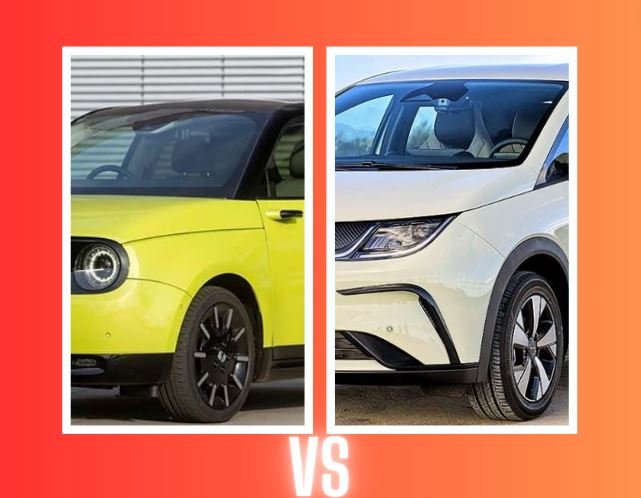
Prices reflect positioning. The Honda e sits above many city EVs with compact luxury touches, while the BYD Dolphin starts lower and focuses on value for range. Availability differs by region. The Honda e has limited markets, mainly Europe and Japan. The BYD Dolphin is wider in Asia and expanding to more markets. This comparison helps you choose between a city-first EV and a more range-focused small EV.
Within Honda’s EV lineup, the Honda e stands alongside upcoming larger EVs such as the Prologue SUV. Within BYD’s EV range, the Dolphin sits with models like the Atto 3 and Seal, covering broader size and range needs.
The Honda e offers tight turning, pleasant interior layout, and simple tech but has low range and slower charging; the BYD Dolphin offers higher range, quicker charging, and more space but has simple interior materials and weaker brand support in some markets.
Quick verdict; Choose Honda e for easy urban driving. Choose BYD Dolphin for longer range and faster charging.
Related EV Comparisons
- XPeng MONA M03 vs BYD Dolphin
- XPeng MONA M03 vs BYD Qin Plus EV
- BYD Atto 2 vs BYD Atto 3
- BYD Atto 2 vs BYD Dolphin
- Zeekr 7X vs BYD Sea Lion 7

| |
| Price | $33,000.00 $38,000.00 |
| Our Rating | |
| Brand | BYD HONDA |
| Category | Electric Cars Electric Cars |
MODEL
| Available Trims / Variants |
BYD Dolphin Active BYD Dolphin Boost BYD Dolphin Comfort/Design Honda e Advance |
PRICE & AVAILABILITY
| Base Price (USD) | € 33,000 € 38,000 £ 34,160 |
| Availability Status | Available. Released 2023, June Available to order. Released 2020 |
BATTERY & CHARGING
| Battery Capacity | 60 kWh total 29 kWh usable, 35.5 kWh total |
| Range (WLTP/CLTC/EPA) | 265 mi WLTP 137 mi WLTP |
| DC Charging (Max kW) |
CCS 88 kW, 30-80% in 29 min Vehicle to load (V2L) - 3.3 kW max CCS 100 kW max, 0-80% in 36 min CCS 100 kW max, 0-80% in 36 min |
| AC Charging (Max kW) |
Type 2 11 kW
Type 2 6.6 kW, 0-100% in 5 hours 59 min |
| Energy Consumption | 277 Wh/mi WLTP |
PERFORMANCE
| Power Output (kW / hp) |
FWD 204 hp (150 kW)
RWD 154 hp (113 kW) |
| 0–100 km/h / 0-60 mph (seconds) The acceleration numbers are an easy way to compare car performance. We list either time from 0 to 100 km/h or time from 0 to 60mph, depending on which number(s) the manufacturers provide. The lower the acceleration time, the higher performance the car is. | 7 sec 0-62 mph 8.3 sec 0-62 mph |
| Torque (Nm) | 290 Nm (214 lb-ft) 315 Nm (232 lb-ft) |
| Top Speed (km/h / mph) |
99 mph (160 km/h)
90 mph (145 km/h) |
BODY & DIMENSIONS
| Dimensions (L×W×H mm) |
4290 x 1770 x 1570 mm (168.9 x 69.7 x 61.8 in)
3894 x 1752 x 1512 mm (153.3 x 69.0 x 59.5 in) |
| Trunk/Boot Capacity (L) |
EU: 345 l, 1310 l max
EU: 171 l, 861 l max |
| Body Style |
5 door hatchback, 5 seats
5 door hatchback, 4 seats |
| Kerb Weight (kg) |
EU: 1520 kg unladen, 1870 kg gross |
| Ground Clearance (mm) | 145 mm (5.7 in) |
| Frunk/Bonnet Capacity (L) |
No
No |
SAFETY & DRIVER ASSISTANCE
| Crash Test Ratings | NCAP 2020: 4 stars |
COMFORT & SEATING
| Seating Capacity | Heated front seats Heated front seats |
DISPLAYS & CONNECTIVITY
| Centre Screen (inches) | 12.8" rotating touchscreen Two 12.3" touchscreens, two 6" (Side Camera Mirror System) |
| Driver's Display (inches) | 5" 9" |
| Head-Up Display (HUD) | No No |
TECHNOLOGY
ADDITIONAL SPECS
Note
| Additional Notes | For China market only, dubbed as GAC Honda e:NP1 |

|
Disclaimer Note
Specifications sourced from manufacturer data and may reflect WLTP, CLTC, or EPA test conditions. Import prices in your local are estimates based on grey-market landing costs and exclude duties, clearing fees, and local taxes. Figures are subject to change without notice. Always verify with your local importer before purchase. We can not guarantee that the information on this page is 100% correct