- Home
- Electric Vehicles
- Compare Electric Cars
- Nissan Leaf vs Honda e
Nissan Leaf vs Honda e
The Honda e and Nissan Leaf are compact electric hatchbacks designed for everyday use. The Honda e focuses on city driving with a tight turning radius and simple tech. The Nissan Leaf fits buyers who want a more established EV with broader range choices and practicality for city and suburban driving.
Range differs. The Honda e offers around 220 km (137 miles) WLTP, suited for short trips around town. The Nissan Leaf offers more range, with versions around 240 km to over 360 km (150–225+ miles WLTP) depending on battery size. Charging also differs. The Honda e’s DC fast‑charging capability is limited and slower, so long stops add only modest range. The Leaf supports stronger DC charging in larger battery versions, meaning quicker top‑ups on longer trips.
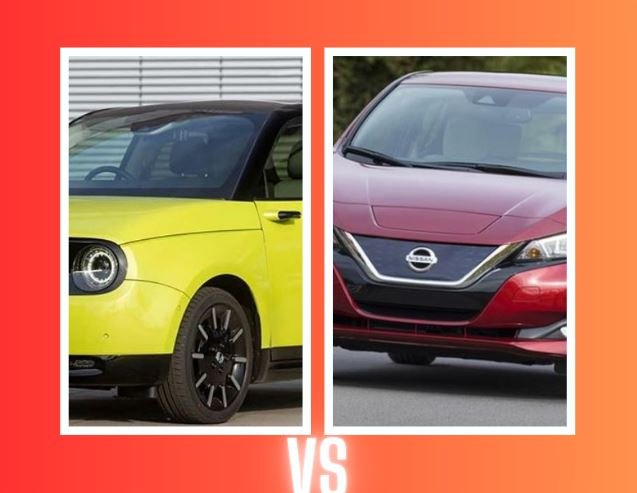
Price reflects positioning. The Honda e sits at a higher entry price for a small urban EV. The Nissan Leaf spans more variants with wider price bands, including lower entry points. Availability varies. The Leaf is sold widely across Europe, Japan, and North America. The Honda e has more limited markets, mainly in Europe and Japan. This comparison guides you on whether you need a compact urban EV or a more range‑flexible compact EV.
Other EVs in Honda’s line include upcoming models such as the Honda Prologue SUV. In Nissan’s range, the Leaf sits alongside newer models like the Ariya SUV, covering larger and longer‑range EV needs.
The Honda e offers tight city handling, modern interior layout, and straightforward controls but has low range and slower charging. The Nissan Leaf offers higher range options, stronger charging on bigger batteries, and wider availability but has more conventional design and less premium cabin feel.
Quick verdict; Choose the Honda e for pure city use. Choose the Nissan Leaf for range and wider use cases.
Related EV Comparisons
- Nissan Ariya vs BYD Seal U
- Nissan Ariya vs Zeekr X
- Nissan Ariya vs BMW iX1
- Nissan Leaf vs Renault 5 E-Tech
- Honda e:Ny1 vs BYD Seal U
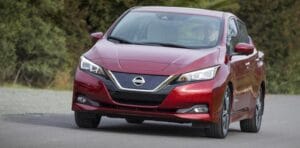

| |
| Price | $27,500.00 $38,000.00 |
| Our Rating | |
| Brand | Nissan HONDA |
| Category | Electric Cars Electric Cars |
MODEL
| Available Trims / Variants |
Nissan Leaf 40kWh Nissan Leaf 62kWh Honda e Advance |
PRICE & AVAILABILITY
| Base Price (USD) |
$ 27,400 € 29,990 £ 25,990 - Nissan Leaf 40kWh $ 32,400 € 37,550 £ 30,440 - Nissan Leaf 62kWh € 38,000 £ 34,160 |
| Availability Status |
Available to order. Released 2018, February - Nissan Leaf 40kWh Available to order. Released 2019 - Nissan Leaf 62kWh Available to order. Released 2020 |
BATTERY & CHARGING
| Battery Capacity |
38 kWh usable, 40 kWh total - Nissan Leaf 40kWh 58 kWh usable, 62 kWh total - Nissan Leaf 62kWh 29 kWh usable, 35.5 kWh total |
| Range (WLTP/CLTC/EPA) |
168 mi WLTP (151 mi EPA, 124 mi NEDC) - Nissan Leaf 40kWh 239 mi WLTP (226 mi EPA, 155 mi NEDC) - Nissan Leaf 62kWh 137 mi WLTP |
| DC Charging (Max kW) |
CHAdeMO 50 kW max, 0-80% in 40 min - Nissan Leaf 40kWh CHAdeMO 100 kW max, 0-80% in 45 min - Nissan Leaf 62kWh CCS 100 kW max, 0-80% in 36 min CCS 100 kW max, 0-80% in 36 min |
| AC Charging (Max kW) |
Type 2 6.6 kW AC, 0-100% in 8 hours - Nissan Leaf 40kWh Type 2 6.6 kW AC, 0-100% in 11 hours 30 min - Nissan Leaf 62kWh Type 2 6.6 kW, 0-100% in 5 hours 59 min |
| Energy Consumption |
300 Wh/mi EPA (332 Wh/mi WLTP) - Nissan Leaf 40kWh 290 Wh/mi WLTP (310 Wh/mi EPA) - Nissan Leaf 62kWh 277 Wh/mi WLTP |
PERFORMANCE
| Power Output (kW / hp) |
FWD 150 hp (110 kW) - Nissan Leaf 40kWh FWD 218 hp (160 kW) - Nissan Leaf 62kWh RWD 154 hp (113 kW) |
| 0–100 km/h / 0-60 mph (seconds) The acceleration numbers are an easy way to compare car performance. We list either time from 0 to 100 km/h or time from 0 to 60mph, depending on which number(s) the manufacturers provide. The lower the acceleration time, the higher performance the car is. |
7.9 sec 0-62 mph - Nissan Leaf 40kWh 6.9 sec 0-62 mph - Nissan Leaf 62kWh 8.3 sec 0-62 mph |
| Torque (Nm) |
320 Nm (236 lb-ft)- Nissan Leaf 40kWh 340 Nm (251 lb-ft) - Nissan Leaf 62kWh 315 Nm (232 lb-ft) |
| Top Speed (km/h / mph) |
89 mph (144 km/h) - Nissan Leaf 40kWh 98 mph (157 km/h) - Nissan Leaf 62kWh 90 mph (145 km/h) |
BODY & DIMENSIONS
| Dimensions (L×W×H mm) |
4490 x 1788 x 1530 mm (176.8 x 70.4 x 60.2 in)
3894 x 1752 x 1512 mm (153.3 x 69.0 x 59.5 in) |
| Trunk/Boot Capacity (L) |
EU: 435 l, 1176 l max - Nissan Leaf 40kWh EU: 420 l, 1161 l max - Nissan Leaf 62kWh EU: 171 l, 861 l max |
| Body Style |
5 door hatchback, 5 seats 5 door hatchback, 4 seats |
| Kerb Weight (kg) |
EU: 1580 kg unladen, 1995 kg gross - Nissan Leaf 40kWh EU: 1756 kg unladen, 2140 kg gross - Nissan Leaf 62kWh EU: 1520 kg unladen, 1870 kg gross |
| Ground Clearance (mm) | 150 mm (5.9 in) 145 mm (5.7 in) |
| Frunk/Bonnet Capacity (L) |
No No |
SAFETY & DRIVER ASSISTANCE
| Crash Test Ratings | NCAP 2018: 5 stars, NHTSA 2020-2022: 5 stars NCAP 2020: 4 stars |
COMFORT & SEATING
| Seating Capacity | Heated front seats, heated outer rear seats Heated front seats |
DISPLAYS & CONNECTIVITY
| Centre Screen (inches) | 5" or 7" or 8" touchscreen Two 12.3" touchscreens, two 6" (Side Camera Mirror System) |
| Driver's Display (inches) | 7" 9" |
| Head-Up Display (HUD) | No No |
TECHNOLOGY
ADDITIONAL SPECS
Note
| Additional Notes | Nissan Leaf 62kWh Also known as Nissan Leaf e+, Nissan Leaf Plus For China market only, dubbed as GAC Honda e:NP1 |

|
Disclaimer Note
Specifications sourced from manufacturer data and may reflect WLTP, CLTC, or EPA test conditions. Import prices in your local are estimates based on grey-market landing costs and exclude duties, clearing fees, and local taxes. Figures are subject to change without notice. Always verify with your local importer before purchase. We can not guarantee that the information on this page is 100% correct