- Home
- Electric Vehicles
- LOTUS
- Lotus Evija
Lotus Evija
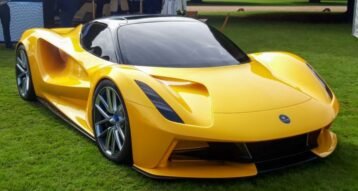
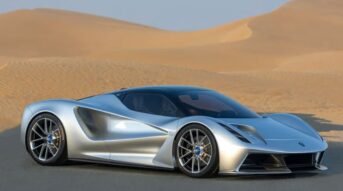
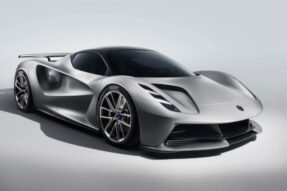
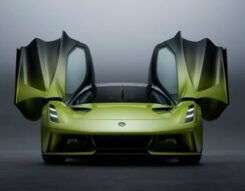
- Drive Type: AWD
- Type: 2-door, 2-seat hypercar
- Self Driving: No
- Airbags: Yes
PROS
- Extremely high power output
- Lightweight construction strategy
- Advanced torque vectoring control
CONS
- Limited driving range relative to mainstream EVs
- Extremely high purchase cost
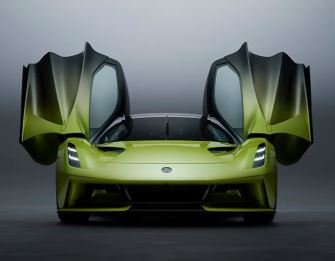
The Lotus Evija is a battery-electric hypercar. It sits in the limited-production performance segment. Body style: two-door coupe. Layout: low-slung, mid-mounted battery architecture designed for maximum power output.
The Evija uses a 70 kWh lithium-ion battery pack. It targets extreme performance rather than long-distance efficiency. Estimated range is roughly 250 miles under WLTP testing, depending on driving conditions. Charging supports high-power DC fast charging. The system is designed for rapid energy replenishment during track-focused use.
Pricing places the Evija in the multi-million-dollar bracket. Production volume is strictly limited. It suits collectors, track enthusiasts, and buyers prioritizing peak performance metrics. Within the brand’s EV lineup, the Lotus Eletre and Lotus Emeya serve different roles as SUV and sedan models. Key alternatives include the Rimac Nevera and Pininfarina Battista. A common comparison focuses on Evija vs Nevera performance characteristics.
Lotus Evija Images


Full Specifications
MODEL
| Models |
Lotus Evija Lotus Evija Fittipaldi Lotus Evija X |
LAUNCH
| Announced |
July 2019 October 2022 Revealed in 2023 |
| Status | In production (limited to 130 units) |
| Country of origin | Britain |
| Base Price | ~$2.3 million USD |
PERFORMANCE
| Power | ~2,000 hp, Quad-motor AWD (one motor per wheel) |
| Torque | ~1,700 Nm |
| Acceleration The acceleration numbers are an easy way to compare car performance. We list either time from 0 to 100 km/h or time from 0 to 60mph, depending on which number(s) the manufacturers provide. The lower the acceleration time, the higher performance the car is. | 0–100 km/h < 3.0 s; 0–300 km/h < 9.0 s |
| Max Speed | ~350 km/h (217 mph) |
BATTERY
| Capacity |
~93 kWh lithium-ion 70 kWh |
| Tech | Integrated with Williams Advanced Engineering, liquid-cooled |
| Range | ~346 km (215 mi) WLTP |
| Consumption | ~27 kWh/100 km (est.) |
| Recuperation | Regenerative braking |
| Heat Pump | |
| AC Charging | 22 kW, ~6 hours full |
| DC Charging | 350 kW, 0–80% ~12 min, 100% ~18 min |
| Others | Future-proofed for 800 kW charging (possible 9 min full) |
BODY
| Type | 2-door, 2-seat hypercar |
| Platform | Lotus custom carbon-fiber monocoque |
| Dimensions | L 4,459 mm | W 2,000 mm | H 1,122 mm |
| Drag Co-Efficient | ~0.35 (est., active aero) |
| Wheelbase | 2,700 mm |
| Clearance | Low-slung (track-oriented) |
| Weight | ~1,680 kg |
| Suspension | Race-inspired double wishbone (front & rear) |
| Wheels | 20” front, 21” rear, carbon wheels optional |
| Trunk/Boot | Small rear luggage compartment |
| Frunk/Bonnet | None (space used for aero & cooling) |
| Towing | None |
| Others | Venturi tunnels for airflow through body |
DISPLAYS
| Centre | Minimal infotainment screen |
| Driver's Display | Digital cluster with performance data |
| Head-Up | Not Available |
| Others | Camera-based side mirror displays |
COMFORT
| Seats | Carbon-fiber racing seats with Alcantara/leather |
| Roof | Fixed carbon roof |
| Parking Aids | Rearview camera, parking sensors |
| Connectivity | Bluetooth, navigation, telemetry data logging |
| Others | Lightweight interior focus, minimal distractions |
SAFETY
| Airbags | Front airbags |
| Driving Aids | ABS, traction control, stability control, torque vectoring |
| Self Driving | None |
Note
| Others | The Lotus Evija is built for extreme performance and exclusivity, prioritizing power-to-weight ratio and aerodynamics over everyday practicality. |
Reviews
Disclaimer Note
We can not guarantee that the information on this page is 100% correct