- Home
- Electric Vehicles
- Compare Electric Cars
- XPeng P5 vs BYD Han
XPeng P5 vs BYD Han
The XPeng P5 and BYD Han sit in different tiers of the sedan segment. The P5 targets entry-level and mid-range buyers who want a practical EV for daily use. The Han targets buyers who want a larger, more premium sedan with higher performance and more comfort features.
Range shows a clear gap. The P5 delivers about 375 to 475 km WLTP depending on battery size. The Han reaches around 500 to 520 km WLTP depending on version. Charging also differs. The P5 supports DC charging up to about 70–80 kW, leading to longer charging stops. The Han supports higher DC speeds around 120 kW, which reduces charging time compared to the P5, though it still sits below newer fast-charging platforms.
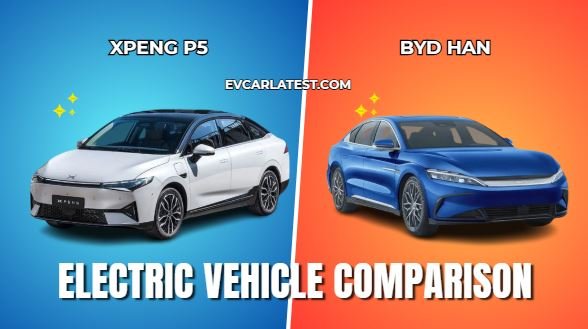
Price positioning separates both clearly. The P5 sits in a lower price band as an entry sedan. The Han sits higher as a flagship sedan in its lineup. The P5 has limited global presence and focuses on China with selective exports. The Han has wider exposure across China and some international markets. This page helps you decide between a budget-friendly sedan and a larger, more premium alternative.
Within XPeng’s lineup, the P5 sits below models like the P7 and G6, focusing on affordability and core features. Within BYD’s lineup, the Han sits above models like the Seal and Atto 3, acting as a flagship sedan with more power and premium positioning.
The P5 offers lower cost, good efficiency, and simple daily usability, but has shorter range and slower charging. The Han offers stronger performance, longer range, and a more refined interior, but costs more and is larger to handle in tight spaces.
Quick verdict; Pick the P5 if you want a lower-cost sedan for daily use. Pick the Han if you want more range, higher performance, and a more premium setup.
Related EV Comparisons
- XPeng MONA M03 vs BYD Dolphin
- XPeng MONA M03 vs BYD Qin Plus EV
- BYD Atto 2 vs BYD Atto 3
- BYD Atto 2 vs BYD Dolphin
- Zeekr 7X vs XPeng G9

| |
| Price | $49,000.00 $72,000.00 |
| Our Rating | |
| Brand | XPeng BYD |
| Category | Electric Cars Electric Cars |
MODEL
| Available Trims / Variants | XPeng P5 Standard Range FWD |
PRICE & AVAILABILITY
| Base Price (USD) | € 49,400 € 72,000 |
| Availability Status | Available to order. Released 2022, Q4 Available to order. Released 2022, Q4 |
BATTERY & CHARGING
| Battery Capacity | 66.2 kWh total 85.4 kWh total |
| Range (WLTP/CLTC/EPA) | 289 mi WLTP 324 mi WLTP |
| DC Charging (Max kW) |
CCS 70 kW max, 30-80% in 36 min CCS 150 kW, 30-80% in 30 min Vehicle to load (V2L) |
| AC Charging (Max kW) |
Type 2, 30-80% in 3h 45 min
Type 2 7 kW Type 2 11 kW |
| Energy Consumption | 238 Wh/mi WLTP |
PERFORMANCE
| Power Output (kW / hp) | FWD 211 hp (155 kW) AWD 509 hp (380 kW) |
| 0–100 km/h / 0-60 mph (seconds) The acceleration numbers are an easy way to compare car performance. We list either time from 0 to 100 km/h or time from 0 to 60mph, depending on which number(s) the manufacturers provide. The lower the acceleration time, the higher performance the car is. | 7.5 sec 0-62 mph 3.9 sec 0-62 mph |
| Torque (Nm) | 229 lb-ft (310 Nm) 516 lb-ft (700 Nm) |
| Top Speed (km/h / mph) | 109 mph (175 km/h) 112 mph (180 km/h) |
BODY & DIMENSIONS
| Dimensions (L×W×H mm) | 189.3 x 72.4 x 59.8 in (4808 x 1840 x 1520 mm) 196.7 x 75.2 x 58.9 in (4995 x 1910 x 1495 mm) |
| Trunk/Boot Capacity (L) | EU: 18.4 ft³ EU: 14.5 ft³ |
| Body Style | 4 door sedan, 5 seats 4 door sedan, 5 seats |
| Kerb Weight (kg) | EU: 3781 lb unladen, 4718 lb gross EU: 4960 lb unladen |
| Ground Clearance (mm) | 5.1 in (130 mm) |
| Frunk/Bonnet Capacity (L) | No No |
SAFETY & DRIVER ASSISTANCE
COMFORT & SEATING
| Seating Capacity | Heated front and rear seats Heated and ventilated front seats |
DISPLAYS & CONNECTIVITY
| Centre Screen (inches) | 15.6" touchscreen 15.6" rotating touchscreen |
| Driver's Display (inches) | 12.3" 12.3" |
| Head-Up Display (HUD) | No Yes, projector type |
TECHNOLOGY
ADDITIONAL SPECS
Note
| Additional Notes | For European market For European market |

|
Disclaimer Note
Specifications sourced from manufacturer data and may reflect WLTP, CLTC, or EPA test conditions. Import prices in your local are estimates based on grey-market landing costs and exclude duties, clearing fees, and local taxes. Figures are subject to change without notice. Always verify with your local importer before purchase. We can not guarantee that the information on this page is 100% correct