

- Electric Vehicles
- Compare Electric Cars
- Volkswagen ID. Unyx 07 vs Xiaomi SU7 2026
Volkswagen ID. Unyx 07 vs Xiaomi SU7 2026
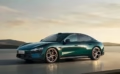
Volkswagen calls its ID. Unyx a coupe-SUV, and Xiaomi’s SU7 is a low-slung electric sedan. On paper they look worlds apart, but they’re actually chasing a similar buyer: someone who wants a fresh, tech-heavy EV that feels like the future. The ID. Unyx suits the practical family person who still wants design flair, while the SU7 is for the hyper-connected driver who lives in Xiaomi’s universe. Both are Chinese-built, both are flirting with right-hand-drive production, and that’s exactly why this matters right now—South Africans keen on premium electric options are suddenly paying attention.
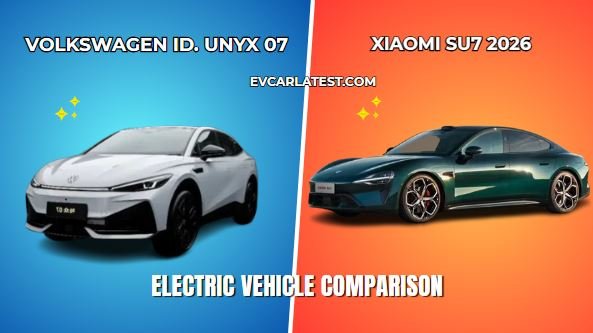
On a full charge, the ID. Unyx promises up to 550 km WLTP from a 77 kWh battery. In the real world, expect something closer to 450 km if you’re mixing highway and city driving. The base Xiaomi SU7 squeezes about 520 km WLTP from a slightly smaller 73.6 kWh pack; real mixed use will land around 430 km. Plug into a DC fast charger and the Volkswagen climbs from 10 to 80% in roughly half an hour at 135 kW. The SU7 has a small edge—150 kW peak charging shaves that down to about 25 minutes. Both sip overnight AC at 11 kW, so home charging is a non-issue.
If these make it to South Africa, expect the ID. Unyx to start around R850,000 (roughly 45,000USD),based on its ¥209,900 tag in China. The SU7 Standard would sit near R870,000 (about 46,000 USD), coming from ¥215,900. Volkswagen offers Pro and Pro S trims, while Xiaomi splits into Standard, Pro, and the dual-motor Max. Both are China-only for now, but a global push is clearly brewing. This guide is for the person on the fence: do you want a flexible crossover you can lean on, or a tech-packed sedan that feels like rolling smart home?
Volkswagen already sells the ID.4 locally, so service and spares won’t be a guessing game. Xiaomi’s car division is brand new—no other model, no local footprint yet. Looking beyond these two, a Tesla Model 3 or BYD Seal offers similar range and tech at a similar price. But this comparison still matters because neither of those splits the story quite like this: practical, dealer-backed crossover versus ecosystem-first sports sedan. You’re choosing between aftercare peace of mind and pure digital immersion.
Volkswagen ID. Unyx pros:
The tall driving position and spacious cabin make daily life with kids and bumpy roads genuinely easier. Access to VW’s existing dealer network takes a lot of the “first EV” anxiety off your shoulders. Its real-world range is competitive enough that weekend trips won’t feel like a charging scavenger hunt.
Cons:
The touchscreen can be laggy and distractingly fussy—something you’ll notice every single drive if you’re used to a smooth phone. Some cabin plastics feel a bit ordinary for the money, which might disappoint buyers expecting premium ambience.
Xiaomi SU7 pros:
HyperOS ties your car, phone, and smart home together so seamlessly it’s almost addictive—getting in feels like logging into your digital life. Even the base version is genuinely fun to throw around, with sharp steering and eager acceleration that flatters the driver. The sleek sedan shape isn’t just for looks; it cuts through air efficiently enough to make that quoted range believable in daily use.
Cons:
No African service support yet means a breakdown or simple repair could turn into a logistical puzzle you didn’t want. The roofline sacrifices back-seat headroom and limits boot practicality—tall friends and big luggage will complain.
Quick verdict:
Go for the Volkswagen ID. Unyx if everyday practicality, ride height, and local backup matter most—it’s the less flashy but more liveable choice. Pick the Xiaomi SU7 if you want a car that feels like a fast, smart personal device and you’re willing to gamble a little on aftersales support. One makes life easy, the other makes it exciting. Your call comes down to whether you need an adaptable tool or a statement piece on wheels.
Related EV Comparisons
- Volkswagen ID. Unyx 07 vs Volkswagen ID.7 2025
- Volkswagen ID.Polo vs Renault 5 E-Tech
- Volkswagen ID.Polo vs Fiat Grande Panda
- Volkswagen ID.Polo vs Citroen e-C3
- Volkswagen ID.Polo vs Hyundai Inster
| |
| Price | $16,000.00 $32,000.00 |
| Our Rating | |
| Brand | VOLKSWAGEN Xiaomi |
| Category | Electric Cars Electric Cars |
MODEL
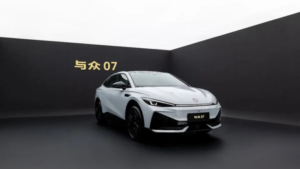
| Full Model Name | Volkswagen ID. Unyx 07 (大众与众07) |
| Generation | 1st generation |
| Segment / Class | Mid-size electric sedan (D-segment) |
| Available Trims / Variants |
Pure; Pure SE
Standard Pro Max (RWD and AWD) |
| Powertrain Options | Single motor RWD (at launch); AWD and larger battery variant confirmed for later 2026 |
| Additional Notes | Second model in the ID. Unyx sub-brand; first Volkswagen model built on the CEA platform co-developed with Xpeng |
LAUNCH
| Reveal Date | October 2025 (MIIT regulatory filing) 2026 (facelift/update) |
| Launch Year | 2026 |
| Availability Status | On sale — China only In production |
| Brand / Manufacturer | Volkswagen Anhui (Volkswagen Group joint venture) |
| Country of origin | China China |
| Assembly Country | China (Hefei, Anhui — Volkswagen Anhui plant) |
| Markets Available | China only |
| Grey Market Import | Possible via parallel import channels |
| Base Price (USD) | ~$16,200 USD (limited-time launch price, Pure trim) / ~$19,100 USD (guide price, Pure trim) $32,800 |
| Additional Notes | Limited-time pricing: Pure RMB 109,900 / Pure SE RMB 119,900. Guide price: Pure RMB 129,900 / Pure SE RMB 139,900. Grey market import to Nigeria estimated at ₦26–32 million landed (Pure), subject to exchange rate and duty |
BATTERY
| Battery Capacity | 60 kWh LFP 73.6 / 96.3 / 101.7 kWh |
| Battery Chemistry |
Lithium Iron Phosphate (LFP)
LFP (base), NMC (higher trims) |
| Battery Architecture | 400V |
| Range (WLTP/CLTC/EPA) | 558 km — CLTC cycle (mi WLTP); ~430–520 mi (est from 700–900 km CLTC) |
| Energy Consumption | 12.3 kWh/100 km |
| Regen Braking (Max kW) | Yes (regenerative braking) |
| Heat Pump | |
| AC Charging (Max kW) | 7–11 kW, ~7–10 hrs (full) |
| DC Charging (Max kW) | up to ~300 kW, ~10–80% in ~20–30 min |
| Cell Brand | Gotion Hi-Tech (per MIIT filing / Wikipedia); CATL cited by some sources — conflicting, unresolved |
| Additional Notes | Larger battery variant confirmed by Volkswagen Anhui for later 2026; full specs not yet disclosed. AC/DC charging figures expected at that time 800V architecture, CTB battery integration |
PERFORMANCE
| Motor Type | Permanent magnet synchronous (PMSM) |
| Motor Configuration | Single rear motor |
| Rear Motor Output (kW / HP) | 170 kW / 228 hp |
| Power Output (kW / hp) | 170 kW / 228 hp 320–691 hp, RWD or dual-motor AWD |
| Torque (Nm) | 400–838 Nm |
| 0–100 km/h / 0-60 mph (seconds) The acceleration numbers are an easy way to compare car performance. We list either time from 0 to 100 km/h or time from 0 to 60mph, depending on which number(s) the manufacturers provide. The lower the acceleration time, the higher performance the car is. |
5.3 sec (base) 2.78 sec (Max) |
| Top Speed (km/h / mph) | 160 km/h 240–265 km/h |
| Transmission / Drive | Single-speed, rear-wheel drive (RWD) Single-speed automatic |
BODY
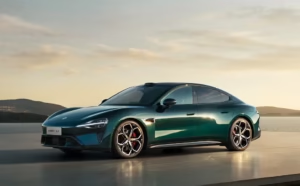
| Body Style | 4-door fastback sedan with integrated hatchback tailgate 4-door sedan, 5 seats |
| Platform / Architecture | CEA (China Electrical Architecture) — co-developed with Xpeng Xiaomi EV platform |
| Dimensions (L×W×H mm) | 4,853 × 1,852 × 1,566 mm 4997 mm length, 1963 mm width, 1460 mm height |
| Drag Coefficient (Cd) | 0.195 |
| Wheelbase (mm) | 2,826 mm 3000 mm |
| Ground Clearance (mm) | 120 mm |
| Kerb Weight (kg) | 2,057 kg 2055 kg |
| Suspension (Front / Rear) | Double wishbone front, multi-link rear |
| Wheel Size (inches) | 19 inches 19–20 inch |
| Parking Brake | Electronic |
| Trunk/Boot Capacity (L) | 517 L |
| Frunk/Bonnet Capacity (L) | Yes |
| Wading Depth (mm) | Not applicable (sedan) |
| Approach / Departure Angle | Not applicable |
| Sunroof | Sectional panoramic sunroof (opens outward to preserve headroom) |
| Additional Notes | Design language: "wind-breaking" — U-shaped front fascia, full-width LED light bar, illuminated gold VW badge, dual waistlines, hidden door handles, flat-top steering wheel Low center of gravity battery layout |
SAFETY
| Airbags (count) | Multiple airbags |
| Anti-lock Braking System (ABS) | Yes |
| Electronic Brakeforce Distribution (EBD) | Yes |
| Electronic Stability Control (ESC) | Yes |
| Traction Control System (TCS) | Yes |
| Driver Assistance (ADAS) | Yes — two tiers offered ADAS, lane assist, adaptive cruise |
| ADAS Features | Highway NOA (Navigate on Autopilot) standard on all trims; 6 HD cameras, 1 millimetre-wave radar, 12 ultrasonic radars. Urban NOA (LiDAR-based) available as an option — deliveries expected end of 2026 |
| Autonomous Driving Level | L2 (highway NOA standard); L2+ (urban NOA with LiDAR option) Advanced driver assist with lidar (higher trims) |
| Autonomous Driving System Name | IQ.Drive (Volkswagen Anhui / CEA platform) |
| Autonomous Driving Hardware | Vision tier: 6 HD cameras, 1 mmWave radar, 12 ultrasonic. LiDAR tier: adds 1 LiDAR unit |
| Over-the-Air (OTA) Safety Updates | Yes (CEA platform supports OTA) |
| Additional Notes | Memory parking and cross-level autonomous parking (up to 2 km) standard across all trims |
COMFORT
| Seating Capacity | 5 5 seats, powered and heated (higher trims) |
| Steering Wheel | Flat-top |
| Roof Type | Sectional panoramic sunroof (standard) Panoramic glass |
| Bluetooth / Wi-Fi | Full Xiaomi ecosystem, OTA updates |
| Parking Aids | Memory parking; 2 km cross-level autonomous parking (standard) 360 camera, sensors |
| Additional Notes | Comfort and trim detail expected to be published alongside larger battery variant reveal Smart cabin, voice control |
DISPLAYS
| Centre Screen (inches) | 15-inch floating touchscreen, 2K resolution Large central touchscreen |
| Driver's Display (inches) | 10-inch digital instrument cluster Digital cluster |
| Head-Up Display (HUD) | 27-inch AR-HUD Available |
| Rear Passenger Screen | 12-inch 2K screen (front passenger side confirmed; rear unconfirmed) |
| Display Resolution | 2K (centre screen and front passenger screen) |
| Operating System | CEA platform-based; |
| Additional Notes | Display layout confirmed via CarNewsChina launch report (May 23, 2026) Xiaomi HyperOS integration |
LIGHTING
| Headlight Type (LED/Matrix/Laser) | LED matrix headlights |
| Daytime Running Lights (DRL) | Full-width LED strip |
| Tail Light Design | Full-width LED bar (carries over from ID. Unyx 06) |
| Additional Notes | Illuminated gold Volkswagen badge at front; gold badging also at rear |
INFOTAINMENT & AUDIO
| Navigation System | Yes (highway NOA implies onboard mapping) |
TECHNOLOGY
| Remote Parking | Yes — cross-level autonomous parking up to 2 km |
| Automatic Parking | Yes — memory parking standard |
| Over-the-Air Map Updates | Yes (CEA platform supports OTA) |
| Additional Notes | CEA platform co-developed with Xpeng brings zonal architecture and central compute; full tech feature list not published at launch |
OWNERSHIP
| Official Dealer Network | Volkswagen Anhui dealer network in China only |
| Spare Parts Availability | China only at present |
Note
| Data Source | CarNewsChina (launch report, May 23 2026); MIIT regulatory filing (Oct 2025); Wikipedia ID. Unyx 07 article; CnEVPost |
| Last Updated | May 23, 2026 |
| Additional Notes | Focus on high efficiency, fast charging, and strong performance balance. |
| Editor's Note | All unconfirmed fields are explicitly marked. Do not populate spec tables on evcarlatest.com from estimated or third-party figures without flagging them as unconfirmed. |
|
Disclaimer Note
Specifications sourced from manufacturer data and may reflect WLTP, CLTC, or EPA test conditions. Import prices in your local are estimates based on grey-market landing costs and exclude duties, clearing fees, and local taxes. Figures are subject to change without notice. Always verify with your local importer before purchase. We can not guarantee that the information on this page is 100% correct