- Electric Vehicles
- Compare Electric Cars
- Lexus TZ vs BMW iX3 2026
Lexus TZ vs BMW iX3 2026
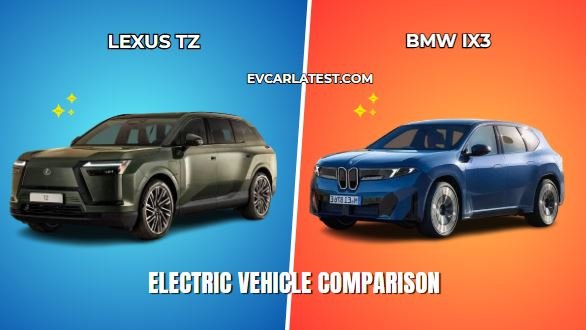
The Lexus TZ is a three-row full-size luxury electric SUV from Toyota’s premium brand, designed for families who need a spacious, quiet cabin without moving into full-size SUV territory. The BMW iX3 2026 is a two-row mid-size luxury electric SUV built on BMW’s new Neue Klasse platform, aimed at tech-driven buyers who want class-leading range and ultra-fast charging in a driver-focused package. Both vehicles are arriving simultaneously — the iX3 begins US deliveries in summer 2026 while the TZ goes on sale before year-end, making this one of the most relevant new-to-new luxury EV comparisons available right now.
Range & Charging
The Lexus TZ delivers up to 300 miles EPA estimated range with its 95.82 kWh battery, with DC fast charging capped at 150 kW and a 10–80% time of roughly 35 minutes. The BMW iX3 is in a different class on both metrics. BMW estimates approximately 400 miles on the EPA cycle, backed by 800V architecture supporting up to 400 kW DC fast charging — enough to complete 10–80% in about 21 minutes. Real-world testing recorded around 360 miles under normal driving conditions. The iX3’s charging speed and range advantage over the TZ is substantial and not a minor gap.
Price, Availability & Market Fit
The Lexus TZ is expected to start around $60,000 USD at end-of-2026 launch — approximately ₦95M–₦110M NGN, KES 7.7M–9M, or ZAR 1.1M–1.3M at grey-market import rates. The BMW iX3 50 xDrive starts at around $60,000 USD for US buyers, with European pricing from €73,925 (~$85,200) — relevant because African grey-market stock typically flows from European channels, pushing the landed cost to roughly ₦130M–₦140M NGN. Neither vehicle has an official African sales channel outside South Africa. This page helps buyers decide whether the iX3’s technical edge justifies a potentially significant import cost premium over the TZ.
Ecosystem & Rival Context
Within Lexus, the two-row RZ 450e (~$52,875) suits buyers who don’t need the extra row. Within BMW, the iX starts at $76,325 for 2026 and gives buyers a larger two-row option at a higher price. Outside both brands, the Mercedes-Benz EQE SUV and Audi Q8 e-tron compete in this price and segment. This TZ vs iX3 comparison wins for buyers specifically weighing Japanese three-row practicality against BMW’s new-generation technology at a similar headline price point.
Pros & Cons
Lexus TZ: Three rows of seating is the clearest differentiator — no version of the iX3 offers this, and it matters for buyers with more than five regular passengers. DIRECT4 AWD is standard across all trims, meaning there is no base-spec penalty on traction. The expected $60,000 US starting price likely translates to lower grey-market import costs than the European-priced iX3. The downside is charging infrastructure fit — 150 kW DC charging is adequate but falls well short of the iX3 when fast stops are needed. Grey-market stock won’t reach African buyers in volume until mid-2027, leaving early adopters with limited parts access.
BMW iX3 2026: 400 miles of estimated EPA range and 21-minute 10–80% charging are the two figures that separate this car from almost everything else in the segment, and both matter directly in markets where charging stops are infrequent or unreliable. The 800V architecture and up to 400 kW charging capability means the iX3 is future-ready for infrastructure improvements as they roll out across Africa. The Neue Klasse platform brings an entirely new interior design with a 17.9-inch touchscreen, which positions it well against older German rivals. European sourcing pushes grey-market landed cost significantly higher than the US sticker price. Two rows cap seating at five, with no workaround.
Quick Verdict
Choose the Lexus TZ if you need three rows, want a lower grey-market import cost, and can accept a slower charging profile. Choose the BMW iX3 if range and charging speed are your priorities and the higher European-sourced import price is manageable. The 100-mile range gap and 14-minute charging difference between them are not minor — for buyers who cover long distances with limited charging access, those numbers matter more than the extra row of seats.
Related EV Comparisons
- Lexus TZ vs Mercedes-Benz EQE SUV
- Lexus TZ vs Genesis GV70
- Lexus TZ vs Tesla Model Y 2025
- Lexus TZ vs Audi Q8 e-tron
- Lexus TZ vs Lexus RZ 2026

| |
| Price | $60,000.00 |
| Our Rating | |
| Brand | LEXUS BMW |
| Category | Electric Cars Electric Cars |
MODEL
| Full Model Name | 2027 Lexus TZ |
| Generation | 1st Generation |
| Segment / Class | Full-size Premium Three-Row Electric SUV |
| Available Trims / Variants |
iX3 40 (RWD, coming late 2026), iX3 50 xDrive (AWD, at launch) |
| Powertrain Options | Dual-motor AWD (standard on all trims) |
| Additional Notes | Lexus' first three-row all-electric SUV; six-seat configuration with second-row captain's chairs |
LAUNCH
| Reveal Date | May 6, 2026 August 2025 (Munich Motor Show) |
| Launch Year | 2027 (US on sale end of 2026) |
| Availability Status | Announced On sale — UK/Europe from Sept 2025; US/Canada from summer 2026 |
| Brand / Manufacturer | Lexus (Toyota Motor Corporation) |
| Country of origin | Japan Germany |
| Markets Available | US (end of 2026); Europe, Japan, China, other markets (early 2027) |
| Base Price (USD) | $60,000 |
BATTERY
| Battery Capacity | 76.96 kWh or 95.82 kWh (gross) 108.4 kWh usable / 113.4 kWh total |
| Battery Chemistry | Lithium-ion NMC cylindrical lithium-ion cells, 800V architecture |
| Thermal Management | Active; includes Battery Preconditioning and Driving Preconditioning |
| Range (WLTP/CLTC/EPA) |
(WLTP): 456–500 miles (EPA): ~400 miles |
| Energy Consumption | 3.7–4.1 miles/kWh (WLTP) |
| Regen Braking (Max kW) | Up to 99% of braking handled via regenerative braking; per-wheel micromanagement via Heart of Joy system |
| Heat Pump | |
| AC Charging (Max kW) | 11 kW standard; 19 kW optional 11 kW onboard charger — 0–100% approx. 11 hours |
| DC Charging (Max kW) | 150 kW Up to 400 kW — 10–80% in 21 minutes; 231 miles added in 10 minutes |
| Charging Time (10–80%) | ~35 minutes |
| Battery Preheating | Yes (Battery Preconditioning confirmed) |
| Additional Notes | US model uses NACS port with Lexus-first 2-in-1 AC+DC combined charging port; CCS1 adapter required for non-NACS DC chargers Bidirectional charging — V2L (mobile powerbank), V2H (home solar storage), V2G (grid feed-in |
PERFORMANCE
| Motor Configuration | Dual-motor AWD (DIRECT4) |
| Front Motor Output (kW / HP) | 167 kW / 224 hp |
| Rear Motor Output (kW / HP) | 167 kW / 224 hp |
| Power Output (kW / hp) |
300 kW / 402 hp
463 hp (345 kW) — dual-motor AWD — Front motor: 123 kW / 255 Nm; Rear motor: 240 kW / 435 Nm |
| Peak Power (kW / hp) | 300 kW / 402 hp |
| Torque (Nm) | 500 Nm (369 lb-ft) 645 Nm (475 lb-ft) |
| 0–100 km/h / 0-60 mph (seconds) The acceleration numbers are an easy way to compare car performance. We list either time from 0 to 100 km/h or time from 0 to 60mph, depending on which number(s) the manufacturers provide. The lower the acceleration time, the higher performance the car is. | 5.4 seconds 0–62 mph in 4.9 seconds |
| Top Speed (km/h / mph) | 130.5 mph (210 km/h) |
| Transmission / Drive | Single-speed; AWD standard Single-speed automatic |
| Rear-Wheel Steering | Yes — Dynamic Rear Steering (DRS), up to 4 degrees; optional on some grades |
| Drive Mode | 5 modes including Rear Comfort mode |
| Torque Vectoring | Yes — DIRECT4 system |
| Simulated Sound | Yes — includes LFA V10 sound simulation |
| Additional Notes | Turning radius 5.24 m (17.2 ft) with DRS active; 5.79 m (19.0 ft) without |
BODY
| Body Style | 5-door SUV, 3-row, 6-seat 5-door, 5-seat electric SUV |
| Platform / Architecture | TNGA (Toyota New Global Architecture), dedicated BEV layout BMW Neue Klasse (NA5) — purpose-built EV architecture |
| Dimensions (L×W×H mm) | 5,100 × 1,989 × 1,704 mm (200.8 × 78.3 × 67.1 in) 4,782 mm L × 1,895 mm W × 1,635 mm H |
| Drag Coefficient (Cd) | 0.27 Cd 0.24 |
| Wheelbase (mm) | 3,050 mm (120.1 in) 2,897 mm |
| Ground Clearance (mm) | 176 mm |
| Kerb Weight (kg) | 2,285 kg curb weight; 2,825 kg max allowable |
| Suspension (Front / Rear) | MacPherson struts / Multi-link Passive steel setup — front and rear; no adaptive dampers or air suspension |
| Wheel Size (inches) | 20-inch (standard) or 22-inch (optional) Standard 20-inch alloys (255/45 R20); 21" and 22" optional |
| Tyre Size | 255/55 R20 or 255/45 R22 |
| Trunk/Boot Capacity (L) | 390 L (13.8 cu ft — behind third row) 520 L standard; 1,750 L with rear seats folded |
| Frunk/Bonnet Capacity (L) | 58 L |
| Towing Capacity (kg) | 1,587 kg (3,500 lbs) 2,000 kg (4,410 lbs) with optional electric fold-in/fold-out tow hitch |
| Turning Circle (m) | 5.24 m (17.2 ft) with DRS |
| Sunroof | Yes — panoramic glass roof with power sunshade |
| Aerodynamics | Flush door handles, aerodynamic mirrors, underbody fins, air dams, optimized wheel covers |
| Additional Notes | Body uses high-rigidity adhesives, laser screw welding, and aluminum components Roof rack compatible; 40/20/40 split rear seats |
SAFETY
| Airbags (count) | standard BMW complement |
| Anti-lock Braking System (ABS) | Yes |
| Electronic Brakeforce Distribution (EBD) | Yes |
| Electronic Stability Control (ESC) | Yes |
| Traction Control System (TCS) | Yes |
| Low-Speed Pedestrian Warning | Yes (low-speed) |
| Tyre Pressure Monitoring (TPMS) | Yes |
| Child Seat Anchors (ISOFIX / LATCH) | Yes (walk-in button on second-row seats to aid access with child seats installed) |
| Reversing Camera | Yes |
| Hill Start Assist | Yes |
| Driver Assistance (ADAS) | Lexus Safety System+ 4.0 (LSS+ 4.0) Active Driving Assistant Plus standard — includes forward collision warning, pedestrian detection, AEB, blind-spot monitoring, stop-and-go adaptive cruise, lane-keep assist, vehicle exit warning |
| ADAS Features | Intersection Turn Assist, Full-Speed Dynamic Radar Cruise Control, Lane Departure Alert with Steering Assist, Lane Change Assist |
| Autonomous Driving Level | Level 2 (advanced ADAS) AI-based automated driving superbrain co-developed with Qualcomm, processes data 20× faster than previous systems; Highway Assist (hands-free) optional |
| Additional Notes | No hands-free highway driving feature confirmed |
COMFORT
| Seating Capacity | 6 (three rows; second-row captain's chairs) Heated front seats standard with electric adjustment; M Sport seats add 10-way adjustment and 7-stage massage |
| Roof Type | Panoramic glass with power sunshade Panoramic sunroof with solar-filtering glass (optional) |
| Ambient Lighting | Yes |
| Bluetooth / Wi-Fi | Wireless Apple CarPlay and Android Auto; wireless phone charging; USB-C ports |
| Parking Aids | Yes Hands-free parking assist (optional); standard rear sensors |
| Additional Notes | Flat-floor architecture; removable rear centre console allows third-row walkthrough access; storage includes front centre console compartment and two-tier rear tray Two-zone climate control standard; three-zone optional with rear touchscreen control; Harman Kardon 13-speaker audio (optional) |
DISPLAYS
| Centre Screen (inches) | ~14 inches (not officially confirmed for TZ; based on shared Highlander EV platform) 17.9-inch touchscreen, 3,340 × 1,440 px, angled 17.5° toward driver; BMW Operating System X (iDrive X) |
| Driver's Display (inches) | Digital instrument cluster BMW Panoramic Vision — projects across the full windshield base (110 cm / 43.3 in), A-pillar to A-pillar; three fixed driver tiles plus six configurable widgets |
| Head-Up Display (HUD) | 3D HUD |
| Mirror Link / Apple CarPlay / Android Auto | Yes — wireless |
| Physical Controls | Limited; climate functions primarily in touchscreen |
| Additional Notes | Widgets draggable from central display to Panoramic Vision; "Hey BMW" voice assistant standard |
LIGHTING
| Headlight Type (LED/Matrix/Laser) | LED (Matrix not confirmed) |
| Daytime Running Lights (DRL) | Yes |
| Tail Light Design | Full-width LED taillights |
INFOTAINMENT & AUDIO
| Navigation System | Yes |
TECHNOLOGY
| Vehicle-to-Load (V2L) | Yes — AC external power supply via rear AC inlet with adapter |
| Remote Climate Control | Yes (departure time preconditioning) |
| Additional Notes | Battery management includes: Driving Preconditioning, Optimal Charging (Auto), Departure Time Preconditioning |
OWNERSHIP
| Official Dealer Network | Lexus dealers (244 in the US) |
| Roadside Assistance | standard Lexus coverage |
Note
| Data Source | Lexus USA Newsroom, Lexus EU Newsroom, Car and Driver, Edmunds, InsideEVs, Destination Charged, HiConsumption, The Car Guide |
| Last Updated | May 2026 |
| Additional Notes | All unconfirmed specs flagged above. Range figure (~300 miles EPA) is Lexus' own estimate, not a certified EPA result. Pricing is industry estimate only. Full specs, trim breakdown, and confirmed pricing expected later in 2026. The iX3 also won the 2026 World Electric Vehicle Award. The iX3 40 (single motor, RWD) is arriving later in 2026 at a lower price. A long-wheelbase China-market variant with 900 km CLTC range is also in production. Some specs and pricing vary by market and trim. |
| Editor's Note | Grey-market availability in Africa is unlikely at launch. African buyers tracking this model should note the 150 kW DC cap and limited public charging infrastructure compatibility outside NACS markets. |

|
Disclaimer Note
Specifications sourced from manufacturer data and may reflect WLTP, CLTC, or EPA test conditions. Import prices in your local are estimates based on grey-market landing costs and exclude duties, clearing fees, and local taxes. Figures are subject to change without notice. Always verify with your local importer before purchase. We can not guarantee that the information on this page is 100% correct