If you only want the short answer: for most homes, a 40–50A Level 2 charger from a proven brand like ChargePoint, Emporia, Tesla, or Grizzl-E is the right call, and whether you go hardwired or plug-in depends on your electrical panel and how much cable-free simplicity you want to pay for. Hardwired units cost more to install but eliminate a failure point (the outlet) and often carry longer warranties. Plug-in units cost less if you already have a NEMA 14-50 outlet, and let you take the charger with you if you move.
That’s the verdict in one paragraph. Below, we break down real specs, real installation costs, the electrical code rule that trips up a lot of buyers, and a side-by-side comparison table so you can match a charger to your car and your panel — not just to a marketing number on the box. Pricing and availability were last verified in July 2026 and may shift as new models launch.
Quick Summary Box
| Takeaway | Detail |
|---|---|
| Best overall | ChargePoint Home Flex — adjustable 16–50A, works with J1772 or NACS, hardwired or plug-in |
| Best plug-in (no electrician) | A 32A NEMA 14-50 unit — delivers roughly 25 miles of range per hour if you already have the outlet |
| Best for Tesla owners | Tesla Wall Connector — tightest integration with Tesla’s ecosystem |
| Best budget pick | Grizzl-E Classic — weatherproof, roughly half the price of premium units |
| Code detail that trips people up | A 48A charger legally needs a 60A circuit, not a 48A or 50A one (see NEC section below) |
Hardwired vs. Plug-In: The Real Difference
What “hardwired” actually means
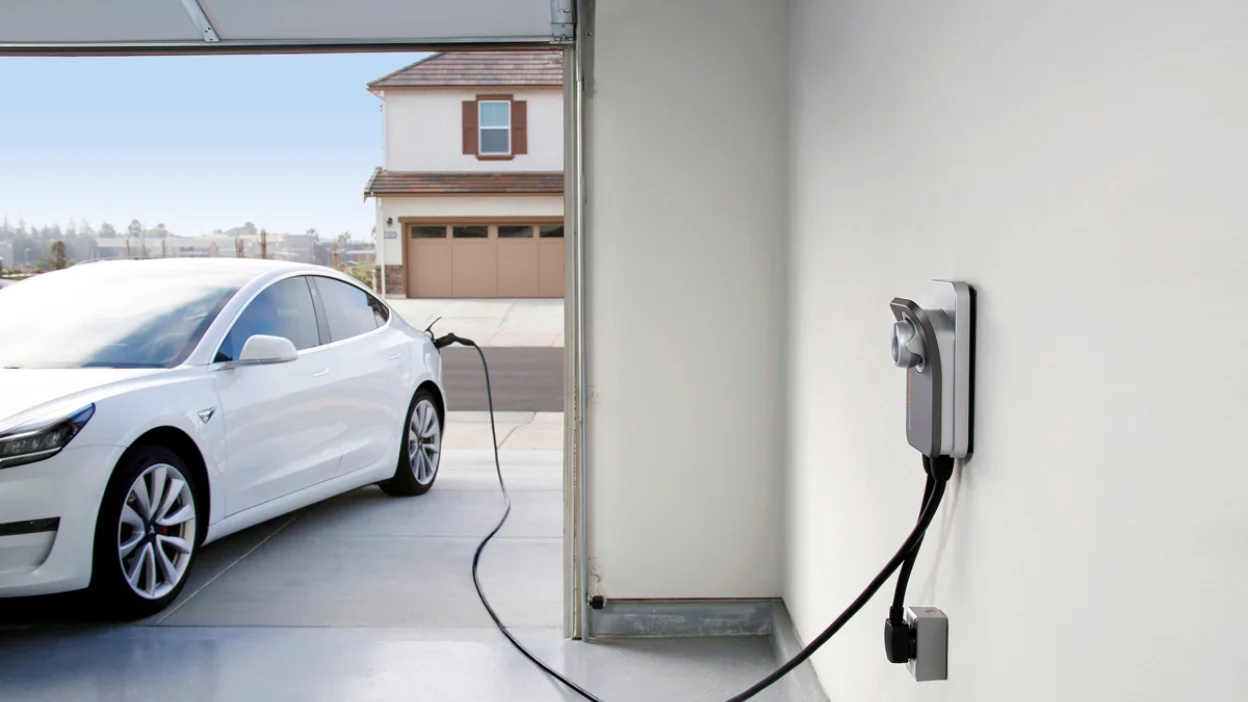
A hardwired charger is wired directly into your electrical panel through a dedicated breaker, with no plug or outlet in between. There’s nothing for a technician to install incorrectly at the connection point, no outlet to loosen or corrode over time, and most manufacturers reserve their longest warranties for hardwired installs. The tradeoff is a mandatory electrician visit, typically adding several hundred dollars to the project.
What “plug-in” actually means
A plug-in charger connects to a NEMA 14-50 or 6-50 outlet — the same style used for RV hookups or electric dryers. If that outlet already exists in your garage, installation cost can drop to zero. If it doesn’t, you’re paying an electrician anyway, which erases most of the plug-in cost advantage. Plug-in chargers also mean one more connection point that can wear out, though quality units address this with thermal sensors that shut the unit down before an overheating connector becomes a hazard.
So which should you pick?
- Already have a 14-50 or 6-50 outlet? Go plug-in. There’s no reason to pay for hardwiring you don’t need.
- No outlet, new install, or you want the cleanest possible setup? Go hardwired. You’re paying an electrician either way, so you may as well get the more failure-resistant configuration.
- Renting, or planning to move soon? Plug-in wins. You can unplug it and take it with you.
The Electrical Code Rule Most Buyers Miss
The National Electrical Code requires continuous loads — and overnight EV charging, which regularly runs more than three hours straight, counts as continuous — to stay at or below 80% of a circuit’s rated capacity. That means a 48A charger needs a circuit rated for at least 60A, not 48A and not 50A. A 50A charger technically needs 62.5A of headroom, which in practice means electricians round up to a 60A or 70A breaker. If a contractor quotes a 50A breaker for a 48A hardwired charger, that’s a code violation worth flagging before the work starts.
Your Car’s Onboard Charger Is the Real Speed Limit
This is the detail most shopping guides skip. The number printed on a charger’s box is a ceiling, not a guarantee. A 48A/11.5kW charger paired with a car whose onboard charger tops out at 7.2kW will only ever deliver 7.2kW — the extra capacity on the EVSE goes unused. Before comparing chargers on kW alone, check your specific vehicle’s onboard AC charging rate. Buying a charger rated well above what your car can accept is money spent on a number you’ll never see.
Cable Length and Garage Layout
Most Level 2 chargers in this category ship with a 23–25 foot cable. That’s generally enough for a single-car garage with the charger mounted near the car’s charge port, but layout still matters — measure from your likely mounting point to where your charge port sits with the car parked normally, not to the nearest wall.
Indoor vs. Outdoor Mounting
If the charger will live outside or in an unheated, exposed garage, prioritize a weather rating of NEMA 4 or IP65 or better. Indoor-rated units are often cheaper but aren’t built for direct rain or extreme temperature swings.
Incentives: Check Before You Buy, Not After
Incentive availability has been shifting through 2026 and varies by country, state, and utility, so confirm current eligibility with your local energy authority or installer before finalizing a purchase — figures quoted in older guides may no longer apply. ⚠️ Incentive programs referenced in older articles should be independently reconfirmed, as several have changed or expired since original publication.
Comparison Table: Top Level 2 Home Chargers, 2026
| Charger | Type | Max Output | Connector | Best For | Notable Feature |
|---|---|---|---|---|---|
| ChargePoint Home Flex | Hardwired or plug-in | 16–50A (~12 kW) | J1772 or NACS | Most buyers | Adjustable amperage, strong app, works with any panel size |
| Tesla Wall Connector | Hardwired | Up to 48A | NACS (Tesla) | Tesla owners | Deepest integration with Tesla’s charging ecosystem |
| Grizzl-E Classic | Plug-in or hardwired | Up to 40A | J1772 | Budget buyers | Weatherproof, roughly half the price of premium units |
| Autel MaxiCharger | Hardwired | Up to 50A (~12 kW) | J1772 or NACS | Fastest home charging | Requires a 60A circuit |
| 32A NEMA 14-50 plug-in unit | Plug-in | 32A (~7.7 kW) | J1772 | No-electrician installs | Zero install cost if outlet exists; ~25 mi range/hour |
Exact pricing varies by region and retailer; confirm current figures before purchase.
Bottom Line: Our Verdict
For most drivers, the ChargePoint Home Flex is the safest recommendation in 2026 — it adjusts to fit almost any panel, works with nearly every EV on the market, and can be installed hardwired or plug-in depending on what your garage already has. If you already own a NEMA 14-50 outlet and want to avoid an electrician entirely, a 32A plug-in unit gets you most of the practical charging speed at a fraction of the cost. Skip the temptation to buy on kW numbers alone — your car’s onboard charger, not the box, decides your real-world charging speed.