The answer used to be simple. Range anxiety was real, charging infrastructure barely existed outside major cities, and PHEVs felt like a sensible hedge — you got the electric torque without betting everything on a plug. That calculus is changing fast in 2026, but not uniformly. Where you live still matters enormously.
If you’re buying in Lagos, Nairobi, or Johannesburg, this decision looks different than it does in London or Los Angeles. Here’s what actually separates these two drivetrains in 2026.
What Is a PHEV, Actually?
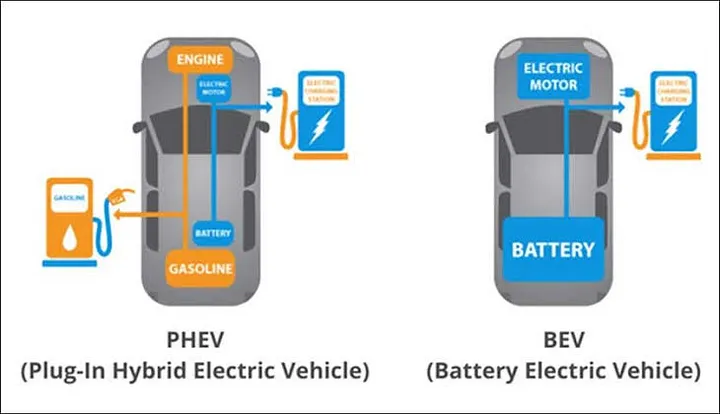
A plug-in hybrid (PHEV) runs on both a combustion engine and an electric motor. You can charge the battery from a wall socket, drive 40–80 km on electricity alone, then switch to petrol when the battery runs out. The Toyota RAV4 Prime, Mitsubishi Outlander PHEV, and BYD Tang are popular examples.
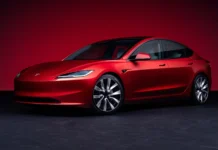
A battery electric vehicle (BEV) runs on electricity only. No fuel tank, no engine, no exhaust pipe. You charge at home, at work, or at a public station. Cars like the BYD Atto 3, Tesla Model 3, and Hyundai Ioniq 6 fall into this category.
Range: Who Actually Wins in 2026?
PHEVs carry a combined range advantage on paper — most cover 600–900 km total when you factor in the petrol engine. That number is real and it matters if you’re doing Abuja–Lagos on a single trip with no reliable fast charger in sight.
Full EVs have come a long way. The BYD Seal offers 570 km WLTP. The Tesla Model 3 Long Range hits 629 km. But those figures are tested under European lab conditions. Real-world range in hot climates — with the AC running — typically drops 15–25%.
Verdict on range: PHEVs still win for long-distance trips in areas with thin charging networks. Full EVs win for daily urban commutes where home charging is possible.
Charging: The Honest Picture
This is where Africa-specific context changes everything.
Most PHEV owners charge at home overnight on a standard socket — no special hardware needed. That works fine. If you forget to charge, you just run on petrol. No drama.
Full EV owners who lack a home charging setup face a real problem. Public DC fast chargers are still sparse across most of West Africa and parts of East Africa. South Africa has better coverage, especially along the N1 and N3 corridors, but it still can’t match Europe or China.
If you live in a house with a garage or a reliable power supply, home EV charging is straightforward and cheap. If you’re in an apartment block in Victoria Island or Westlands Nairobi, depending entirely on public chargers is a daily stress you should think carefully about.
Cost: Purchase Price vs Running Costs
PHEVs are generally cheaper to buy than comparable full EVs. A Mitsubishi Eclipse Cross PHEV grey-market import into Nigeria runs around ₦28–35 million. A BYD Atto 3 sits in the ₦38–48 million range depending on spec and import route.
Running costs flip the equation. Petrol in Nigeria averaged ₦1,100–₦1,400/litre through late 2025. Charging a full EV at home costs a fraction of that per kilometre — provided you have solar backup or stable grid power. PHEVs still burn petrol once the battery depletes, so if you’re doing mostly city driving, you’ll likely use less fuel than a conventional car, but you won’t eliminate the fuel bill.
In South Africa, electricity costs roughly ZAR 3.50–4.00/kWh on standard tariffs. Charging a 60 kWh EV costs around ZAR 210–240 — that’s roughly 400–500 km of range, compared to ZAR 900+ in petrol for the same distance in a traditional car.
Environmental Impact
PHEVs only deliver low emissions if you actually charge them regularly. Studies from Europe found many PHEV owners rarely plug in, running mostly on petrol. The car then carries the weight of a battery pack while delivering no electric benefit — worse in some cases than a regular hybrid.
Full EVs produce zero tailpipe emissions. That said, where your electricity comes from matters. In South Africa, where coal still dominates the grid, a full EV has a lower lifecycle carbon footprint than petrol — but the margin is smaller than in countries with cleaner grids.
Which One Makes Sense for You in 2026?
Buy a PHEV if:
- You regularly drive intercity routes (300 km+) where charging infrastructure is unreliable
- You live in an apartment or rented home with no access to a private charging point
- You want to transition to EV ownership gradually without committing fully
- Your budget is tight and petrol is available near you
Buy a full EV if:
- You have a house with reliable power or solar panels for home charging
- Your daily commute is under 150 km and you rarely do long-distance
- You’re based in South Africa, Kenya, or a Nigerian city with growing charging infrastructure
- You want lower running costs over a 3–5 year ownership period
Quick Verdict
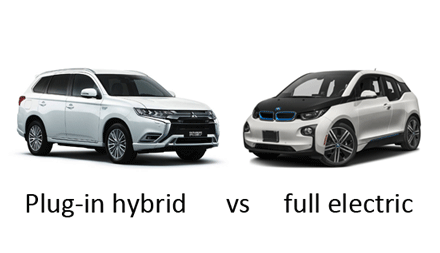
PHEVs are not a stepping stone for people who can’t commit — they’re the right answer for specific situations, particularly in markets where charging infrastructure is still catching up. Full EVs are genuinely ready for daily use in African cities in 2026, provided home charging is available. The technology gap has closed. The infrastructure gap hasn’t.
Frequently Asked Questions
Is a PHEV better than a full electric car in 2026?
It depends on your driving habits and charging access. PHEVs are better for long-distance travel in areas with limited charging. Full EVs are cheaper to run for daily urban driving when home charging is available.
Can I charge a PHEV with a regular plug socket in Nigeria or Kenya?
Yes. Most PHEVs charge from a standard household socket (Type A or Type G). A full charge typically takes 4–6 hours overnight, which works well in most homes.
What is the cheapest full electric car available in Africa in 2026?
The BYD Seagull and BYD Dolphin are among the most affordable full EVs in African markets, with prices starting around $15,000–$20,000 USD depending on import route and country.
Does a PHEV save money on fuel in Nigeria?
It can. If you charge regularly and mostly drive in the city, you can cut fuel costs by 40–60% compared to a regular petrol car. But you still need petrol for longer trips, so savings depend entirely on how often you plug in.
Which is better for the environment — PHEV or full EV?
A full EV produces zero tailpipe emissions. PHEVs only perform well environmentally if the battery is charged regularly. A PHEV that’s rarely plugged in can end up less efficient than a standard hybrid.
Related EV News
- EV Battery Degradation: How Much Range Will You Lose Over Time?
- BYD Cars Nigeria: Prices, Specs, and Where to Buy (2026)
- Best Chinese Electric Cars in 2026: The Complete Buyer’s Guide
- What Is a Solid State Battery and Why It Could Change EVs Forever
- Electric Motorcycle Nigeria: Best Options for Lagos & Abuja (2026)