Electric cars in Nigeria 2026: prices, models, and what buyers need to know
Nigerian EV owners are saving up to ₦850,000 a month on fuel. But is an electric car actually practical in Nigeria today? We break down the real costs, the best models, and the honest challenges.
Why EVs are gaining ground in Nigeria right now
Three forces have converged to make 2026 a turning point for electric vehicles in Nigeria.
Petrol prices have made ICE vehicles unaffordable to run. A typical petrol car in Lagos costs between ₦350 and ₦420 per kilometre in fuel alone. For a driver covering 100 kilometres a day — not unusual in Lagos traffic — that is over ₦1 million a month just in fuel. The pain is acute and impossible to ignore.
Solar inverter systems have become mainstream. The same infrastructure crisis that makes grid power unreliable has pushed millions of Nigerians to install home solar systems. Those systems can charge an EV overnight at a cost of roughly ₦80–₦120 per kilometre — less than a quarter of the petrol equivalent. Nigeria accidentally solved its own EV charging problem.
Policy has finally moved in the right direction. The zero import duty policy on electric vehicles, first announced in 2024 and fully in force in 2026, has brought the cost of imported EVs down significantly. Local assembly — led by Innoson — is also reducing the foreign exchange exposure that historically inflated vehicle prices.
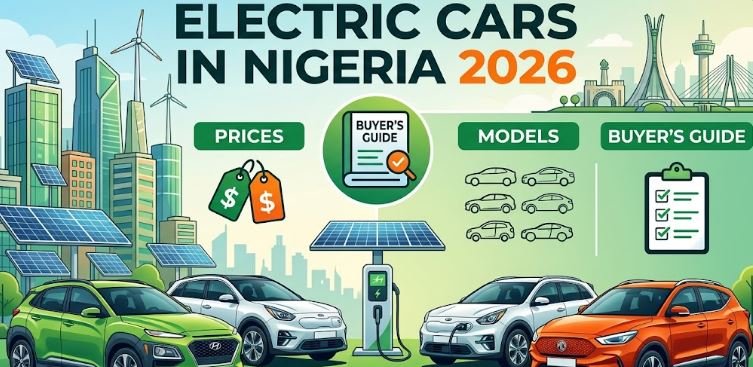
Best electric car models available in Nigeria (2026)
The Nigerian EV market has expanded significantly. Here are the most accessible and recommended models currently available, with honest assessments of each.
| Model | Price (from) | Range | Verdict | Tag |
|---|---|---|---|---|
| Innoson IVM G40E | ₦18,000,000 | 300km | Best for buyers who want local support, parts availability, and no FX risk | Made in Nigeria |
| BYD Atto 3 | ₦28,000,000 | 420km | Best overall: strong range, growing dealer network in Lagos, price sweet spot | Best seller |
| Peugeot e-208 | ₦32,000,000 | 340km | Good for compact city use; Peugeot’s existing Nigeria service network is an advantage | |
| Hyundai Ioniq 5 | ₦45,000,000 | 480km | Best charging speed (ultra-fast compatible); comfortable for inter-city trips | Premium |
| Kia EV6 | ₦48,000,000 | 500km | Longest range available; sporty drive; best for Abuja–Lagos weekend runs | Premium |
For most Nigerian buyers, the BYD Atto 3 represents the best balance of range, price, and support infrastructure. If budget is the primary concern, the Innoson G40E’s ₦18 million entry point — with the benefit of naira-denominated pricing and local after-sales — makes it increasingly compelling.
Real cost of owning an EV in Nigeria
The purchase price is only part of the picture. Here is an honest total cost breakdown for a mid-range EV like the BYD Atto 3 versus a comparable petrol car.
Fuel / charging cost
Servicing
Solar setup cost (one-time)
Battery replacement (long-term)
Insurance
“For a driver covering 100km daily in Lagos, the fuel savings alone from switching to an EV charged by solar amount to over ₦8 million per year — at current petrol prices.”
Charging: what the situation actually looks like
Charging infrastructure is the most common concern for prospective EV buyers in Nigeria — and it deserves an honest answer, not marketing spin.
Home charging (the primary solution)
The vast majority of Nigerian EV owners charge at home using solar inverter systems. A standard 5kW solar setup can fully charge most EVs overnight. If you already have a solar system — as many Lagos and Abuja homeowners do — your marginal charging cost is near zero. If you do not, a capable EV-compatible solar setup costs ₦3M–₦8M.
Public charging stations
Nigeria had fewer than 80 public fast-charging stations as of early 2026, concentrated in Lagos (Lekki, Victoria Island, Ikeja), Abuja (Wuse, Maitama), and Port Harcourt (GRA). Several fuel stations — including some NNPC outlets — have begun retrofitting EV chargers under a federal incentive programme. The network is expanding but still insufficient for long-distance travel without careful planning.
Inter-city travel
Trips like Lagos to Abuja (750km) remain challenging without advance planning. The Ioniq 5 and EV6 can cover 480–500km on a charge, but charging stations along the highway route are sparse. Until the public network matures further — expected by mid-2027 — consider an EV primarily as a city or regional vehicle.
Honest challenges you need to know
No buyer’s guide is complete without the downsides. Here are the real obstacles, stated plainly.
- FX volatility: Imported EVs are priced in foreign currency. A naira depreciation between when you place an order and when it arrives can add millions to the final price. Innoson’s naira-priced models avoid this risk entirely.
- Authorised service centres: Outside Lagos and Abuja, certified EV technicians are almost nonexistent. If you live in Enugu, Kano, or Kaduna, factor in the cost and inconvenience of travelling to a service centre.
- Resale market: Nigeria’s used EV market is still nascent. Resale values are unpredictable and liquidity is low compared to used petrol cars. This matters if you plan to sell within 3–5 years.
- Import timeline: Lead times for imported EVs can run 3–6 months. Prices quoted today may not hold by delivery date given FX movements.
Should you buy an electric car in Nigeria in 2026?
Our verdict
Yes, if you drive heavily in a major city and have solar charging. The financial case is now unambiguous for high-mileage urban drivers. Fuel savings recoup the EV premium within 3–5 years even at current vehicle prices.
Wait 12–18 months if you travel inter-city frequently or live outside a major city. The public charging network and service infrastructure will be meaningfully better by late 2027, and prices may soften as local assembly scales up.
Frequently asked questions about electric cars in Nigeria
- Electric Car Price in Nigeria: Complete 2026 Guide
- Nigeria’s EV Revolution Is Here: How Africa’s Largest Economy Is Racing to Lead the Electric Vehicle Market
- LG Energy Solution Posts $138M Q1 2026 Loss as EV Demand Slows — Worse Than Expected
- Rivian R2 EPA Ratings Leaked: 335-Mile Range, 144 MPGe — and It Beats the Tesla Model Y
- EV Adoption in Africa 2026: The Complete Data Guide