

- Electric Vehicles
- Compare Electric Cars
- GAC Aion V vs GAC Aion i60 2026
GAC Aion V vs GAC Aion i60 2026
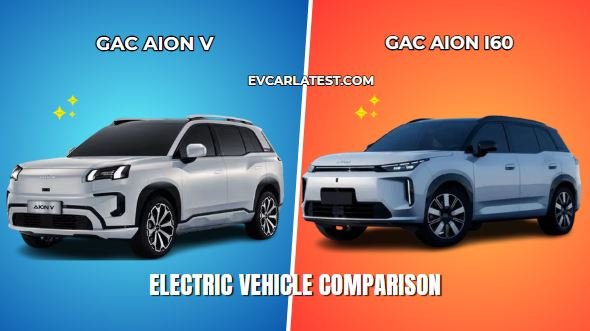
Both the Aion V and Aion i60 are electric SUVs built by GAC Aion, China’s state-backed EV arm. The Aion V is a mid-size, RAV4-footprint SUV aimed at buyers who want a family-capable EV with a proven platform and competitive range. The Aion i60 is a slightly larger, newer model targeting urban families and commuters who want maximum flexibility — including a range-extended (EREV) powertrain option alongside its BEV variants. With the i60 now available in both pure electric and hybrid-electric form and the Aion V expanding into new export markets, this comparison helps buyers choose between two SUVs from the same brand that are no longer playing the same game.
Range & Charging
The Aion V carries a 75.26 kWh LFP battery with a WLTP-rated range of 510 km — a figure measured under standardised European test conditions. Real-world range under mixed driving is closer to 380–420 km. DC fast charging tops out at around 80 kW, putting a 10–80% session at roughly 45–55 minutes. AC onboard charging runs at 7 kW. The Aion i60 BEV (top 62.2 kWh variant) claims 400 km on the CLTC cycle — note this is a Chinese test standard that runs more optimistic than WLTP, so real-world range is closer to 305–320 km. The EREV version (29.165 kWh battery + 1.5L range extender) offers 210 km pure EV range and 1,240 km combined. The i60’s 3C DC fast charging brings it from 30–80% in under 20 minutes — meaningfully faster than the Aion V.
Price, Availability & Market Fit
The Aion V starts at AUD $42,590 (approximately ₦72 million at grey-market import estimate) in the Australian market, sold in Premium and Luxury trims. It is currently confirmed for Australia, parts of Southeast Asia, and select African grey-market channels. The Aion i60 carries a Chinese retail price between ¥109,800 and ¥135,800 RMB (approximately ₦21–26 million at current parallel rates), making it substantially more accessible if direct-import channels open. The Aion V is the choice if you need a tested, near-market platform with a confirmed service network. The i60 is for buyers willing to navigate grey-market sourcing in exchange for lower entry cost and the EREV option that eliminates range anxiety on Nigerian roads. CarExpertPortauto
Ecosystem & Rival Context
Within GAC Aion’s lineup, the Aion LX sits above both as a larger luxury SUV, while the Aion Y targets the budget end. Outside GAC, the BYD Atto 3 competes directly with the Aion V on range and pricing, while the BYD Song Pro PHEV rivals the i60 EREV on flexibility. The Aion V beats the Atto 3 on WLTP range; the i60 EREV beats the Song Pro on charging speed. Neither outside rival offers both advantages in one package the way this comparison does.
Pros & Cons
The Aion V’s 510 km WLTP range means fewer charging stops for intercity trips, which matters on routes like Lagos–Abuja where reliable fast chargers remain sparse. Its LFP battery chemistry reduces long-term degradation risk, important for resale value in emerging markets. The confirmed 5-star ANCAP rating gives buyers objective safety assurance that most rivals cannot match at this price. However, the Aion V’s DC charging ceiling means long-distance charging sessions run longer than necessary given the competition. It also carries a significantly higher import price, narrowing its buyer pool in African markets.
The Aion i60’s 3C fast charging is its clearest advantage — a sub-20-minute top-up from 30–80% removes a major pain point for daily urban users. The EREV variant is particularly relevant for Nigerian buyers: 210 km of pure EV range covers most weekly city driving, and the 1,240 km combined range handles any trip without infrastructure dependency. The starting price also undercuts the Aion V considerably at grey-market import levels. The downside: i60 range figures use CLTC, not WLTP, so real-world performance will disappoint buyers who take the headline number literally. Direct market availability outside China also remains limited and unconfirmed for most African markets as of mid-2026.
Quick Verdict
Choose the Aion V if WLTP-rated range and a confirmed export market footprint matter more than upfront cost. Choose the Aion i60 if you want faster charging, a lower price point, or the EREV powertrain as a hedge against Nigeria’s charging infrastructure gaps. Both come from the same manufacturer, so brand trust is a wash — the decision comes down to budget, powertrain preference, and how much grey-market import risk you’re willing to absorb.

| |
| Price | $27,000.00 $15,500.00 |
| Our Rating | |
| Brand | GAC GAC |
| Category | Electric Cars Electric Cars |
MODEL
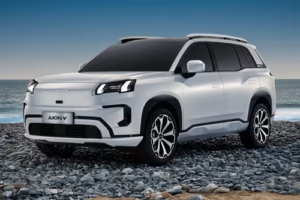
| Full Model Name | GAC Aion V |
| Generation | 2nd Generation |
| Segment / Class | Mid-size Electric SUV |
| Available Trims / Variants |
Premium, Luxury (Australia / most markets); Elite, Premium (Philippines)
GAC Aion i60 2026 BEV GAC Aion i60 2026 EREV |
| Powertrain Options | Single motor, FWD only — no AWD option available |
| Additional Notes | Shares AEP 3.0 platform with the Toyota bZ3X via GAC–Toyota joint venture |
LAUNCH
| Reveal Date | 2023 (China debut); refreshed for 2nd gen international launch 2025 2025 |
| Launch Year | 2025–2026 (market-dependent) |
| Availability Status | On sale On sale |
| Brand / Manufacturer | GAC Aion (Guangzhou Automobile Group) |
| Country of origin | China China |
| Assembly Country | China (Guangzhou) |
| Markets Available | China, Australia, New Zealand, UAE, Indonesia, Philippines, Pakistan; select other Asian and Middle Eastern markets |
| Grey Market Import | Possible |
| Base Price (USD) | ~AUD $42,590 (~USD $27,500) for Premium; ~AUD $44,590 (~USD $28,800) for Luxury — Australia launch pricing. From $15,500 |
| Additional Notes | Pakistan launch handled by Lucky Motor Corporation (LMC) with a 64.5kWh/435km WLTP variant — different spec to the 75.3kWh international version |
BATTERY
| Battery Capacity |
75.3kWh
29.2 kWh 62.3 kWh 75 kWh |
| Battery Chemistry |
Lithium Iron Phosphate (LFP)
LFP battery Aion Tank Battery 2.0 |
| Battery Architecture | 400V |
| Thermal Management | Liquid cooling |
| Range (WLTP/CLTC/EPA) | 510km WLTP (317 miles per Top Gear UK test) Around 190 to 310 miles depending on battery |
| Energy Consumption | 16.7kWh/100km (WLTP claimed); real-world ~16.1kWh/100km urban; up to ~25kWh/100km highway/cold |
| Regen Braking (Max kW) | Regenerative braking system |
| Heat Pump | |
| AC Charging (Max kW) |
11kW onboard
Up to 11 kW Around 7 to 8 hours |
| DC Charging (Max kW) |
180kW peak
Up to 3C fast charging 30 to 80 percent in about 15 to 18 minutes |
| Charging Time (10–80%) | ~24 minutes (DC, 180kW); full charge from wallbox ~8.5 hours |
| Battery Warranty | 8 years / 200,000km (Australia) — vehicle warranty listed separately as 48 months / 150,000km by some sources; verify with local importer |
| Additional Notes | EREV version offers combined range over 700 miles CLTC |
PERFORMANCE
| Motor Type | Permanent Magnet Synchronous Motor (PMSM) |
| Motor Configuration | Single front motor (FWD) |
| Front Motor Output (kW / HP) | 150kW / 201hp |
| Rear Motor Output (kW / HP) | N/A |
| Power Output (kW / hp) |
150kW / 201hp
Up to 221 hp Front wheel drive |
| Torque (Nm) | 210Nm 240 Nm |
| 0–100 km/h / 0-60 mph (seconds) The acceleration numbers are an easy way to compare car performance. We list either time from 0 to 100 km/h or time from 0 to 60mph, depending on which number(s) the manufacturers provide. The lower the acceleration time, the higher performance the car is. | Over 8 seconds 0 to 62 mph in about 7.8 seconds |
| Top Speed (km/h / mph) | ~160km/h Up to 180 km/h |
| Transmission / Drive | Single-speed automatic / FWD Single speed reduction gear |
| Rear-Wheel Steering | No |
| Torque Vectoring | No |
BODY
| Body Style | 5-door SUV 5 door compact SUV 5 seats |
| Body Colour Options | multiple colours available in Australia at launch |
| Platform / Architecture | GAC Architecture Electric Platform 3.0 (AEP 3.0) AEP electric platform |
| Dimensions (L×W×H mm) |
4,605 × 1,854 × 1,686 mm
Length 4685 mm Width 1854 mm Height 1660 mm |
| Wheelbase (mm) | 2,775mm 2775 mm |
| Ground Clearance (mm) | 171mm |
| Kerb Weight (kg) | 1,780kg Around 1630 to 1750 kg |
| Suspension (Front / Rear) |
MacPherson front Multi-link rear |
| Wheel Size (inches) |
19 inches
18 inch 19 inch optional |
| Tyre Size | 225/45 R19 |
| Parking Brake | Electric |
| Trunk/Boot Capacity (L) |
427L (seats up) / 978L (rear seats folded)
About 416 L Up to about 967 L with seats folded |
| Roof Load (kg) | 75kg |
| Towing Capacity (kg) | Not rated for towing |
| Sunroof | Panoramic sunroof (both Premium and Luxury in Australia) |
| Additional Notes | Flush door handles |
SAFETY
| Airbags (count) |
7 — dual front, front side, front centre, side curtain (front and rear)
Front Side Curtain airbags |
| Anti-lock Braking System (ABS) | Yes |
| Electronic Brakeforce Distribution (EBD) | Yes |
| Electronic Stability Control (ESC) | Yes |
| Traction Control System (TCS) | Yes |
| Low-Speed Pedestrian Warning | Yes |
| Tyre Pressure Monitoring (TPMS) | Yes |
| Child Seat Anchors (ISOFIX / LATCH) | Yes — rear outboard seats; top tether points behind all three rear seats |
| 360° Camera / Surround View | Yes (surround-view camera system, standard) |
| Reversing Camera | Yes |
| Hill Start Assist | Yes |
| Driver Assistance (ADAS) |
Adaptive cruise control Lane keeping assist Automatic emergency braking |
| ADAS Features | AEB (car-to-car, vulnerable road user, junction, crossing), adaptive cruise control, lane keep assist (LKA), lane departure warning (LDW), emergency lane keeping (ELK), blind spot monitoring, rear cross-traffic alert with braking, traffic sign recognition, driver and occupant monitoring, child presence detection, front and rear parking sensors |
| Autonomous Driving Level | Level 2 ADAS Level 2 driver assistance |
| Crash Test Ratings | 5-star Euro NCAP (2025); 5-star ANCAP (2025, covers all variants built from September 2025) |
COMFORT
| Seating Capacity |
5
Five seats Adjustable rear seatback |
| Seat Material | Fabric (Premium); Genuine leather (Luxury) |
| Driver Seat Adjustment | Power (multi-way) |
| Passenger Seat Adjustment | Power |
| Seat Heating | Yes (front, both trims) |
| Seat Ventilation | Yes (front, both trims) |
| Massage Function | Yes (front seats, Luxury trim) |
| Climate Control | Dual-zone |
| PM2.5 Filtration | Standard on Luxury; uprated particulate sensor on Luxury HVAC |
| Steering Wheel | Adjustable (rake and reach — confirm reach adjustment, some reviews note rake-only on related model) |
| Roof Type | Panoramic sunroof with powered blind (Luxury) Panoramic glass roof optional |
| Ambient Lighting | Yes |
| Interior Rear-View Mirror | Auto-dimming (Luxury) |
| Noise Insulation | Above average for segment per multiple reviews |
| Bluetooth / Wi-Fi |
Yes
Bluetooth Navigation OTA updates |
| Wireless Charging | Yes (Luxury) |
| Parking Aids |
Front and rear sensors + 360° surround view
Rear camera standard 360 degree camera optional |
| Additional Notes | Luxury adds second-row tray tables and a 6.6-litre built-in centre console refrigerator Ambient interior lighting |
DISPLAYS
| Centre Screen (inches) | 14.6 inches 14.6 inch touchscreen |
| Driver's Display (inches) | 8.88 inches 10.25 inch digital cluster |
| Rear Passenger Screen | No |
| Mirror Link / Apple CarPlay / Android Auto | Yes — wireless |
| Physical Controls | Limited — heavily screen-centric; steering wheel rollers for key functions |
| Voice Control | Yes |
| Additional Notes | Screen-heavy control layout is a noted criticism across most reviews; no AM radio, FM and DAB only Wireless phone charging on selected trims |
LIGHTING
| Headlight Type (LED/Matrix/Laser) | LED |
| Daytime Running Lights (DRL) | Yes |
| Adaptive Headlights | Yes (intelligent high beam standard) |
| Tail Light Design | LED |
| Interior Ambient Lighting | Yes |
INFOTAINMENT & AUDIO
| Sound System Brand | 9-speaker system |
| Streaming Services | Yes (online functionality confirmed) |
| AM/FM/DAB Radio | FM and DAB only — no AM |
| Navigation System | Yes (online maps) |
TECHNOLOGY
| Keyless Entry / Start | Yes |
| Vehicle-to-Load (V2L) | Yes — standard |
OWNERSHIP
| Official Dealer Network | Australia, New Zealand, UAE, Indonesia, Philippines, Pakistan — none in Africa |
| Service Interval | 12 months or 15,000km (Australia) |
| Spare Parts Availability | Limited to nil in African markets — grey market risk |
Note
| Data Source | CarExpert AU, CarsGuide AU, The Beep AU, NRMA, Chasing Cars, Top Gear UK, ANCAP, PakWheels, EV Database, ZigWheels UAE |
| Last Updated | June 2026 |
| Additional Notes |
Specs vary by trim and powertrain Data reflects China market versions only |
| Editor's Note | Usable battery capacity, suspension type, drag coefficient, and several technology features (HUD, heat pump, OTA, digital key) are not confirmed in any published press material — mark as TBC in your spec attribute framework and update when GAC releases official technical documentation for any African market entry |

|
Disclaimer Note
Specifications sourced from manufacturer data and may reflect WLTP, CLTC, or EPA test conditions. Import prices in your local are estimates based on grey-market landing costs and exclude duties, clearing fees, and local taxes. Figures are subject to change without notice. Always verify with your local importer before purchase. We can not guarantee that the information on this page is 100% correct