1. Home
  2. Electric Vehicles
  3. Compare
  4. Hongqi Tiangong 06 vs Hyundai Ioniq 5

Hongqi Tiangong 06 vs Hyundai Ioniq 5

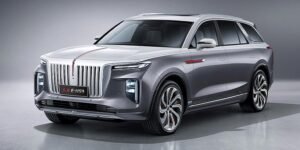
The Hongqi Tiangong 06 is a five-door midsize electric SUV from China’s state-owned luxury brand Hongqi, a subsidiary of FAW Group. Built for buyers who want premium interior quality and strong performance without a premium price tag, it targets tech-forward families and value-conscious professionals. The Tiangong 06 was first shown at the 2025 Auto Shanghai and currently sells only in China, making it a grey-market import prospect for African buyers. The Hyundai Ioniq 5 is a Korean-built electric crossover with an established global footprint and official dealer presence across South Africa, Kenya, and select African markets — ideal for buyers who need after-sales support. Hongqi’s launch of an 800V fast-charging version of the Tiangong 06 makes this comparison timely: the Chinese SUV now directly challenges the Ioniq 5 on one of its defining strengths.

Hongqi Tiangong 06 vs Hyundai Ioniq 5

The Tiangong 06‘s updated 800V version is rated at up to 610 km under the CLTC cycle — real-world WLTP equivalent is approximately 450–480 km. It can recharge from 10% to 80% in just 12 minutes using an 800V fast charger. The Ioniq 5, sold in Africa with its Long Range battery, offers up to 481 km of WLTP-rated range in rear-wheel-drive configuration. On a DC fast charger, the Ioniq 5 can go from 10% to 80% in approximately 20 minutes at a peak rate of 257 kW. Both are 800V vehicles, but the Tiangong 06’s 12-minute charge window gives it a clear edge for long-distance African driving where charger stops may be infrequent.

The Tiangong 06’s 800V variants start at 191,800 yuan, approximately $26,700 — roughly ₦43.5M NGN, KES 3.5M, or ZAR 490,000 before import duties and shipping. Grey-market buyers should budget an additional 20–35% for landing costs. The Ioniq 5 starts at around $44,000 in international markets, landing at approximately ₦71M NGN or ZAR 820,000 through official channels in South Africa and Kenya. If you are choosing between a brand-new Ioniq 5 through a dealer or a grey-import Tiangong 06, this page helps you weigh warranty and support certainty against significant upfront savings.

Hongqi’s broader EV lineup includes the Tiangong 05 sedan, which starts at around $22,050, offering a lower-cost entry point in the same family. Hyundai’s electric range includes the Kona Electric for budget-conscious buyers and the larger Ioniq 9 for families needing three rows. Buyers should also consider the BYD Seal U (available through growing African dealer networks) and the MG Marvel R, both of which sit in a similar price-to-spec band. The Tiangong 06 vs Ioniq 5 comparison still wins over those alternatives because it directly pits a proven global EV against a high-spec Chinese challenger at a dramatically different price point.

Hongqi Tiangong 06: Its 12-minute 10–80% charge time is one of the fastest available in this segment, which matters enormously on routes with sparse charging infrastructure. The starting price undercuts the Ioniq 5 by over $15,000, freeing up significant budget for a home charger or import duties. The 100 kWh battery, AR head-up display, 15.6-inch touchscreen, and massage seats deliver luxury-tier value well below the usual price. On the downside, grey-market import means no local warranty or official spare parts network — a serious risk outside major Nigerian or Kenyan cities. Brand recognition in Africa is near zero, making resale difficult.

Hyundai Ioniq 5: Official dealer availability in South Africa and Kenya means warranty coverage, certified technicians, and genuine parts — critical for fleet and professional buyers. Its global award-winning platform and wide charging compatibility (including CCS standard) make it the safer long-term ownership bet. Real-world range of 380–420 km is well-matched to most African intercity routes. However, the higher purchase price places it out of reach for many private buyers without financing. Cargo space is more limited than similarly sized Chinese rivals at this price.

Quick Verdict

Choose the Hongqi Tiangong 06 if extreme charging speed and maximum spec-per-dollar are your priorities and you are comfortable sourcing an import through a trusted grey-market agent. Choose the Hyundai Ioniq 5 if after-sales support, dealer accessibility, and resale value matter more — it remains the safer ownership choice for most African buyers today. The gap in price is real, but so is the gap in infrastructure support.

FAQ

Is the Hongqi Tiangong 06 better than the Hyundai Ioniq 5 for long trips?

On paper, yes. The Tiangong 06’s faster 12-minute 10–80% charge time makes long-distance stops quicker than the Ioniq 5’s 20-minute equivalent. However, the Ioniq 5’s wider charger network compatibility and official dealer support across African markets make it more practical for intercity travel where roadside assistance matters.

Which is cheaper to maintain, the Tiangong 06 or the Ioniq 5?

The Ioniq 5 wins here. Official Hyundai service centres in South Africa and Kenya offer standardised servicing, genuine parts, and warranty coverage. The Tiangong 06, as a grey-market import, has no official service network in Africa, meaning parts and repairs depend entirely on private importers — which can be costlier and slower.

Is the Hyundai Ioniq 5 available in Nigeria?

The Ioniq 5 is not officially sold in Nigeria through a Hyundai dealership as of 2025. It can be imported privately through grey-market channels, most commonly from the UAE or UK. South Africa and Kenya are the primary African markets with official Hyundai EV dealer support.

Can the Hongqi Tiangong 06 be imported into Africa?

Yes, through grey-market importers, primarily from China. Several Nigerian and Kenyan EV import agents have begun sourcing Hongqi models, though the Tiangong 06 is still rare. Import costs, port fees, and customs duties will significantly add to the base price, so buyers should factor in the full landed cost before comparing it directly to locally available models.

Related EV Comparisons

 
  Hongqi Tiangong 06 Hyundai Ioniq 5
Price $26,000.00 $44,000.00
Our Rating 5.5 6.2
Brand Hongqi Hyundai
Category Cars Cars

MODEL

Models 400V (RWD & AWD) and 800V (RWD & AWD); 2026 update applies to 800V series Hyundai Ioniq 5 63kWh RWD
Hyundai Ioniq 5 84kWh RWD
Hyundai Ioniq 5 84kWh AWD

LAUNCH

Announced Pre-sale opened March 2025
800V trims launched April 2026
2024, March 04
Status On sale — China market only Available to order. Released 2024, July
Country of origin China South Korea
Base Price ~$26,700 (191,800 yuan) — 800V entry trim € 44,000 £ 40,000 - Hyundai Ioniq 5 63kWh RWD
€ 51,700 £ 43,400 - Hyundai Ioniq 5 84kWh RWD
€ 59,400 £ 50,900 - Hyundai Ioniq 5 84kWh AWD

PERFORMANCE

Power 400V RWD: 282 hp (210 kW)
400V AWD: 553 hp (412 kW)
800V RWD: 402 hp (300 kW)
800V AWD: ~643 hp (480 kW)
RWD 170 hp (125 kW) - Hyundai Ioniq 5 63kWh RWD
RWD 228 hp (168 kW) - Hyundai Ioniq 5 84kWh RWD
AWD 325 hp (239 kW) - Hyundai Ioniq 5 84kWh AWD
Torque 400V RWD: 317 Nm
400V AWD: 623 Nm
800V RWD: 450 Nm
800V AWD: 770 Nm
350 Nm (258 lb-ft) - Hyundai Ioniq 5 63kWh RWD
350 Nm (258 lb-ft) - Hyundai Ioniq 5 84kWh RWD
605 Nm (446 lb-ft) - Hyundai Ioniq 5 84kWh AWD
Acceleration The acceleration numbers are an easy way to compare car performance. We list either time from 0 to 100 km/h or time from 0 to 60mph, depending on which number(s) the manufacturers provide. The lower the acceleration time, the higher performance the car is. 5 sec (AWD) 8.5 sec 0-62 mph - Hyundai Ioniq 5 63kWh RWD
7.5 sec 0-62 mph - Hyundai Ioniq 5 84kWh RWD
5.3 sec 0-62 mph - Hyundai Ioniq 5 84kWh AWD
Max Speed 230 km/h / 143 mph 115 mph (185 km/h)
transmission Single-speed direct drive Single-speed

BATTERY

Capacity 62 kWh or 85 kWh (400V trims)
98 kWh (800V trims)
63 kWh total - Hyundai Ioniq 5 63kWh RWD
84 kWh total - Hyundai Ioniq 5 84kWh RWD
84 kWh total - Hyundai Ioniq 5 84kWh AWD
Tech LFP — 400V trims
Ternary lithium (NMC) — 800V trims
Liquid-cooled Li-Po (800V type)
Range 520–610 km depending on trim (800V: up to 610 km CLTC)
370–380 mi / ~595–610 km — WLTP
273 mi WLTP (240 mi EPA) - Hyundai Ioniq 5 63kWh RWD
320 mi WLTP (310 mi EPA) - Hyundai Ioniq 5 84kWh RWD
308 mi WLTP (280 mi EPA) - Hyundai Ioniq 5 84kWh AWD
Consumption 251 Wh/mi WLTP - Hyundai Ioniq 5 63kWh RWD
277 Wh/mi WLTP - Hyundai Ioniq 5 84kWh RWD
293 Wh/mi WLTP - Hyundai Ioniq 5 84kWh AWD
Recuperation 4 levels, with steering wheel paddles
Heat Pump
AC Charging Type 2 11 kW
DC Charging 800V: 10%–80% in 12 minutes CCS 180 kW, 10-80% in 18 min - Hyundai Ioniq 5 63kWh RWD
CCS 235 kW, 10-80% in 18 min - Hyundai Ioniq 5 84kWh RWD
CCS 235 kW, 10-80% in 18 min - Hyundai Ioniq 5 84kWh AWD
Others V2L (vehicle-to-load) external discharge at 6 kW Vehicle to load (V2L)
230V electrical outlet (3.6 KW max)

BODY

Type 5-door midsize SUV, 5 seats 5 door crossover, 5 seats
Platform Hongqi Tiangong Architecture (400V or 800V variant) E-GMP
Dimensions 4,750 mm (L) × 1,900 mm (W) × 1,640 mm (H) 4655 x 1890 x 1605 mm (183.3 x 74.4 x 63.2 in)
Drag Co-Efficient 0.259 Cd 0.288 Cd
Wheelbase 2,900 mm 3000 mm (118.1 in)
Clearance 160 mm (6.3 in)
Weight EU: 1965 kg unladen, 2470 kg gross - Hyundai Ioniq 5 63kWh RWD
EU: 2070 kg unladen, 2590 kg gross - Hyundai Ioniq 5 84kWh RWD
EU: 2175 kg unladen, 2685 kg gross - Hyundai Ioniq 5 84kWh AWD
Suspension Front MacPherson struts, rear multi-link
Wheels 19-inch or 20-inch alloy; 235/55 R19 or 235/50 R20 R19, R20
Trunk/Boot 472 L standard / 1,611 L seats folded EU: 527 l, 1587 l max
Frunk/Bonnet 57 l
57 l
24 l
Towing EU: 750 kg unbraked, 750 kg braked - Hyundai Ioniq 5 63kWh RWD
EU: 750 kg unbraked, 1600 kg braked - Hyundai Ioniq 5 84kWh RWD
EU: 750 kg unbraked, 1600 kg braked - Hyundai Ioniq 5 84kWh AWD
Others Hidden door handles; double-layer acoustic laminated glass (front) Battery thermal pre-conditioning
Smart Frequency Dampers
Digital Centre Mirror
Digital Side Mirrors

DISPLAYS

Centre 15.6-inch 2.5K floating touchscreen 12.3" touchscreen
Driver's Display 12.3"
Head-Up AR-HUD (standard) Yes, projector type
Others Lingxi smart cockpit OS with AI voice assistant; multi-zone voice recognition

COMFORT

Seats Zero-gravity passenger seat; heated, ventilated, and massage seats (higher trims) Heated and ventilated front seats, heated rear seats
Roof Panoramic glass roof, solar roof
Parking Aids Auto parking; multi-level memory parking; trace reverse parking Front and rear sensors, 360 camera, front and reversing camera, Remote Smart Parking Assist 2
Connectivity Bluetooth, Wi-Fi (assumed); Lingxi cockpit with AI voice Wireless Android Auto and Apple CarPlay
Others 14-speaker Dynaudio system (higher trims)
Warm ambient lighting; large bed/flat mode; 5 interior colour options

SAFETY

Airbags 8 airbags: side, front and rear, including head airbag system
Driving Aids Hongqi Sinan system (camera-only); highway NOA; urban NOA; L2.9 ADAS rating Front and corner radars, cameras. Forward/Side/Reverse Parking Collision-Avoidance Assist, Autonomous Emergency Braking with Pedestrian and Cyclist Recognition, Blind Spot Collision-Avoidance Assist, Rear Cross-Traffic Collision-Avoidance Assist, Lane Keeping Assist 2, Safe Exit Assist, High Beam Assist, Intelligent Speed Limit Assist, Driver Attention Warning, Hands-On Detection
Self Driving L2.9 (advanced driver assistance, not autonomous)

Note

Others Solid-state battery prototype has been installed in a Tiangong 06 test vehicle; production version targeting 2027, not confirmed for this model.
CLTC figures are China-specific and typically read 15–20% higher than real-world range.
The 800V/900V trims are the same architecture referenced under different names across sources — the 2026 launch specifically used the 800V designation.
No confirmed export markets as of April 2026.
disclaimer We can not guarantee that the information on this page is 100% correct
  Hongqi Tiangong 06 Hyundai Ioniq 5

Disclaimer Note

We can not guarantee that the information on this page is 100% correct

Filter Electric Vehicles