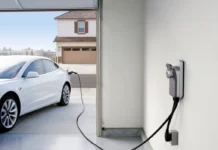
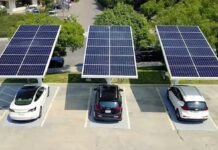
Installing a home EV charger typically costs between $200 and $2,500 total, depending on charger type, wiring distance, and whether your electrical panel needs an upgrade. A basic Level 1 charger needs no installation cost since it plugs into a standard outlet, while a hardwired Level 2 charger — the most common home setup — usually runs $1,200 to $2,500 including equipment and licensed electrician labor. Panel upgrades, when required, can add $800 to $3,000 on top of that. Below, we break down exact pricing by charger type, the factors that push costs up or down, and how to estimate your total before requesting quotes.
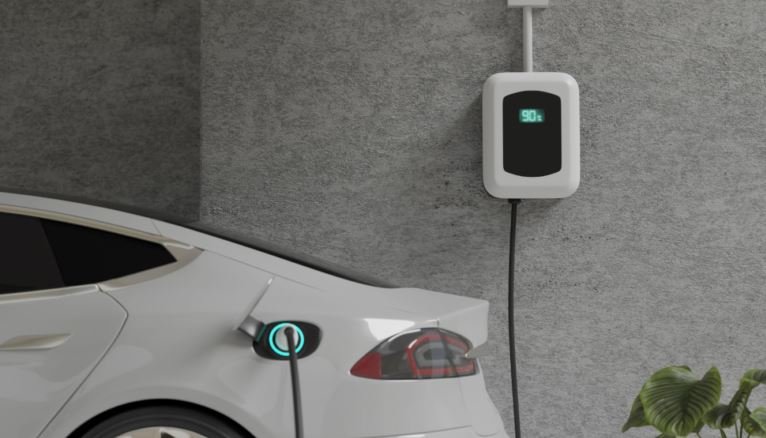
Quick Summary Box
- Level 1 charging costs $0–$300 (charger only, no install) but adds only 3–5 miles of range per hour
- Level 2 charging costs $1,200–$2,500 installed and adds 20–30 miles of range per hour
- Panel upgrades, needed in roughly 20–30% of homes, add $800–$3,000
- Permit and inspection fees typically run $50–$300 depending on jurisdiction
- Wiring distance from panel to charger is the single biggest labor-cost variable
What Determines Home EV Charger Installation Cost
Home charger installation pricing is driven by four main factors: the charger hardware itself, the electrical work required to support it, permitting, and labor rates in your area. Hardware is the easiest to compare since manufacturers publish fixed prices. The bigger swing factor is almost always electrical work — specifically whether your home’s panel has enough spare capacity, and how far the charger will sit from that panel.
Charger Hardware Costs
- Level 1 (120V): Often included with the vehicle purchase; standalone units run $150–$300
- Level 2 (240V), non-networked: $300–$700 for the unit alone
- Level 2 (240V), smart/networked (Wi-Fi, app control, scheduling): $500–$900
- Level 2, high-amperage (48–80A) for faster charging: $700–$1,200
Electrical and Labor Costs
Labor for a straightforward Level 2 install — where the panel is close to the charger location and has spare capacity — typically costs $400–$900. If the run is long (garage detached from the main panel, or charger mounted on an exterior wall far from the service entrance), expect $900–$1,800 in labor due to added conduit, trenching, or wiring.
Panel Capacity and Upgrades
Older homes with 100A service panels are the most common trigger for upgrade costs, since a Level 2 charger alone can draw 30–50A. A panel upgrade to 200A service typically costs $800–$2,000, while a full service upgrade involving the utility connection can reach $2,500–$3,500 in more complex cases. These figures vary significantly by local labor rates and utility requirements and should be confirmed with a licensed electrician before budgeting.
Permits and Inspection
Most jurisdictions require an electrical permit for 240V circuit work, typically $50–$300, plus a follow-up inspection. Some utilities also require notification or approval before a high-draw circuit is activated, which can add processing time but rarely adds direct cost.
Level 1 vs. Level 2: Cost-to-Speed Tradeoff
The core decision for most homeowners is whether the lower upfront cost of Level 1 justifies its much slower charging speed. Level 1 works reasonably well for plug-in hybrids or drivers with short daily commutes who can charge overnight without needing a full battery replenishment. Level 2 becomes the practical choice for full battery-electric vehicles or households with higher daily mileage, since it can fully recharge most EVs overnight.
Charging Speed by Type
| Charger Type | Voltage | Typical Output | Range Added Per Hour | Full Charge Time (60 kWh battery) |
|---|---|---|---|---|
| Level 1 | 120V | 1.2–1.8 kW | 3–5 miles | 40–50 hours |
| Level 2 (standard) | 240V | 7–11 kW | 20–30 miles | 6–8 hours |
| Level 2 (high-amp) | 240V | 11–19 kW | 30–45 miles | 3–5 hours |
Hardware and Installation Cost by Charger Category
| Charger Type | Hardware Cost | Typical Install Cost | Total Installed Range | Best For |
|---|---|---|---|---|
| Level 1 (portable) | $150–$300 | $0 (uses existing outlet) | $150–$300 | Short commutes, PHEVs |
| Level 2, non-networked | $300–$700 | $400–$1,200 | $700–$1,900 | Budget-conscious daily drivers |
| Level 2, smart/networked | $500–$900 | $400–$1,200 | $900–$2,100 | Households wanting scheduling, app monitoring |
| Level 2, high-amperage | $700–$1,200 | $500–$1,300 | $1,200–$2,500 | Multi-EV households, larger batteries |
| Level 2 + panel upgrade | $500–$900 | $1,200–$3,000 | $1,700–$3,900 | Older homes with insufficient panel capacity |
Additional Cost Considerations
Outdoor vs. Garage Installation
Outdoor-rated chargers cost slightly more upfront (roughly $50–$150 above equivalent indoor units) due to weatherproofing requirements, but avoid the need for interior wall penetration in homes without an attached garage.
Multi-Vehicle Households
Households planning to charge two EVs may consider either a dual-port charger or two separate circuits. Dual-port hardware typically costs $900–$1,600, while running two independent circuits can cost more in labor but allows simultaneous full-speed charging for both vehicles.
Rebates and Incentive Programs
Many utilities and regional programs offer partial rebates for Level 2 installation, particularly for off-peak charging enrollment. Availability, eligibility, and rebate amounts vary widely by utility provider and region, so homeowners should confirm current program details directly with their local utility before factoring rebates into a budget.
Bottom Line Verdict
For most single-EV households, a standard Level 2 charger — hardware plus installation — lands between $900 and $2,100, and is the clearest value given the jump in charging speed over Level 1. Homes with older or undersized electrical panels should budget an additional $800–$3,000 and get a licensed electrician’s assessment before purchasing hardware. Level 1 remains a reasonable no-installation option only for plug-in hybrids or very low daily mileage; for daily full-EV use, Level 2 pays for itself in convenience within the first few months of ownership.