- Home
- Electric Vehicles
- Compare
- Hyundai Ioniq 5 vs Lexus RZ
Hyundai Ioniq 5 vs Lexus RZ
Hyundai Ioniq 5 and Lexus RZ target different parts of the electric SUV market. The Ioniq 5 sits in the mainstream midsize EV crossover segment with strong tech focus and wide global reach. The Lexus RZ sits in the premium electric SUV segment with emphasis on comfort, brand loyalty, and luxury interior quality. Buyers choosing the Hyundai often prioritize charging speed and value. Buyers choosing the Lexus usually look for a luxury badge with EV capability.
Range figures favor the Hyundai in many trims. The Ioniq 5 reaches up to about 570 km WLTP with the long-range rear-drive setup. The Lexus RZ offers roughly 403–440 km WLTP depending on version and wheels. Charging systems differ strongly. The Hyundai uses an 800-volt architecture that supports ultra-fast charging up to about 350 kW and charges from 10 to 80 percent in about 18 minutes. The Lexus uses a 400-volt system with DC charging around 150 kW and roughly 25 minutes for a 10–80 percent refill.
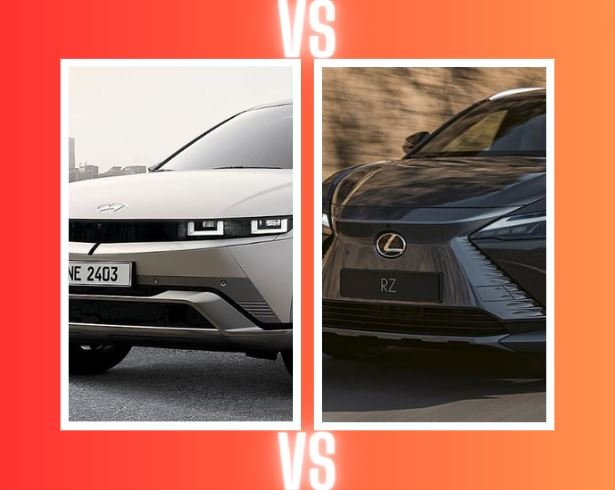
Price positioning reflects brand hierarchy. The Hyundai Ioniq 5 sits in the mid-price EV crossover category across Europe, North America, and Asia. The Lexus RZ enters the premium electric SUV category with a higher base price. Market availability differs. The Hyundai sells globally with multiple battery and drivetrain options. The Lexus RZ launched mainly in North America, Europe, and Japan. This comparison helps buyers choose between faster charging and wider availability or a premium badge with luxury focus.
Within each brand lineup, both models sit alongside other electric vehicles. Hyundai expands the Ioniq family with the sedan-focused Hyundai Ioniq 6 and upcoming large SUV Hyundai Ioniq 9. Lexus currently offers the RZ as its main dedicated EV while hybrid and plug-in models remain dominant, alongside electrified SUVs such as Lexus NX and Lexus RX.
Ioniq 5 pros include ultra-fast charging capability, strong driving range in long-range versions, and a flexible interior with flat floor design. Ioniq 5 cons include higher energy use in AWD trims and interior materials below luxury-brand level. Lexus RZ pros include quiet ride quality, high cabin material quality, and smooth dual-motor AWD system. Lexus RZ cons include lower driving range compared with several rivals and slower charging speeds.
QUICK VERDICT; Choose the Ioniq 5 for faster charging, longer range options, and broader global support. Choose the Lexus RZ for luxury cabin quality, brand prestige, and a comfort-focused driving experience.
Related EV Comparisons
- Hyundai Ioniq 9 vs Hyundai Ioniq 5
- Leapmotor T03 vs Hyundai Inster
- Hyundai Inster vs Kia EV3
- Kia EV3 vs Hyundai Ioniq 5
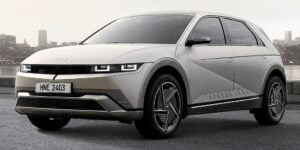
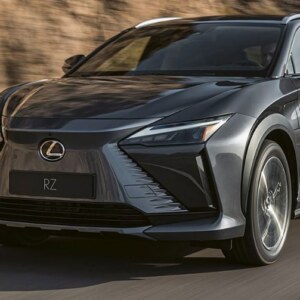
MODEL
| Models |
Hyundai Ioniq 5 63kWh RWD Hyundai Ioniq 5 84kWh RWD Hyundai Ioniq 5 84kWh AWD Lexus RZ 300e Lexus RZ 450e |
LAUNCH
| Announced |
2024, March 04
2023, December 19 -Lexus RZ 300e 2022, April 20 - Lexus RZ 450e |
| Status |
Available to order. Released 2024, July
Available to order. Released 2023, December - Lexus RZ 300e Available to order. Released 2023, February 07 - Lexus RZ 450e |
| Country of origin | South Korea Japan |
| Base Price |
€ 44,000 £ 40,000 - Hyundai Ioniq 5 63kWh RWD € 51,700 £ 43,400 - Hyundai Ioniq 5 84kWh RWD € 59,400 £ 50,900 - Hyundai Ioniq 5 84kWh AWD $ 55,200 - Lexus RZ 300e $ 59,650 € 60,000 £ 62,600 - Lexus RZ 450e |
PERFORMANCE
| Power |
RWD 170 hp (125 kW) - Hyundai Ioniq 5 63kWh RWD RWD 228 hp (168 kW) - Hyundai Ioniq 5 84kWh RWD AWD 325 hp (239 kW) - Hyundai Ioniq 5 84kWh AWD FWD 201 hp (150 kW) - Lexus RZ 300e AWD 313 hp (230 kW) - Lexus RZ 450e |
| Torque |
350 Nm (258 lb-ft) - Hyundai Ioniq 5 63kWh RWD 350 Nm (258 lb-ft) - Hyundai Ioniq 5 84kWh RWD 605 Nm (446 lb-ft) - Hyundai Ioniq 5 84kWh AWD 196 Nm (145 lb-ft) - Lexus RZ 300e 435 Nm (320 lb-ft) - Lexus RZ 450e |
| Acceleration The acceleration numbers are an easy way to compare car performance. We list either time from 0 to 100 km/h or time from 0 to 60mph, depending on which number(s) the manufacturers provide. The lower the acceleration time, the higher performance the car is. |
8.5 sec 0-62 mph - Hyundai Ioniq 5 63kWh RWD 7.5 sec 0-62 mph - Hyundai Ioniq 5 84kWh RWD 5.3 sec 0-62 mph - Hyundai Ioniq 5 84kWh AWD 7.4 sec 0-60 mph - Lexus RZ 300e 5 sec 0-60 mph (5.6 sec 0-62 mph) - Lexus RZ 450e |
| Max Speed | 115 mph (185 km/h) 99 mph (160 km/h) |
| transmission | Single-speed Single-speed |
BATTERY
| Capacity |
63 kWh total - Hyundai Ioniq 5 63kWh RWD 84 kWh total - Hyundai Ioniq 5 84kWh RWD 84 kWh total - Hyundai Ioniq 5 84kWh AWD 72.8 kWh total - Lexus RZ 300e 64 kWh usable, 71.4 kWh total - Lexus RZ 450e |
| Tech | Liquid-cooled Li-Po (800V type) Li-ion 355V (400V type) |
| Range |
273 mi WLTP (240 mi EPA) - Hyundai Ioniq 5 63kWh RWD 320 mi WLTP (310 mi EPA) - Hyundai Ioniq 5 84kWh RWD 308 mi WLTP (280 mi EPA) - Hyundai Ioniq 5 84kWh AWD 266 mi EPA - Lexus RZ 300e 250 mi WLTP (220 mi EPA) -Lexus RZ 450e |
| Consumption |
251 Wh/mi WLTP - Hyundai Ioniq 5 63kWh RWD 277 Wh/mi WLTP - Hyundai Ioniq 5 84kWh RWD 293 Wh/mi WLTP - Hyundai Ioniq 5 84kWh AWD 291 Wh/mi WLTP (320 Wh/mi EPA) - Lexus RZ 450e |
| Recuperation | 4 levels, with steering wheel paddles Yes, 5 modes |
| Heat Pump | |
| AC Charging | Type 2 11 kW Type 2 7 kW, 0-100% in 9.5 hours |
| DC Charging |
CCS 180 kW, 10-80% in 18 min - Hyundai Ioniq 5 63kWh RWD CCS 235 kW, 10-80% in 18 min - Hyundai Ioniq 5 84kWh RWD CCS 235 kW, 10-80% in 18 min - Hyundai Ioniq 5 84kWh AWD CCS 150 kW max, 0-80% in 35 min - Lexus RZ 300e CCS 150 kW max, 0-80% in 30 min - Lexus RZ 450e |
| Others |
Vehicle to load (V2L) 230V electrical outlet (3.6 KW max) |
BODY
| Type | 5 door crossover, 5 seats 5 door SUV, 5 seats |
| Platform | E-GMP e-TNGA |
| Dimensions | 4655 x 1890 x 1605 mm (183.3 x 74.4 x 63.2 in) 4805 x 1895 x 1635 mm (189.2 x 74.6 x 64.4 in) |
| Drag Co-Efficient | 0.288 Cd 0.29 Cd |
| Wheelbase | 3000 mm (118.1 in) 2850 mm (112.2 in) |
| Clearance | 160 mm (6.3 in) 200 mm (7.9 in) |
| Weight |
EU: 1965 kg unladen, 2470 kg gross - Hyundai Ioniq 5 63kWh RWD EU: 2070 kg unladen, 2590 kg gross - Hyundai Ioniq 5 84kWh RWD EU: 2175 kg unladen, 2685 kg gross - Hyundai Ioniq 5 84kWh AWD EU: 2296 kg unladen (US: 2070 kg curb, 2640 kg GVWR) - Lexus RZ 450e |
| Suspension | Front MacPherson struts, rear multi-link Front MacPherson struts, rear Trailing Wishbone; Frequency reactive dampers |
| Wheels | R19, R20 R18, R20 |
| Trunk/Boot | EU: 527 l, 1587 l max US: 988 l |
| Frunk/Bonnet |
57 l 57 l 24 l No |
| Towing |
EU: 750 kg unbraked, 750 kg braked - Hyundai Ioniq 5 63kWh RWD EU: 750 kg unbraked, 1600 kg braked - Hyundai Ioniq 5 84kWh RWD EU: 750 kg unbraked, 1600 kg braked - Hyundai Ioniq 5 84kWh AWD EU: 750 kg unbraked |
| Others |
Battery thermal pre-conditioning Smart Frequency Dampers Digital Centre Mirror Digital Side Mirrors Active automatic front grille |
DISPLAYS
| Centre | 12.3" touchscreen 14" touchscreen |
| Driver's Display | 12.3" Yes |
| Head-Up | Yes, projector type Yes |
COMFORT
| Seats | Heated and ventilated front seats, heated rear seats Heated and ventilated front seats, heated rear seats |
| Roof | Panoramic glass roof, solar roof Panoramic glass sunroof, fixed, dimming function |
| Parking Aids | Front and rear sensors, 360 camera, front and reversing camera, Remote Smart Parking Assist 2 Front and rear sensors, 360 camera, reversing camera, advanced Park with remote function |
| Connectivity | Wireless Android Auto and Apple CarPlay Wireless Android Auto and Wireless Apple CarPlay |
SAFETY
| Airbags | 8 airbags: side, front and rear, including head airbag system Front, side, rear, head airbag system |
| Driving Aids | Front and corner radars, cameras. Forward/Side/Reverse Parking Collision-Avoidance Assist, Autonomous Emergency Braking with Pedestrian and Cyclist Recognition, Blind Spot Collision-Avoidance Assist, Rear Cross-Traffic Collision-Avoidance Assist, Lane Keeping Assist 2, Safe Exit Assist, High Beam Assist, Intelligent Speed Limit Assist, Driver Attention Warning, Hands-On Detection Front radar, front/rear camera. Lexus Safety System+ 3.0, Pre-Collision System with pedestrian detection, Lane Keep Assist, Lane Trace Assist, Road Sign Assist, High Beam Assist, Secondary Collision brake, Blind Spot Monitor, Front/Rear Cross-Traffic Alert, Emergency brake signal, Emergency Driving Stop System |
Note
| disclaimer | We can not guarantee that the information on this page is 100% correct We can not guarantee that the information on this page is 100% correct |

|
Disclaimer Note
We can not guarantee that the information on this page is 100% correct