

- Electric Vehicles
- Compare Electric Cars
- McMurtry Spéirling vs Rimac Nevera
McMurtry Spéirling vs Rimac Nevera
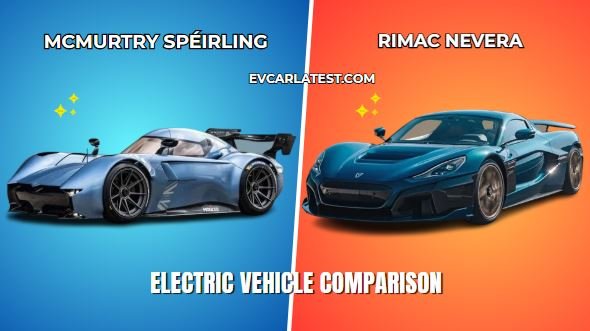
The McMurtry Spéirling is a single-seat British electric fan car designed purely for track use. Built by McMurtry Automotive, it targets serious motorsport enthusiasts who want a road-legal track weapon rather than a conventional supercar. The Rimac Nevera, by contrast, is a Croatian four-seat, all-wheel-drive electric hypercar aimed at buyers who want road-legal extreme performance without sacrificing usability. Both cars compete in the ultra-premium EV performance space, and the comparison is relevant now as Rimac expands its European and Middle Eastern dealer presence while McMurtry attracts growing interest from African collectors via private import.
Range & Charging
The Spéirling carries a relatively small battery optimised for track sessions — it delivers around 130 miles (WLTP) per charge, with real-world range closer to 90–100 miles depending on driving mode. The Nevera achieves 340 miles WLTP, with real-world figures around 280–300 miles at legal road speeds. On charging, the Nevera supports up to 500 kW DC fast charging, hitting 10–80% in roughly 22 minutes. The Spéirling, being track-focused, uses a slower AC-based charge setup, and McMurtry recommends overnight charging between sessions. For daily drivers or long-distance buyers, the Nevera wins this section outright.
Price, Availability & Market Fit
The Rimac Nevera starts at approximately $2.4 million USD — roughly ₦3.9 billion NGN at current parallel rates, or KES 310 million, ZAR 44 million. The McMurtry Spéirling Plus starts around $1 million USD (approx. ₦1.6 billion NGN). Neither is sold through official African dealerships; both enter the continent through grey-market private import channels. If you need a car that works on real roads, travels longer distances, and can seat a passenger, the Nevera is the answer. If track days are your primary use case and you want something genuinely unlike anything else, the Spéirling is the one.
Ecosystem & Rival Context
Rimac’s lineup feeds into the Bugatti Rimac partnership, with the Bugatti Tourbillon as its closest sibling for buyers who want internal combustion alongside EV credentials. McMurtry currently has no other production model beyond the Spéirling variants. Rival EVs worth considering at similar price points include the Lotus Evija (around $2.3 million, more road-focused than the Spéirling but not as usable as the Nevera) and the Pininfarina Battista (around $2.5 million, full road car with 1,877 hp). This Spéirling-vs-Nevera comparison remains relevant because no two cars in this segment divide their priorities as cleanly — one is a road car, the other is a track car, and that distinction settles most buying decisions on its own.
Pros & Cons
McMurtry Spéirling
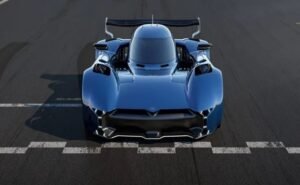
The fan-assisted downforce system generates over 2,000 kg of downforce at low speeds, which means track performance that no road-legal hypercar can match at any price — a genuine edge for buyers who spend real time at circuits. At around $1 million, it costs less than half the Nevera, which matters even at this price tier when total hypercar budgets include storage, transport, and maintenance. The Spéirling’s extreme exclusivity and unusual engineering make it a collector piece that holds attention and likely holds value better than more conventional hypercars.
On the downside, single-seat configuration means no passenger can share the experience, which limits its appeal for buyers who value shared driving or occasional co-pilots. The track-only real-world range and lack of fast DC charging mean the Spéirling is genuinely impractical for anything beyond dedicated track use — it requires a support vehicle and logistics that most buyers will find burdensome outside motorsport contexts.
Rimac Nevera
The Nevera’s 1,914 hp output and all-wheel torque vectoring deliver 0–60 mph in under 1.85 seconds on public roads, making it the fastest-accelerating production car currently available to road buyers. Its 340-mile WLTP range and 500 kW charging mean it functions as an actual daily driver — rare at this performance level — which gives buyers genuine flexibility. Rimac’s engineering credibility and institutional backing (Porsche holds a stake) mean software, support, and parts infrastructure are more stable than most low-volume hypercar startups.
The Nevera’s $2.4 million price puts it beyond what even serious enthusiasts can justify on performance numbers alone; a large part of the purchase is brand positioning. The four-seat layout, while useful, adds weight that slightly dulls the mechanical feel compared to lighter single-seat competitors — buyers focused purely on driver engagement will notice the compromise.
Quick Verdict
Choose the Spéirling if your primary use is track days and you want the most technically unusual machine money can buy at this level. Choose the Nevera if you want extreme road performance you can actually drive daily, with a passenger, over long distances. The Nevera is the more complete car by almost every conventional measure. The Spéirling does one thing — circuit driving — better than anything on the market. That trade-off is the whole decision.
Related EV Comparsions

| |
| Price | $2,000,000.00 |
| Our Rating | |
| Brand | McMurtry RIMAC |
| Category | Electric Cars Electric Cars |
MODEL
| Available Trims / Variants |
McMurtry Spéirling Prototype McMurtry Spéirling Pure Rimac Nevera 120kWh |
LAUNCH
| Reveal Date |
2021 - McMurtry Spéirling Prototype July 2023 (Goodwood Festival of Speed) - McMurtry Spéirling Pure 2021, June 01 |
| Availability Status |
Prototype / Track-only demonstrator - McMurtry Spéirling Prototype In development, deliveries start 2025 - McMurtry Spéirling Pure Available to order. Released 2021, December |
| Country of origin | Britain Croatia |
| Base Price (USD) |
Not for sale (concept vehicle) - McMurtry Spéirling Prototype £995,000 (before taxes) - McMurtry Spéirling Pure € 2,000,000 |
BATTERY
| Battery Capacity | 60 kWh 120 kWh total |
| Battery Chemistry |
High-power lithium-ion (Molicel cells)
Liquid-cooled 730V (800V-type), Lithium Nickel Manganese Cobalt Oxide |
| Range (WLTP/CLTC/EPA) | 30–60 min of flat-out track driving 340 mi WLTP, 402 mi NEDC |
| Energy Consumption | Very high under performance use |
| Regen Braking (Max kW) | Yes (regen braking) Yes, up to 300 kW |
| Heat Pump | |
| AC Charging (Max kW) | N/A Type 2 22 kW |
| DC Charging (Max kW) | 20–30 min to 80% CCS 500 kW max, 0-80% in 22 min |
| Additional Notes |
Actively cooled for race use Battery swap capability for race teams |
PERFORMANCE
| Power Output (kW / hp) |
745 kW (1,000 hp), dual motors, rear-wheel drive AWD 1914 hp (1427 kW) |
| Torque (Nm) | 2360 Nm (1741 lb-ft) |
| 0–100 km/h / 0-60 mph (seconds) The acceleration numbers are an easy way to compare car performance. We list either time from 0 to 100 km/h or time from 0 to 60mph, depending on which number(s) the manufacturers provide. The lower the acceleration time, the higher performance the car is. | 0–60 mph < 1.5 sec 1.7 sec 0-60 mph (1.8 sec 0-62 mph) |
| Top Speed (km/h / mph) | 190+ mph (limited for track use) 256 mph (412 km/h) |
BODY
| Body Style | Single-seat, closed-cockpit track car 2 door coupe, 2 seats |
| Platform / Architecture | Carbon-fiber monocoque |
| Dimensions (L×W×H mm) |
Length: ~3.5 m Width: ~1.7 m Height: ~1.0 m 4750 x 1986 x 1208 mm (187.0 x 78.2 x 47.6 in) |
| Drag Coefficient (Cd) | 0.3 Cd |
| Wheelbase (mm) | Compact (exact not public) 2745 mm (108.1 in) |
| Ground Clearance (mm) | Very low |
| Kerb Weight (kg) | <1,000 kg EU: 2150 kg unladen |
| Suspension (Front / Rear) | Double wishbone, adjustable Double wishbone, electronically controlled dampers, active ride height adjustment |
| Wheel Size (inches) | Lightweight alloys with slicks R20 |
| Trunk/Boot Capacity (L) | None EU: 100 l |
| Frunk/Bonnet Capacity (L) | None No |
| Towing Capacity (kg) | No |
| Additional Notes | Twin-fan active downforce system (2,000+ kg of downforce) |
SAFETY
| Airbags (count) | None Front, side, head airbag system |
| Driver Assistance (ADAS) | None (no ABS, no TC) 6 radars, 13 cameras, 12 sensors (up to 160m object detection) |
| Autonomous Driving Level | No Autopilot with full Self-Driving capability |
| Crash Test Ratings | Not publicly tested |
COMFORT
| Seating Capacity | 1 racing bucket seat Heated front seats |
| Roof Type | Fixed canopy No glass roof |
| Bluetooth / Wi-Fi | Limited (track data logging) |
| Parking Aids | None Front and rear sensors, 360 camera, reversing camera |
| Additional Notes | Air conditioning for driver only |
DISPLAYS
| Centre Screen (inches) | Minimalist screen Yes |
| Driver's Display (inches) | Compact digital cluster Yes |
| Head-Up Display (HUD) | No No |
| Additional Notes | Track telemetry system |
LIGHTING
INFOTAINMENT & AUDIO
TECHNOLOGY
OWNERSHIP
Note
| Additional Notes |
– Record-holder at Goodwood Hillclimb (39.08 sec, 2022) – Fan system creates instant grip, even from a standstill – Noise resembles a jet turbine – Not road legal Carbon-fiber monocoque body (70000 Nm/degree torsional stiffness) |
| Disclaimer | We can not guarantee that the information on this page is 100% correct |
|
Disclaimer Note
Specifications sourced from manufacturer data and may reflect WLTP, CLTC, or EPA test conditions. Import prices in your local are estimates based on grey-market landing costs and exclude duties, clearing fees, and local taxes. Figures are subject to change without notice. Always verify with your local importer before purchase. We can not guarantee that the information on this page is 100% correct