Mercedes-Benz EQS Becomes First German Car With Steer-by-Wire — And It Changes Everything About How an EV Drives
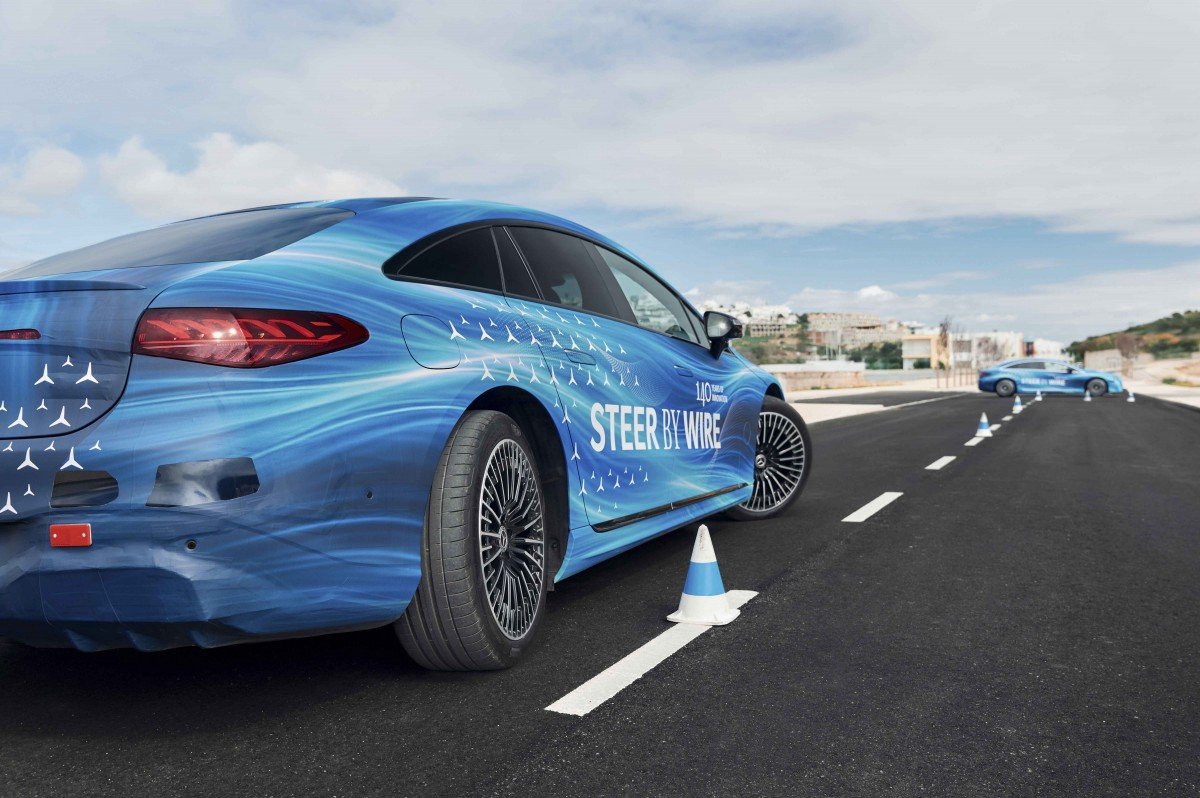
Mercedes-Benz is marking 140 years of automobile manufacturing with one of the boldest engineering decisions in recent memory: cutting the physical link between the steering wheel and the front tires in its flagship electric sedan, the EQS.
The technology is called steer-by-wire, and the 2025 Mercedes-Benz EQS is the first German production car to use it. Instead of a metal steering column, sensors read the driver’s input and send digital signals to an electric motor that moves the wheels. It is the same principle behind fly-by-wire aircraft — and it has major consequences for how the car looks, feels, and drives.
What Steer-by-Wire Means for the 2025 Mercedes-Benz EQS
In a conventional car, turning the steering wheel physically rotates a rod connected to the front wheels. Every bump and pothole sends vibrations back up that rod to the driver’s hands. With steer-by-wire, that physical path no longer exists.
Instead, a computer reads how far the driver has turned the wheel, calculates the correct response, and commands an electric motor to steer accordingly. The system also simulates natural steering resistance — so the wheel still pushes back and feels like a real car — but filters out unwanted road noise and vibration before it ever reaches the driver’s hands.
Parking Gets Easier. Seriously.
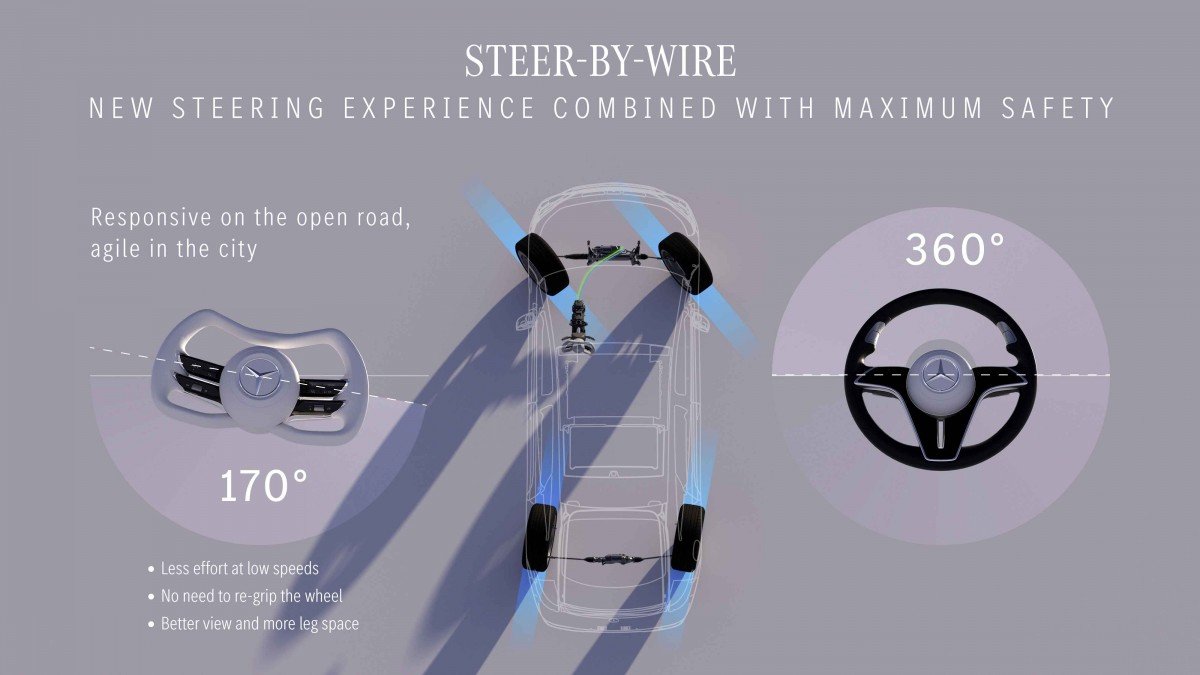
One of the most practical benefits of the EQS steer-by-wire system is variable steering ratio. The car automatically adjusts how responsive the wheels are based on vehicle speed.
At low speeds — in a parking garage or tight street — a small turn of the wheel produces a large change in wheel angle. Drivers no longer need to cross their arms or spin the wheel repeatedly to navigate into a space. At highway speeds, the steering becomes more precise and stable, reducing the risk of overcorrection.
Combined with a rear-axle steering system that turns the back wheels up to 10 degrees, the EQS can feel as maneuverable as a compact car despite its full-size footprint.
The Interior Looks Like a Spaceship — Because It Kind of Is
Removing the steering column created unexpected design freedom inside the cabin. The EQS no longer uses a traditional circular steering wheel. The new control unit is flat on the top and bottom — a yoke-style design — which frees up legroom and improves sightlines to the large digital dashboard.
Mercedes-Benz positions the EQS interior as a “home away from home,” and the additional space makes that claim more credible than ever.
However, the unconventional wheel shape created a genuine safety engineering challenge. Standard airbags rely on the circular rim of the steering wheel for structural support when they deploy. With no full rim, engineers had to design an entirely new airbag that holds its shape through a specialized folding pattern — without any external support. (This specific design has already been banned in China, citing airbag safety concerns.)
Is Steer-by-Wire Safe If Something Goes Wrong?
Redundancy is built into every layer of the system. Two independent signal paths handle every steering command simultaneously — if one fails, the other takes over without any input from the driver. In a worst-case scenario where the entire steering system lost power, the EQS can use individual wheel braking and rear-axle steering to help the driver maintain directional control and pull over safely.
Mercedes-Benz says the system meets all current automotive safety standards and has been engineered to exceed them.
Why This Matters Beyond the EQS
Steer-by-wire has been discussed in automotive engineering circles for decades. Its arrival in a mainstream luxury EV from one of the world’s oldest automakers signals that the technology is ready for broad adoption. Expect other manufacturers — particularly in the EV segment — to follow within the next few years.
For now, the 2025 Mercedes-Benz EQS stands as the most technically advanced steering system available in any German production vehicle, and one of the most sophisticated in any electric car on the market today.
Related EV News
- GAC Aion N60 SUV: 610 km Range, LiDAR, Under $22K
- Exeed EX7 Launch April 17 With 726 km Range and EMB Brakes
- Leapmotor D19 SUV Launch April 16 With 720 km Range
- Zeekr 007 Refresh, 007 GT Pre-Sales Start April 2
- BMW iX3 LWB Debuts in China With 900km Range and 800V Tech