- Home
- Electric Vehicles
- Compare Electric Cars
- Hyundai Ioniq 3 vs Kia EV3
Hyundai Ioniq 3 vs Kia EV3
Hyundai Ioniq 3 and Kia EV3 sit in the compact electric SUV space from two Korean brands under the same group. Both target urban drivers, young families, and ride-hailing operators who want low running cost, compact size, and modern tech. Hyundai positions the Ioniq 3 as a value-focused entry into the Ioniq family with a city-first design. Kia EV3 follows a similar path with a slightly more boxy SUV stance and a stronger focus on interior practicality.
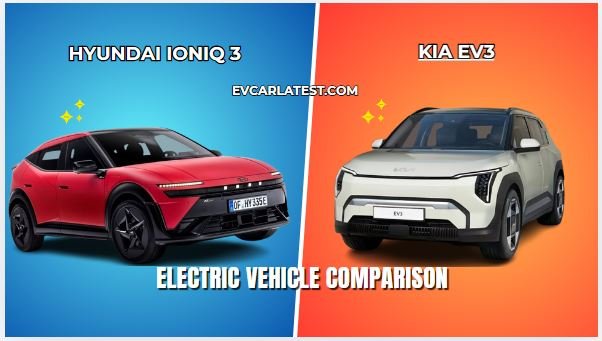
This comparison matters now because both models sit in the next wave of affordable compact EVs aimed at global markets, including emerging EV adoption zones across Africa.
Hyundai Ioniq 3 targets an estimated WLTP range of 420 to 500 km depending on battery size and drivetrain setup. Real-world driving in mixed city and highway use typically lands around 360 to 440 km based on similar E-GMP compact models.
Kia EV3 posts WLTP figures between 430 and 600 km depending on the long-range or standard pack. Real-world use sits near 380 to 520 km based on driving style and terrain.
Charging speed for both models follows E-GMP architecture. DC fast charging peaks around 120 to 135 kW. A 10 to 80 percent charge session takes about 25 to 30 minutes under optimal conditions. AC home charging runs at 11 kW, giving a full overnight charge in about 6 to 7 hours for the larger pack.
Both models support strong fast-charging consistency, though Kia EV3 holds a slight edge in energy efficiency on paper.
Hyundai Ioniq 3 expected starting price sits near 35,000 to 38,000 USD. In Nigeria, import cost plus duty places early units near 60 million to 75 million NGN depending on trim and dealer structure.
Kia EV3 starts near 33,000 to 40,000 USD. Nigeria landed pricing trends place it close to 58 million to 78 million NGN based on configuration and shipping source.
Trim focus for Ioniq 3 centers on Standard Range and Long Range packs with mid-tier tech packages. Kia EV3 offers Light, Air, and GT-Line trims with clearer feature separation and optional long-range battery.
Both models appear first in Europe, Korea, and select Asian markets. EV3 rollout appears faster due to Kia’s aggressive global EV distribution strategy.
This page helps you decide between two compact EV SUVs with similar pricing, range, and charging speed but different interior philosophy and design approach.
Hyundai Ioniq lineup includes Ioniq 5, Ioniq 6, and Ioniq 7 for larger SUV buyers who need more space and highway stability. Kia EV family includes EV6, EV9, and EV5, targeting both premium and mid-size SUV buyers.
Outside both brands, key rivals include BYD Atto 3 and Volvo EX30. Atto 3 focuses on affordability and features. EX30 focuses on premium compact performance.
This comparison still stands strong because both EV3 and Ioniq 3 sit at the intersection of range efficiency, fast charging, and global platform maturity from established EV architectures.
Hyundai Ioniq 3 pros include strong energy efficiency that supports longer daily range for city drivers, a balanced ride setup suited for mixed road conditions, and integration with Hyundai’s expanding charging network partnerships in global markets. Its cons include a less aggressive design appeal for buyers who prefer bold styling and a slightly less flexible cargo layout compared with boxier rivals.
Kia EV3 pros include higher maximum range figures in the long-range version, a more practical interior layout with better rear space usability, and a more distinctive SUV design that appeals to younger buyers. Its cons include slightly higher price variance between trims and a firmer ride setup in sport-oriented versions.
Quick Verdict
Choose Hyundai Ioniq 3 if daily driving efficiency and a smoother ride profile matter more to your use case. Choose Kia EV3 if longer range options and interior space flexibility sit higher in priority. Both serve similar budgets and charging needs, so the decision sits on design preference and range targets. Expect close competition in urban EV markets with minimal ownership cost difference over time.
FAQ
Is Hyundai Ioniq 3 better than Kia EV3 for long trips
Kia EV3 holds advantage in long-range variants due to higher WLTP figures. Hyundai Ioniq 3 focuses more on efficiency in city and mixed driving. Long-distance drivers lean toward EV3 for fewer charging stops.
Which is cheaper to maintain, Hyundai Ioniq 3 or Kia EV3
Both share similar E-GMP components and service structure. Maintenance cost difference stays minimal across routine servicing, brake wear, and battery management systems.
Is Kia EV3 available in Nigeria or Africa
Both models arrive through import channels first, followed by limited dealership introductions in select African cities. Availability depends on regional distributor rollout timelines and homologation approvals.
Related EV Comparisons
- Hyundai Ioniq 3 vs BYD Dolphin
- Hyundai Ioniq 3 vs Renault 4 E-Tech
- Hyundai Ioniq 3 vs Volkswagen ID.3 2026
- Hyundai Ioniq 5 vs Kia EV6
- Hyundai Ioniq 6 N vs Tesla Model 3
| |
| Price | $35,000.00 |
| Our Rating | |
| Brand | Hyundai KIA |
| Category | Electric Cars Electric Cars |
MODEL
| Available Trims / Variants |
Hyundai Ioniq 3 Standard Range Hyundai Ioniq 3 Long Range Kia EV3 Standard Range FWD Kia EV3 Long Range FWD Kia EV3 GT |
PRICE & AVAILABILITY
| Base Price (USD) |
€ 36,000 £ 33,000 - Kia EV3 Standard Range FWD € 41,400 £ 36,000 - Kia EV3 Long Range FWD |
| Availability Status |
Coming soon. Expected release: 2026, Q4
Available to order. Released 2024, August - Kia EV3 Standard Range FWD Available to order. Released 2024, August - Kia EV3 Long Range FWD Coming soon. Expected release 2026, Q2 - Kia EV3 GT |
BATTERY & CHARGING
| Battery Capacity |
42.2 kWh total - Hyundai Ioniq 3 Standard Range 61 kWh total - Hyundai Ioniq 3 Long Range 58.3 kWh total - Kia EV3 Standard Range FWD 81.4 kWh total - Kia EV3 Long Range FWD 81.4 kWh total - Kia EV3 GT |
| Range (WLTP/CLTC/EPA) |
214 mi WLTP - Hyundai Ioniq 3 Standard Range 308 mi WLTP - Hyundai Ioniq 3 Long Range 257 mi WLTP - Kia EV3 Standard Range FWD 350 mi WLTP - Kia EV3 Long Range FWD |
| DC Charging (Max kW) |
CCS , 10-80% in 29 min - Hyundai Ioniq 3 Standard Range CCS , 10-80% in 30 min - Hyundai Ioniq 3 Long Range CCS 100 kW, 10-80% in 31 min - Kia EV3 Standard Range FWD CCS 135 kW, 10-80% in 33 min - Kia EV3 Long Range FWD CCS 135 kW, 10-80% in 33 min - Kia EV3 GT |
| AC Charging (Max kW) |
Type 2 11 kW Type 2 22 kW (optional) Type 2 11 kW |
| Energy Consumption |
254 Wh/mi WLTP - Kia EV3 Standard Range FWD 261 Wh/mi WLTP - Kia EV3 Long Range FWD |
PERFORMANCE
| Power Output (kW / hp) |
FWD 147 hp (107 kW) - Hyundai Ioniq 3 Standard Range FWD 135 hp (99 kW) - Hyundai Ioniq 3 Long Range FWD 204 hp (150 kW) - Kia EV3 Standard Range FWD FWD 204 hp (150 kW) - Kia EV3 Long Range FWD AWD 288 hp (215 kW) - Kia EV3 GT |
| 0–100 km/h / 0-60 mph (seconds) The acceleration numbers are an easy way to compare car performance. We list either time from 0 to 100 km/h or time from 0 to 60mph, depending on which number(s) the manufacturers provide. The lower the acceleration time, the higher performance the car is. |
9 sec 0-62 mph - Hyundai Ioniq 3 Standard Range 9.6 sec 0-62 mph - Hyundai Ioniq 3 Long Range 7.5 sec 0-62 mph - Kia EV3 Standard Range FWD 7.7 sec 0-62 mph - Kia EV3 Long Range FWD 5.7 sec 0-62 mph - Kia EV3 GT |
| Torque (Nm) | 250 Nm (184 lb-ft) 283 Nm (209 lb-ft) |
| Top Speed (km/h / mph) | 106 mph (170 km/h) 106 mph (170 km/h) |
BODY & DIMENSIONS
| Dimensions (L×W×H mm) | 4155 x 1800 x 1505 mm (163.6 x 70.9 x 59.3 in) 4300 x 1850 x 1560 mm (169.3 x 72.8 x 61.4 in) |
| Trunk/Boot Capacity (L) | EU: 441 l EU: 460 l, 1251 l max |
| Body Style | 5 door crossover, 5 seats 5 door crossover, 5 seats |
| Kerb Weight (kg) |
EU: 1550 kg unladen - Hyundai Ioniq 3 Standard Range EU: 1580 kg unladen - Hyundai Ioniq 3 Long Range EU: 1800 kg unladen, 2270 kg gross - Kia EV3 Standard Range FWD EU: 1885 kg unladen, 2355 kg gross - Kia EV3 Long Range FWD EU: 1885 kg unladen, 2355 kg gross - Kia EV3 GT |
| Frunk/Bonnet Capacity (L) | No 25 l |
SAFETY & DRIVER ASSISTANCE
COMFORT & SEATING
| Seating Capacity |
Heated and ventilated front seats, heated rear seats
Heated front seats |
DISPLAYS & CONNECTIVITY
| Centre Screen (inches) |
12.9" or 14.6" touchscreen
12.3" touchscreen |
| Driver's Display (inches) | 12.3" 12.3" |
| Head-Up Display (HUD) | Yes, projector type Yes |
TECHNOLOGY
ADDITIONAL SPECS
Note
|
Disclaimer Note
Specifications sourced from manufacturer data and may reflect WLTP, CLTC, or EPA test conditions. Import prices in your local are estimates based on grey-market landing costs and exclude duties, clearing fees, and local taxes. Figures are subject to change without notice. Always verify with your local importer before purchase. We can not guarantee that the information on this page is 100% correct