- Home
- Electric Vehicles
- Compare Electric Cars
- Hyundai Ioniq 3 vs Renault 4 E-Tech
Hyundai Ioniq 3 vs Renault 4 E-Tech
Hyundai Ioniq 3 is a compact electric crossover from Hyundai, positioned under the Ioniq 5 with a focus on efficiency, tech features, and urban comfort. Renault 4 E-Tech is a compact electric SUV inspired by the classic Renault 4, built for Renault’s small EV lineup with a focus on practicality and retro-modern styling. Both target city drivers, young professionals, and small families who want affordable electric mobility in Europe, with growing import attention in African markets like Nigeria. Ioniq 3 focuses on modern efficiency and fast EV architecture. Renault 4 E-Tech focuses on simple usability and compact SUV space. This comparison matters as both models sit in the emerging affordable compact EV SUV space gaining demand in 2026.
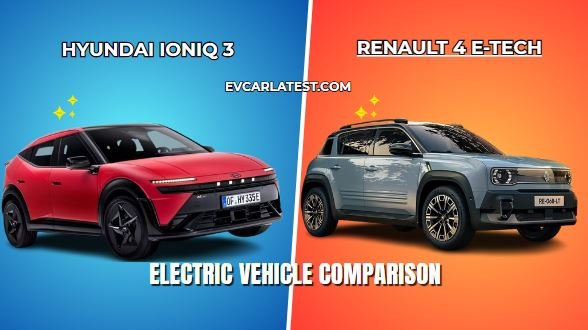
Hyundai Ioniq 3 targets WLTP range between 420 km and 480 km depending on battery size and configuration. Renault 4 E-Tech delivers WLTP range around 350 km to 420 km depending on trim and battery option. Real-world driving places Ioniq 3 around 360 km to 420 km in mixed conditions, while Renault 4 E-Tech sits near 300 km to 370 km depending on speed and load. DC fast charging for Ioniq 3 reaches about 100 kW to 130 kW, supporting 10 to 80 percent in 30 to 35 minutes. Renault 4 E-Tech supports up to around 100 kW DC charging, reaching 10 to 80 percent in 30 to 40 minutes. AC charging sits around 7 kW to 11 kW for both, giving full charge overnight with a home wall unit.
Hyundai Ioniq 3 pricing starts near 32,000 to 39,000 USD, around 50 million to 62 million NGN. Renault 4 E-Tech starts near 30,000 to 37,000 USD, around 47 million to 59 million NGN. Ioniq 3 trims focus on Standard, Long Range, and tech-focused variants. Renault 4 E-Tech offers evolution-style trims with basic, comfort, and extended feature packages. Ioniq 3 launches first in Europe with limited import access into Africa. Renault 4 E-Tech targets wider European rollout with stronger entry-level positioning. This comparison helps decide between longer-range efficiency-focused SUV and lower-cost compact EV SUV with simpler design and city focus.
Hyundai EV lineup around this segment includes Kona Electric, Ioniq 5, and upcoming compact Ioniq models. Renault EV lineup includes Megane E-Tech, Scenic E-Tech, and Renault 5 E-Tech in the small EV range. Key rivals include BYD Atto 3 and MG4 EV in the same price bracket, plus Peugeot e-2008 in Europe. Ioniq 3 stands stronger on range efficiency and charging performance. Renault 4 E-Tech stands stronger on price positioning and simple urban usability.
Hyundai Ioniq 3 delivers higher driving range, which supports fewer charging stops for daily commuting and intercity travel. It offers faster DC charging compared to most entry compact EVs in its class. Cabin design focuses on digital systems and driver assistance features suited for modern users. Higher purchase cost affects entry-level buyers. Limited early availability in African markets reduces immediate access.
Renault 4 E-Tech offers lower entry pricing, which suits budget-focused EV buyers entering electric mobility. It provides compact SUV practicality with easy city handling and parking. Renault service network strength across Europe supports maintenance access. Lower range limits long-distance travel flexibility. Charging speed sits slightly behind premium compact EV rivals.
Quick Verdict
Choose Hyundai Ioniq 3 if higher range, faster charging, and stronger tech features matter more. Choose Renault 4 E-Tech if lower purchase price and simple city-focused driving matter more. Ioniq 3 fits users who drive longer distances with fewer stops. Renault 4 E-Tech fits users who stay mostly within city routes and want lower upfront cost.
Related EV Comparisons
- Hyundai Ioniq 3 vs Volkswagen ID.3 2026
- Hyundai Ioniq 5 vs Kia EV6
- Hyundai Ioniq 6 N vs Tesla Model 3
- Renault 5 E-Tech vs Mini Cooper Electric
- Hyundai Kona Electric vs Chevrolet Bolt EUV
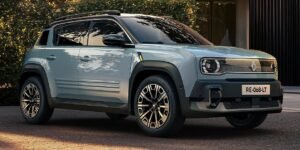
| |
| Price | |
| Our Rating | |
| Brand | Hyundai RENAULT |
| Category | Electric Cars Electric Cars |
MODEL
| Available Trims / Variants |
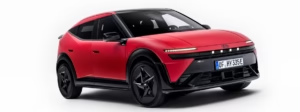
Hyundai Ioniq 3 Standard Range Hyundai Ioniq 3 Long Range Renault 4 E-Tech 120 HP 40 kWh Renault 4 E-Tech 150 HP 52 kWh |
PRICE & AVAILABILITY
| Base Price (USD) |
€ 29,400 £ 24,000 - Renault 4 E-Tech 120 HP 40 kWh € 32,400 £ 28,000 - Renault 4 E-Tech 150 HP 52 kWh |
| Availability Status | Coming soon. Expected release: 2026, Q4 Available to order. Released 2025, March |
BATTERY & CHARGING
| Battery Capacity |
42.2 kWh total - Hyundai Ioniq 3 Standard Range 61 kWh total - Hyundai Ioniq 3 Long Range 40 kWh usable - Renault 4 E-Tech 120 HP 40 kWh 52 kWh usable - Renault 4 E-Tech 150 HP 52 kWh |
| Range (WLTP/CLTC/EPA) |
214 mi WLTP - Hyundai Ioniq 3 Standard Range 308 mi WLTP - Hyundai Ioniq 3 Long Range 186 mi WLTP - Renault 4 E-Tech 120 HP 40 kWh 254 mi WLTP - Renault 4 E-Tech 150 HP 52 kWh |
| DC Charging (Max kW) |
CCS , 10-80% in 29 min - Hyundai Ioniq 3 Standard Range CCS , 10-80% in 30 min - Hyundai Ioniq 3 Long Range CCS 80 kW, 15-80% in 30 min - Renault 4 E-Tech 120 HP 40 kWh CCS 100 kW, 15-80% in 30 min - Renault 4 E-Tech 150 HP 52 kWh |
| AC Charging (Max kW) |
Type 2 11 kW Type 2 22 kW (optional) Type 2 11 kW, 10-100% in 3 hours 30 min - Renault 4 E-Tech 120 HP 40 kWh Type 2 11 kW, 10-100% in 4 hours 30 min - Renault 4 E-Tech 150 HP 52 kWh |
| Energy Consumption |
229 Wh/mi WLTP - Renault 4 E-Tech 120 HP 40 kWh 243 Wh/mi WLTP - Renault 4 E-Tech 150 HP 52 kWh |
PERFORMANCE
| Power Output (kW / hp) |
FWD 147 hp (107 kW) - Hyundai Ioniq 3 Standard Range FWD 135 hp (99 kW) - Hyundai Ioniq 3 Long Range FWD 120 hp (90 kW) - Renault 4 E-Tech 120 HP 40 kWh FWD 150 hp (110 kW) - Renault 4 E-Tech 150 HP 52 kWh |
| 0–100 km/h / 0-60 mph (seconds) The acceleration numbers are an easy way to compare car performance. We list either time from 0 to 100 km/h or time from 0 to 60mph, depending on which number(s) the manufacturers provide. The lower the acceleration time, the higher performance the car is. |
9 sec 0-62 mph - Hyundai Ioniq 3 Standard Range 9.6 sec 0-62 mph - Hyundai Ioniq 3 Long Range 9.2 sec 0-62 mph - Renault 4 E-Tech 120 HP 40 kWh 8.2 sec 0-62 mph - Renault 4 E-Tech 150 HP 52 kWh |
| Torque (Nm) |
250 Nm (184 lb-ft)
166 lb-ft (225 Nm) - Renault 4 E-Tech 120 HP 40 kWh 245 Nm (181 lb-ft) - Renault 4 E-Tech 150 HP 52 kWh |
| Top Speed (km/h / mph) | 106 mph (170 km/h) 93 mph (150 km/h) |
BODY & DIMENSIONS
| Dimensions (L×W×H mm) | 4155 x 1800 x 1505 mm (163.6 x 70.9 x 59.3 in) 163.0 x 70.9 x 61.8 in (4140 x 1800 x 1570 mm) |
| Trunk/Boot Capacity (L) | EU: 441 l EU: 420 l, 1405 l max |
| Body Style | 5 door crossover, 5 seats 5 door hatchback, 5 seats |
| Kerb Weight (kg) |
EU: 1550 kg unladen - Hyundai Ioniq 3 Standard Range EU: 1580 kg unladen - Hyundai Ioniq 3 Long Range EU: 1510 kg unladen, 1895 kg gross - Renault 4 E-Tech 120 HP 40 kWh EU: 1562 kg unladen, 1980 kg gross - Renault 4 E-Tech 150 HP 52 kWh |
| Ground Clearance (mm) | 7.1 in (181 mm) |
| Frunk/Bonnet Capacity (L) | No No |
SAFETY & DRIVER ASSISTANCE
COMFORT & SEATING
| Seating Capacity | Heated and ventilated front seats, heated rear seats Heated front seats |
DISPLAYS & CONNECTIVITY
| Centre Screen (inches) | 12.9" or 14.6" touchscreen 10" touchscreen |
| Driver's Display (inches) | 12.3" 7" or 10.1" |
| Head-Up Display (HUD) | Yes, projector type No |
TECHNOLOGY
ADDITIONAL SPECS
Note
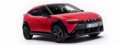
|
Disclaimer Note
Specifications sourced from manufacturer data and may reflect WLTP, CLTC, or EPA test conditions. Import prices in your local are estimates based on grey-market landing costs and exclude duties, clearing fees, and local taxes. Figures are subject to change without notice. Always verify with your local importer before purchase. We can not guarantee that the information on this page is 100% correct