- Home
- Electric Vehicles
- Compare Electric Cars
- Hyundai Ioniq 6 N vs Tesla Model 3
Hyundai Ioniq 6 N vs Tesla Model 3
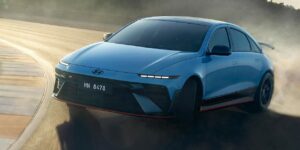
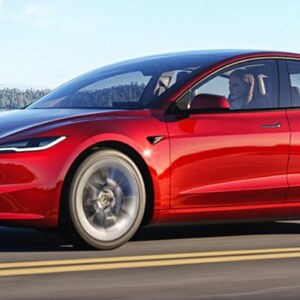
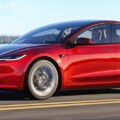
The Hyundai Ioniq 6 N is a performance-tuned version of the Ioniq 6 fastback, built on Hyundai’s E-GMP platform and positioned as a driver-focused EV with track-oriented hardware. The Tesla Model 3 is a five-door electric sedan that has been on the market since 2017 and received a full interior and exterior refresh in late 2023. Both sit in the mid-size electric sedan segment, though they attract somewhat different buyers. The Ioniq 6 N draws people who want driving feel and performance credentials in an EV. The Model 3 tends to appeal to those who prioritize software integration, charging network reliability, and long-term ownership familiarity.
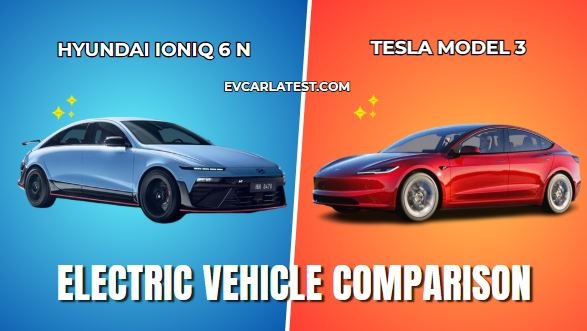
On range, the Tesla Model 3 Long Range AWD is rated at around 358 miles (WLTP), while the Ioniq 6 N returns approximately 270–290 miles depending on the variant — a gap worth noting if range is a top priority for you. Charging is where the comparison gets more interesting. The Model 3 uses Tesla’s Supercharger network, which remains one of the most consistent fast-charging networks globally and in parts of Africa. The Ioniq 6 N uses 800V architecture, which means it can charge from 10 to 80 percent in roughly 18 minutes on a compatible DC fast charger — faster peak charging than the Model 3 when the infrastructure is available.
The Tesla Model 3 Long Range starts at around $42,000–$45,000 in major markets, with the Performance variant pushing higher. The Ioniq 6 N is priced from roughly $67,000–$72,000 depending on the market, placing it above the Model 3 by a significant margin. Both are primarily available in North America, Europe, South Korea, and select Asia-Pacific markets. Neither has an official retail presence in Nigeria or most of sub-Saharan Africa, though grey imports of both models do exist. This page helps buyers decide whether the Ioniq 6 N’s performance hardware and faster peak charging justifies its price premium over a more affordable and more widely supported Model 3.
Hyundai’s EV lineup extends well beyond the Ioniq 6 N. Related models include the standard Ioniq 6, the Ioniq 5, the Ioniq 5 N, and the larger Ioniq 7 for buyers who need more space. On Tesla’s side, alternatives within the brand include the Model 3 Standard Range, the Model Y which shares the same platform, and the Model S for buyers with a higher budget. Outside of both brands, rivals worth comparing in this segment include the BMW i4, the Polestar 2, and the BYD Seal — the Seal in particular is worth attention for African buyers given BYD’s growing presence on the continent.
The Ioniq 6 N runs on 800V architecture, enabling some of the fastest DC charging speeds in its class. It has genuine performance credentials, with a dual-motor setup producing around 641 hp and a tuned chassis that is clearly intended for drivers who want more from an EV than just straight-line acceleration. That said, its price point is hard to justify for most buyers unless performance and charging speed are genuinely the priority, it currently has limited service infrastructure in emerging markets, and the range trails the Model 3 by a noticeable margin. The Tesla Model 3 benefits from one of the most developed charging networks in the world, its updated interior is a significant improvement over the previous generation, and it offers strong range for its price tier. The main drawbacks are that the driving dynamics remain less engaging compared to the Ioniq 6 N, and the dual-screen setup removed the instrument cluster in a way that some drivers find less convenient.
QUICK VERDICT
If charging network access and long-range practicality matter more to you, the Model 3 is the more straightforward choice and costs considerably less. If you’re specifically after a performance-oriented electric sedan and have access to fast DC charging infrastructure, the Ioniq 6 N is technically impressive — but you’re paying a premium for it. For most buyers in African markets dealing with limited charging infrastructure, the Model 3’s Supercharger network coverage, wider grey-market availability, and lower entry price make it the more practical option of the two.
Related EV Comparisons
- Onvo L60 vs Tesla Model Y
- BYD Sealion 06 vs Tesla Model Y
- Hyundai Kona Electric vs Chevrolet Bolt EUV
- Tesla Model Y vs Hyundai Ioniq 5
- GMC Hummer EV Pickup vs Tesla Cybertruck
| |
| Price | $43,000.00 |
| Our Rating | |
| Brand | Hyundai TESLA |
| Category | Electric Cars Electric Cars |
MODEL
| Available Trims / Variants |
Tesla Model 3 Standard Range Tesla Model 3 Long Range RWD Tesla Model 3 Long Range Tesla Model 3 Performance |
PRICE & AVAILABILITY
| Base Price (USD) |
€ 43,000 - Tesla Model 3 Standard Range $ 42,500 - Tesla Model 3 Long Range RWD $ 47,500 € 52,000 - Tesla Model 3 Long Range $ 53,000 € 58,500 £ 60,000 - Tesla Model 3 Performance |
| Availability Status |
Coming soon. Expected release 2025
Available to order. Released 2023, October - Tesla Model 3 Standard Range Available to order. Released 2024, July - Tesla Model 3 Long Range RWD Available to order. Released 2023, October - Tesla Model 3 Long Range Available to order. Released 2024, April - Tesla Model 3 Performance |
BATTERY & CHARGING
| Battery Capacity |
84 kWh total
57.3 kWh usable, 60 kWh total -Tesla Model 3 Standard Range 78 kWh total - Tesla Model 3 Long Range RWD 78 kWh total - Tesla Model 3 Long Range 78 kWh total - Tesla Model 3 Performance |
| Range (WLTP/CLTC/EPA) |
272 mi EPA (319 mi WLTP) - Tesla Model 3 Standard Range 436 mi WLTP (363 mi EPA) - Tesla Model 3 Long Range RWD 421 mi WLTP (342 mi EPA) - Tesla Model 3 Long Range 328 mi WLTP (296 mi EPA) - Tesla Model 3 Performance |
| DC Charging (Max kW) |
CCS 350 kW max, 10-80% in 18 min
Supercharger V3 170 kW max -Tesla Model 3 Standard Range CCS 170 kW max Supercharger V3 250 kW max - Tesla Model 3 Long Range RWD CCS 250 kW max Supercharger V3 250 kW max - Tesla Model 3 Long Range CCS 250 kW max Supercharger V3 250 kW max - Tesla Model 3 Performance CCS 250 kW max |
| AC Charging (Max kW) |
Type 2 11 kW
Type 2 11 kW, 0-100% in 7 hours 33 min - Tesla Model 3 Standard Range Type 2 11 kW, 0-100% in 8 hours 15 min - Tesla Model 3 Long Range RWD Type 2 11 kW, 0-100% in 8 hours 15 min - Tesla Model 3 Long Range Type 2 11 kW - Tesla Model 3 Performance |
| Energy Consumption |
212 Wh/mi WLTP - Tesla Model 3 Standard Range 225 Wh/mi WLTP (260 Wh/mi EPA) - Tesla Model 3 Long Range 269 Wh/mi WLTP - Tesla Model 3 Performance |
PERFORMANCE
| Power Output (kW / hp) |
AWD 650 hp (478 kW)
RWD 283 hp (208 kW) - Tesla Model 3 Standard Range RWD -Tesla Model 3 Long Range RWD AWD 498 hp (366 kW) - Tesla Model 3 Long Range AWD 625 hp (460 kW) - Tesla Model 3 Performance |
| 0–100 km/h / 0-60 mph (seconds) The acceleration numbers are an easy way to compare car performance. We list either time from 0 to 100 km/h or time from 0 to 60mph, depending on which number(s) the manufacturers provide. The lower the acceleration time, the higher performance the car is. |
3.2 sec 0-62 mph
5.8 sec 0-60 mph (6.1 sec 0-62 mph) - Tesla Model 3 Standard Range 4.9 sec 0-60 mph - Tesla Model 3 Long Range RWD 4.2 sec 0-60 mph (4.4 sec 0-62 mph) - Tesla Model 3 Long Range 2.9 sec 0-60 mph (3.1 sec 0-62 mph) - Tesla Model 3 Performance |
| Torque (Nm) |
568 lb-ft (770 Nm)
450 Nm (332 lb-ft) - Tesla Model 3 Standard Range 493 Nm (364 lb-ft) - Tesla Model 3 Long Range 741 Nm (547 lb-ft) - Tesla Model 3 Performance |
| Top Speed (km/h / mph) |
160 mph (257 km/h)
125 mph (201 km/h) - Tesla Model 3 Standard Range 125 mph (201 km/h) - Tesla Model 3 Long Range RWD 125 mph (201 km/h) - Tesla Model 3 Long Range 163 mph (262 km/h) - Tesla Model 3 Performance |
BODY & DIMENSIONS
| Dimensions (L×W×H mm) | 194.3 x 76.4 x 58.9 in (4935 x 1940 x 1495 mm) 4720 x 1933 x 1441 mm (185.8 x 76.1 x 56.7 in) |
| Trunk/Boot Capacity (L) |
EU: 682 l - Tesla Model 3 Standard Range EU: 594 l - Tesla Model 3 Long Range RWD EU: 594 l - Tesla Model 3 Long Range EU: 594 l - Tesla Model 3 Performance |
| Body Style | 4 door sedan, 5 seats 4 door sedan, 5 seats |
| Kerb Weight (kg) |
EU: 1765 kg unladen -Tesla Model 3 Standard Range EU: 1822 kg unladen - Tesla Model 3 Long Range RWD EU: 1828 kg unladen, 2263 kg gross - Tesla Model 3 Long Range EU: 1929 kg unladen, 2271 kg gross - Tesla Model 3 Performance |
| Ground Clearance (mm) | 138 mm (5.4 in) |
| Frunk/Bonnet Capacity (L) | No 88 l |
SAFETY & DRIVER ASSISTANCE
| Autonomous Driving Level | Autopilot with full Self-Driving capability |
COMFORT & SEATING
| Seating Capacity | Heated and ventilated front seats, heated rear seats Heated and ventilated/cooled front seats, heated rear seats |
DISPLAYS & CONNECTIVITY
| Centre Screen (inches) | 12.3" touchscreen 15.4" touchscreen |
| Driver's Display (inches) | 12.3" No |
| Head-Up Display (HUD) | Yes, projector type No |
TECHNOLOGY
ADDITIONAL SPECS
Note
| Additional Notes |
02 October 2024: Model 3 Standard Range is discontinued in USA 10 January 2024: Initial release price 38,990 USD 01 September 2023: Initial release price 42,990 EUR |

|
Disclaimer Note
Specifications sourced from manufacturer data and may reflect WLTP, CLTC, or EPA test conditions. Import prices in your local are estimates based on grey-market landing costs and exclude duties, clearing fees, and local taxes. Figures are subject to change without notice. Always verify with your local importer before purchase. We can not guarantee that the information on this page is 100% correct