- Electric Vehicles
- Compare Electric Cars
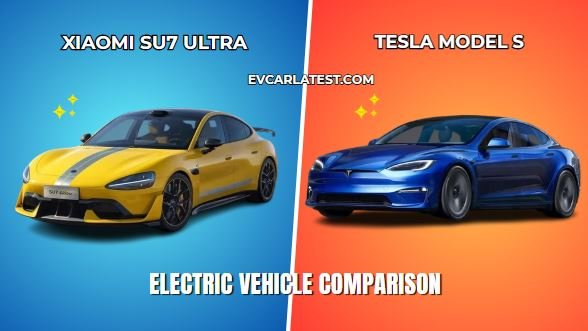
- Xiaomi SU7 Ultra vs Tesla Model S
Xiaomi SU7 Ultra vs Tesla Model S
The Xiaomi SU7 Ultra and Tesla Model S are both full-size electric performance sedans targeting buyers who want serious performance without sacrificing comfort or tech. The Model S is aimed at affluent professionals and tech-forward drivers in North America, Europe, and China — people who already live inside an established EV ecosystem. The SU7 Ultra, built by Xiaomi and launched in early 2025, targets a younger, more connected buyer: someone already using Xiaomi devices, living in China’s urban core, and willing to spend serious money on a car that integrates deeply with their lifestyle. This comparison matters now because the SU7 Ultra has pushed into Plaid-level performance territory at a price that undercuts Tesla’s top trim by a significant margin.
Range & Charging
The Tesla Model S Long Range delivers around 628 km (WLTP) or 405 miles (EPA), with real-world estimates sitting between 480–560 km depending on driving conditions. The Plaid version drops slightly to roughly 600 km WLTP. The Xiaomi SU7 Ultra is rated at 630 km (CLTC), which translates to roughly 490–520 km in real-world use — CLTC figures typically run optimistic. On charging, the Model S supports up to 250 kW DC fast charging, taking roughly 20 minutes from 10–80%. The SU7 Ultra supports 800V architecture with up to 615 kW peak DC charging, cutting the 10–80% window to around 11 minutes. On AC, both support 11 kW onboard charging, though this is rarely a deciding factor for buyers in this segment.
Price, Availability & Market Fit
The Tesla Model S starts at approximately $74,990 (Long Range) and $89,990 (Plaid) in the US. Grey-market import pricing into Nigeria typically lands in the range of ₦120M–₦160M depending on trim and condition; Kenya and South Africa see similar premiums. The Xiaomi SU7 Ultra is priced at CNY 814,900 (roughly $112,000 USD) in China — positioning it above the standard SU7 but at a level that directly challenges the Model S Plaid. It is currently sold only in China, with no confirmed grey-market availability yet in Africa. If you’re in Nigeria, Kenya, or South Africa and want to buy today, the Model S is the realistic option. If you’re researching where performance EVs are heading and are in China or planning an import, the SU7 Ultra is the more interesting purchase.
Ecosystem & Rival Context
Within Tesla’s lineup, buyers considering the Model S might also look at the Model 3 Performance for a more practical spend, or the upcoming refreshed Model S if timing allows. Xiaomi buyers at this level have little else in the current SU7 lineup that competes — the standard SU7 and SU7 Max both sit below the Ultra in spec and price. Outside both brands, the Porsche Taycan Turbo S and the BMW i7 M70 xDrive are the most credible alternatives in this performance-sedan space. The Xiaomi vs Tesla comparison still wins over those alternatives because it offers a cleaner price-versus-performance trade-off, without the complexity of choosing between a German luxury brand and an EV-first manufacturer.
Pros & Cons
Xiaomi SU7 Ultra
The SU7 Ultra’s 615 kW charging speed is the fastest available in any production sedan today, which matters for buyers who can’t afford to plan their drives around charging stops. Its triple-motor setup produces over 1,500 hp, making it one of the quickest sedans on sale regardless of powertrain type. Deep integration with Xiaomi’s HyperOS means it connects natively with the Xiaomi device ecosystem, which is a genuine convenience advantage for users already on that platform.
On the downside, it is only sold in China right now, which rules it out entirely for most African buyers doing direct comparisons. The CLTC range rating is also less trustworthy than EPA or WLTP figures, so buyers outside China have less certainty about real-world range.
The Model S Long Range still offers best-in-class real-world range for a performance sedan, which is the most practical advantage for drivers covering long distances without reliable charging infrastructure — relevant for African grey-market buyers in particular. Tesla’s Supercharger network is more developed globally than Xiaomi’s current charging coverage. The Model S also carries a more established resale market outside China, which reduces risk for buyers purchasing through grey-market imports.
The main drawbacks are price and age. The Model S interior has been refreshed but the platform is aging relative to newer entrants, and the Plaid trim’s premium is harder to justify once the SU7 Ultra enters wider markets. The yoke steering, while divisive, is now standard on newer builds and remains a frustration point for some buyers.
Quick Verdict
Choose the Xiaomi SU7 Ultra if outright performance and charging speed are your top priorities and you’re buying in China. Choose the Tesla Model S if you need global availability, proven long-range reliability, and an established resale market — particularly if you’re importing into Nigeria, Kenya, or South Africa. For African buyers right now, the Model S is the only practical choice between these two. The SU7 Ultra is worth watching as Xiaomi expands, but it isn’t a real purchase option outside China yet.
Related EV Comparsions
- Tesla Model 3 vs Hyundai Ioniq 6
- Volkswagen ID.4 vs Tesla Model Y
- YangWang U7 vs Tesla Model S
- BYD Seal 08 vs Tesla Model S
- Ferrari Luce vs Tesla Model S
| |
| Price | $73,000.00 |
| Our Rating | |
| Brand | Xiaomi TESLA |
| Category | Electric Cars Electric Cars |
MODEL
| Available Trims / Variants |
Tesla Model S Long Range Tesla Model S Plaid |
LAUNCH
| Reveal Date | 2024, October 29 2021 |
| Availability Status | Coming soon. Expected release 2025, March Available to order. Released 2021 |
| Country of origin | United States |
| Base Price (USD) |
$ 73,000 € 95,000 - Tesla Model S Long Range $ 88,000 € 110,000 - Tesla Model S Plaid |
BATTERY
| Battery Capacity | 93.7 kWh total 92.6 kWh usable, 100 kWh total |
| Battery Chemistry | Liquid-cooled (800V type) Liquid-cooled Li-ion 350V |
| Range (WLTP/CLTC/EPA) |
391 mi CLTC
405 mi EPA (449 mi WLTP) - Tesla Model S Long Range 432 mi WLTP (359 mi EPA) - Tesla Model S Plaid |
| Energy Consumption |
280 Wh/mi EPA (282 Wh/mi WLTP) - Tesla Model S Long Range 301 Wh/mi WLTP (330 Wh/mi EPA) - Tesla Model S Plaid |
| Regen Braking (Max kW) | Yes 1 level, no coasting, no regen when pedal braking |
| Heat Pump | |
| AC Charging (Max kW) | Type 2 Type 2 11 kW, 0-100% in 10 hours |
| DC Charging (Max kW) |
CCS, 10-80% in 11 min CCS Supercharger V3 250 kW max, 10-80% in 30 min |
PERFORMANCE
| Power Output (kW / hp) |
AWD 1548 hp (1139 kW)
AWD 670 hp (415 kW) - Tesla Model S Long Range AWD 1020 hp (760 kW) - Tesla Model S Plaid |
| Torque (Nm) |
557 lb-ft (755 Nm) - Tesla Model S Long Range 1420 Nm (1047 lb-ft) - Tesla Model S Plaid |
| 0–100 km/h / 0-60 mph (seconds) The acceleration numbers are an easy way to compare car performance. We list either time from 0 to 100 km/h or time from 0 to 60mph, depending on which number(s) the manufacturers provide. The lower the acceleration time, the higher performance the car is. |
2 sec 0-62 mph
3.1 sec 0-60 mph (3.2 sec 0-62 mph) - Tesla Model S Long Range 2 sec 0-60 mph (2.1 sec 0-62 mph) - Tesla Model S Plaid |
| Top Speed (km/h / mph) |
217 mph (350 km/h)
155 mph (250 km/h) - Tesla Model S Long Range 200 mph (322 km/h) - Tesla Model S Plaid |
| Transmission / Drive | Single-speed |
BODY
| Body Style | 4 door sedan, 5 seats 5 door Liftback, 5 seats |
| Platform / Architecture | Modena |
| Dimensions (L×W×H mm) | 201.4 x 77.6 x 57.7 in (5115 x 1970 x 1465 mm) 195.7 x 77.3 x 56.9 in (4970 x 1964 x 1445 mm) |
| Drag Coefficient (Cd) | 0.208 Cd |
| Wheelbase (mm) |
118.1 in (3000 mm) 116.5 in (2960 mm) |
| Ground Clearance (mm) | 4.6 - 6.2 in (117 - 158 mm) |
| Kerb Weight (kg) | EU: 4784 lb unladen |
| Suspension (Front / Rear) | Adaptive Air suspension, dual-chamber air springs and high-performance continuous damping control Adaptive Air suspension |
| Wheel Size (inches) | R21 R19, R21 |
| Trunk/Boot Capacity (L) | EU: 25.0 ft³, 61.4 ft³ max |
| Frunk/Bonnet Capacity (L) | No 3.1 ft³ |
| Towing Capacity (kg) | Yes |
SAFETY
| Airbags (count) | Front, side, rear, head airbag system 8 airbags: front, side, rear, head airbag system, front seats knee airbags |
| Driver Assistance (ADAS) | 1 LiDAR, 3 mmWave radars, 11 cameras, 12 sensors. Forward/Rear/Lateral Collision Prevention, Lane Centering, Lane Change Assist, Lane Departure Warning, Emergency braking with pedestrian and cyclist monitoring, High beam Assist, Blind Spot Alert, Door Open Warning 7 cameras: front, side and rear, 6 front and 6 rear sensors (up to 250m object detection). Automatic Emergency Braking, Dynamic Brake Lights, Lane Assist, Collision Avoidance Assist, Speed Assist, Lane Departure Avoidance, Traffic Light and Stop Sign Control |
| Autonomous Driving Level | Autonomous driving system Autopilot with full Self-Driving capability |
| Crash Test Ratings | NCAP 2022: 5 stars, NHTSA 2013-2022: 5 stars |
COMFORT
| Seating Capacity | Heated and ventilated front seats Heated and ventilated front seats, heated rear seats, heated third row seats |
| Roof Type | No glass roof All-glass roof |
| Parking Aids | Front and rear sensors, 360 camera, reversing camera, Automatic Parking Assistance System 6 front and rear sensors, reversing camera, Parking Assist |
| Additional Notes | Three-zone climate control |
DISPLAYS
| Centre Screen (inches) | 16.1" touchscreen 17" swivel touchscreen |
| Driver's Display (inches) | 7.1 12.3" |
| Head-Up Display (HUD) | Yes |
| Additional Notes | 9.4" rear passenger touchscreen |
LIGHTING
INFOTAINMENT & AUDIO
TECHNOLOGY
OWNERSHIP
Note
| Additional Notes |
Tesla Model S Long Range price history: 19 April 2024: price decrease to 72,990 USD, old price 74,990 USD 01 September 2023: price decrease to 74,990 USD, old price 88,490 USD August 2023: Initial release price 94,990 EUR 12 May 2023: price increase to 88,490 USD, old price 87,490 USD 21 April 2023: price increase to 87,490 USD, old price 84,990 USD 08 April 2023: price decrease to 84,990 USD, old price 89,990 USD 06 March 2023: price decrease to 89,990 USD, old price 94,990 USD 09 March 2023: Added Hardware 4 with the upgraded set of cameras and the Phoenix radar; optional Ultra Red color; improved brake pads with much higher thermal capacity; new high-visibility glass roof with 5x more light and same UV protection |

|
Disclaimer Note
Specifications sourced from manufacturer data and may reflect WLTP, CLTC, or EPA test conditions. Import prices in your local are estimates based on grey-market landing costs and exclude duties, clearing fees, and local taxes. Figures are subject to change without notice. Always verify with your local importer before purchase. We can not guarantee that the information on this page is 100% correct