

- Electric Vehicles
- Compare Electric Cars
- Ferrari Luce vs Audi e-tron GT
Ferrari Luce vs Audi e-tron GT
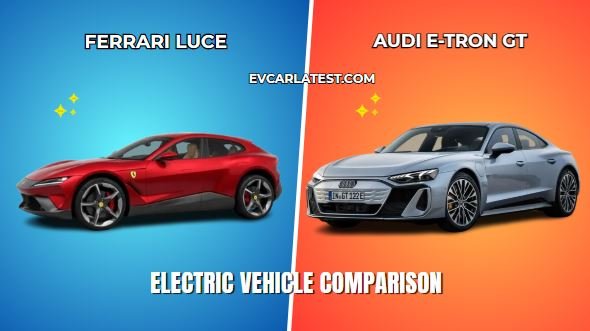
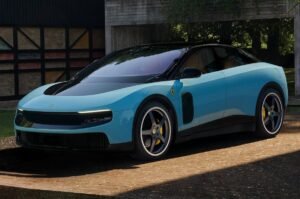
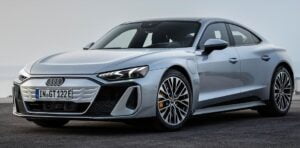
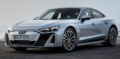
The Ferrari Luce is a five-door luxury sedan and Ferrari’s first series-production EV, built in Maranello for collectors and performance buyers who refuse to compromise on exclusivity. The Audi e-tron GT is a four-door electric grand tourer from Ingolstadt, aimed at wealthy daily drivers who want German engineering precision and a known dealer network. The Luce is scheduled for full reveal on May 25, 2026, with deliveries beginning later in the year — making this comparison timely for buyers deciding between a proven car and a highly anticipated debut.
Range & Charging
The Ferrari Luce carries a 122 kWh SK On battery with a claimed 330-mile (531 km) WLTP range. With an 880V architecture and 350 kW DC charging capability, the Luce is compatible with the fastest stations on the market. Real-world range has not been independently verified yet, given deliveries haven’t begun.
The Audi e-tron GT S offers a WLTP range of 483 km, while the RS variant delivers 446 km from a 97 kWh battery. The 10–80% charge takes approximately 18 minutes. Real-world figures typically land 10–15% below WLTP in mixed driving. The Audi’s charging infrastructure advantage is real — it works with most CCS networks already operating globally.
Price, Availability & Market Fit
Ferrari Luce pricing is expected to exceed €500,000 (approximately $535,000 USD), with African grey-market imports likely pushing well above ₦800 million NGN once duties and shipping are factored in. Production volumes will be limited, with reported waiting times of 12–18 months. The Audi S e-tron GT starts at $126,795 USD, with the RS Performance beginning at $168,295 — grey-market into Nigeria typically lands between ₦180–₦260 million NGN depending on trim and condition. The Audi is available now through parallel import channels in Lagos, Nairobi, and Johannesburg. This page helps buyers decide whether they’re purchasing a performance statement or a usable luxury daily driver.
Ecosystem & Rival Context
Ferrari’s EV lineup is currently just the Luce, supplemented by hybrids like the 296 GTB and SF90. Buyers wanting lower entry points within the brand have no electric alternative. Audi’s EV ecosystem includes the Q4 e-tron, Q6 e-tron, and Q8 e-tron — all available as grey-market imports at lower price points, offering a clear upgrade path. Outside both brands, the Porsche Taycan Turbo GT and Lucid Air Grand Touring are the strongest alternatives at similar price points. This comparison still wins because no rival at either price point carries the Luce’s collector value alongside the e-tron GT’s daily practicality — two genuinely different propositions.
Pros & Cons
Ferrari Luce: The 1,113 hp quad-motor powertrain delivers hypercar performance that no Audi can match, which matters if the driving event itself is the reason you bought the car. The Jony Ive-designed cabin sets a new interior benchmark for electric vehicles, offering an ownership experience unlike anything else. Rarity ensures the Luce will hold — and likely grow — its value in collector markets, a real consideration at this price level. On the downside, real-world charging infrastructure support is untested and deliveries haven’t begun, meaning early buyers carry adoption risk. Africa grey-market availability will be severely limited for years.
Audi e-tron GT: The e-tron GT is available now through established import channels across Nigeria, Kenya, and South Africa, which removes the uncertainty that comes with ordering an undelivered vehicle. Significant updates for 2025 brought more power, a longer range, and faster charging, making this generation genuinely competitive. Build quality and interior refinement are class-leading for a car at this price. However, at 278 miles EPA range, the RS variant falls short of rivals like the Lucid Air, which could frustrate range-conscious buyers. The e-tron GT also lacks the conversation-starting status of the Ferrari badge.
Quick Verdict
Choose the Ferrari Luce if exclusivity, collector value, and owning the first Ferrari EV define what this purchase means to you. Choose the Audi e-tron GT if you want a car you can import, register, and drive today with strong performance and proven reliability. For African buyers, the e-tron GT is the practical answer; the Luce is an aspiration. Both are strong cars — the difference is whether you’re buying a machine or a moment.
Related EV Comparisons
- BMW iX3 2026 vs Audi Q6 e-tron
- Audi Q4 e-tron 2026 vs Mercedes-Benz EQB
- Audi Q4 e-tron 2026 vs Volvo EX40
- Audi Q4 e-tron 2026 vs Kia EV6
- Audi Q4 e-tron 2026 vs Hyundai Ioniq 5
| |
| Price | $640,000.00 $126,000.00 |
| Our Rating | |
| Brand | Ferrari AUDI |
| Category | Electric Cars Electric Cars |
MODEL
| Full Model Name | Ferrari Luce |
| Generation | 1st Generation |
| Segment / Class | Full-size Luxury Liftback Sedan |
| Available Trims / Variants |
Single variant at launch
Audi S e-tron GT Audi RS e-tron GT Audi RS e-tron GT performance |
| Powertrain Options | Quad-motor AWD (only option) |
| Additional Notes | Model code F222. Internally referred to as "Elettrica" before the name Luce was confirmed on February 9, 2026. |
LAUNCH
| Reveal Date |
May 25, 2026 (Rome)
2024, June 18 |
| Launch Year | 2026 |
| Availability Status | Announced; deliveries from Q4 2026 Available to order. Released 2024, June |
| Brand / Manufacturer | Ferrari |
| Country of origin | Italy Germany |
| Assembly Country | Italy (E-Building, Maranello) |
| Markets Available | Global (limited volume) |
| Grey Market Import | Possible but not officially supported |
| Base Price (USD) |
~$640,000 (€550,000)
$ 127,400 € 126,000 - Audi S e-tron GT € 147,500 - Audi RS e-tron GT $ 168,900 € 160,500 - Audi RS e-tron GT performance |
| Additional Notes | Ferrari is keeping production relatively limited, consistent with its long-standing exclusivity strategy. Already oversubscribed at launch. |
BATTERY
| Battery Capacity |
122 kWh gross / 117 kWh usable
97 kWh usable, 105 kWh total |
| Battery Chemistry | NMC (Nickel Manganese Cobalt) Liquid-cooled (800V type) |
| Battery Architecture | 880V |
| Range (WLTP/CLTC/EPA) |
~530 km (329 miles EPA approx.) WLTP
378 mi WLTP - Audi S e-tron GT 372 mi WLTP - Audi RS e-tron GT 368 mi WLTP - Audi RS e-tron GT performance |
| Energy Consumption |
~25 kWh/100 km (est.)
290 Wh/mi WLTP - Audi S e-tron GT 296 Wh/mi WLTP - Audi RS e-tron GT 301 Wh/mi WLTP - Audi RS e-tron GT performance |
| Regen Braking (Max kW) | Yes, up to 400 kW. 3 levels, via driving modes, optional steering wheel paddles |
| Heat Pump | |
| AC Charging (Max kW) |
Type 2 11 kW Type 2 22 kW |
| DC Charging (Max kW) |
350 kW
CCS 800V 320 kW max, 10-80% in 18 min |
| Charging Time (10–80%) | ~19 minutes at 350 kW, with an average charging speed of 253 kW |
| Cell Brand | SK On |
| Additional Notes | Battery pack developed in-house by Ferrari; cells supplied by SK On. |
PERFORMANCE
| Motor Type | Radial-flow Permanent Synchronous (Halbach array) |
| Motor Configuration | Quad-motor, one per wheel, AWD |
| Front Motor Output (kW / HP) | 105 kW / 141 hp each (×2) |
| Rear Motor Output (kW / HP) | 310 kW / 416 hp each (×2) |
| Power Output (kW / hp) |
772 kW / 1,035 hp
AWD 680 hp (500 kW) - Audi S e-tron GT AWD 857 hp (630 kW) - Audi RS e-tron GT AWD 925 hp (680 kW) - Audi RS e-tron GT performance |
| Peak Power (kW / hp) | 830 kW / 1,113 hp |
| Torque (Nm) |
990 Nm combined
740 Nm (546 lb-ft) - Audi S e-tron GT 865 Nm (638 lb-ft) - Audi RS e-tron GT 1027 Nm (757 lb-ft) - Audi RS e-tron GT performance |
| 0–100 km/h / 0-60 mph (seconds) The acceleration numbers are an easy way to compare car performance. We list either time from 0 to 100 km/h or time from 0 to 60mph, depending on which number(s) the manufacturers provide. The lower the acceleration time, the higher performance the car is. |
2.5 seconds
3.3 sec 0-60 mph (3.4 sec 0-62 mph) - Audi S e-tron GT 2.8 sec 0-62 mph - Audi RS e-tron GT 2.4 sec 0-60 mph (2.5 sec 0-62 mph) - Audi RS e-tron GT performance |
| Top Speed (km/h / mph) |
310 km/h (192 mph)
152 mph (245 km/h) - Audi S e-tron GT 155 mph (250 km/h) - Audi RS e-tron GT 155 mph (250 km/h) - Audi RS e-tron GT performance |
| Transmission / Drive | Single-speed, AWD 2-speed automatic with decoupling of the rear-axle |
| Rear-Wheel Steering | Yes (four-wheel steering) |
| Drive Mode | Yes |
| Launch Control | Yes |
| Torque Vectoring | Yes, on both axles |
| Simulated Sound | Yes — described as resembling an electric guitar |
| Additional Notes | During cruising, front motors disconnect to maximize range. The Halbach array directs magnetic flux toward the stator to maximize torque density — a setup adapted from Ferrari's Formula One powertrains. Weight distribution is 47:53 (front:rear). |
BODY
| Body Style | 5-door Liftback Sedan 4 dour sedan, 5 seats |
| Platform / Architecture | Bespoke Ferrari EV platform (880V) PPE |
| Dimensions (L×W×H mm) | ~5,019 × 1,999 × 1,539 mm 4989 x 1964 x 1414 mm (196.4 x 77.3 x 55.7 in) |
| Drag Coefficient (Cd) | Lowest of any Ferrari road car ever built 0.24 Cd |
| Wheelbase (mm) | 2,959 mm 2900 mm (114.2 in) |
| Kerb Weight (kg) |
2,260 kg
EU: 2310 kg unladen, 2840 kg gross - Audi S e-tron GT EU: 2395 kg unladen, 2860 kg gross - Audi RS e-tron GT EU: 2395 kg unladen, 2860 kg gross - Audi RS e-tron GT performance |
| Suspension (Front / Rear) | 48V active suspension front and rear — reaction time so fast that anti-roll bars are not required Adaptive Air with 2-chamber/2-valve technology, rear-axle steering up to 2.8˚; double wishbones |
| Wheel Size (inches) | R20, R21 |
| Trunk/Boot Capacity (L) | EU: 405 l |
| Frunk/Bonnet Capacity (L) | 81 l |
| Towing Capacity (kg) | No |
| Aerodynamics | Front suspension can lower the car by 10 mm at speed to improve efficiency and stability. |
| Additional Notes | ~5 cm shorter in height than the Purosangue but roughly the same footprint. |
SAFETY
| Airbags (count) |
Side airbags, front and rear, including head airbag system, front seats knee airbags |
| Anti-lock Braking System (ABS) | Yes |
| Electronic Brakeforce Distribution (EBD) | Yes |
| Electronic Stability Control (ESC) | Yes |
| Traction Control System (TCS) | Yes |
| Tyre Pressure Monitoring (TPMS) | Yes |
| Child Seat Anchors (ISOFIX / LATCH) | Yes |
| Reversing Camera | Yes |
| Hill Start Assist | Yes |
| Driver Assistance (ADAS) | Night Vision Assist, Lane Keeping Assist, Traffic Sign Recognition, Warn and Brake Assist, Pedestrian/cyclists protection, Exit Warning, Rear and Front Cross Traffic Alert, High Beam Assist |
| Additional Notes | Ferrari debuts a new Vehicle Control Unit architecture in the Luce. |
COMFORT
| Seating Capacity |
5
Heated and ventilated front seats with massage, heated rear seats |
| Seat Material | Leather (premium) |
| Power Seats | Yes |
| Climate Control | Yes (multi-zone expected) |
| Steering Wheel | Custom Ferrari unit |
| Roof Type | Fixed Panoramic glass sunroof (fixed) with variable light transmission |
| Ambient Lighting | Yes |
| Gear Selector | Glass construction |
| Noise Insulation | High (acoustic priority) |
| Bluetooth / Wi-Fi |
Yes
Wireless Android Auto and Apple CarPlay |
| Wireless Charging | Yes |
| Parking Aids |
360 degree cameras Automated parking Front and rear sensors, 360 camera, reversing camera, remote park assist |
| Additional Notes | Interior designed by LoveFrom (Jony Ive and Marc Newson) in collaboration with Centro Stile Ferrari. Ferrari describes propulsion options as "power levels" rather than conventional gears. 3-zone climate control system |
DISPLAYS
| Centre Screen (inches) | Yes 10.1" touchscreen |
| Driver's Display (inches) | Yes 12.3" |
| Head-Up Display (HUD) | Yes |
| Operating System | Ferrari proprietary |
| Physical Controls | Jony Ive deliberately reintroduced physical/tactile controls below the central touchscreen — a departure from his touchscreen-first Apple philosophy. |
| Additional Notes | Passenger display screen |
LIGHTING
| Headlight Type (LED/Matrix/Laser) | LED / Matrix |
| Daytime Running Lights (DRL) | Yes |
| Interior Ambient Lighting | Yes |
INFOTAINMENT & AUDIO
| Navigation System | Yes |
TECHNOLOGY
| Smartphone App Control | Yes |
| Keyless Entry / Start | Yes |
| Over-the-Air Map Updates | Yes |
| Additional Notes | Ferrari claims the Luce features one of the most advanced dynamic control systems ever installed in a production car. |
OWNERSHIP
| Official Dealer Network | Ferrari authorized dealers globally |
| Spare Parts Availability | Limited (low-volume production) |
| Resale Value | Expected to be very high (oversubscribed at launch) |
| Roadside Assistance | Yes (Ferrari official) |
Note
| Data Source | Ferrari official reveal (May 25, 2026), Wikipedia, InsideEVs, Top Gear, EVKX.net, Motor1, Autobics |
| Last Updated | May 27, 2026 |
| Additional Notes | TBC fields reflect information not yet officially confirmed by Ferrari. Some figures (e.g. peak vs. rated power) vary slightly across sources — Wikipedia cites 1,113 hp peak; most outlets report 1,035 hp rated. |
| Editor's Note | The Ferrari Luce is a landmark car but has zero official presence in Africa. For evcarlatest.com, the key angles are: price in NGN (~₦1 billion+), grey market feasibility, comparison to Porsche Taycan Turbo S, and what it signals about ultra-luxury EV direction globally. |
| Disclaimer | We can not guarantee that the information on this page is 100% correct |
|
Disclaimer Note
Specifications sourced from manufacturer data and may reflect WLTP, CLTC, or EPA test conditions. Import prices in your local are estimates based on grey-market landing costs and exclude duties, clearing fees, and local taxes. Figures are subject to change without notice. Always verify with your local importer before purchase. We can not guarantee that the information on this page is 100% correct