

- Electric Vehicles
- Compare Electric Cars
- Lexus TZ vs Toyota Highlander
Lexus TZ vs Toyota Highlander
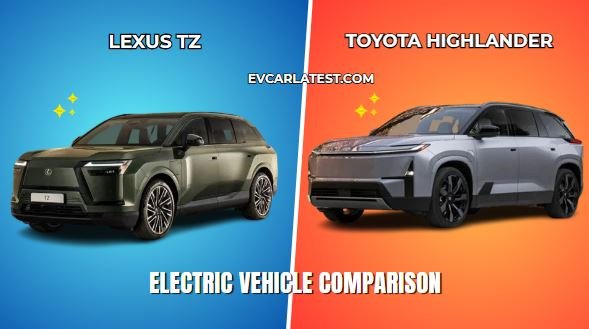
The 2027 Lexus TZ and 2027 Toyota Highlander are both three-row electric SUVs from the Toyota group — one wearing a luxury badge, the other targeting mainstream family buyers. The Highlander drops its gas and hybrid powertrains entirely for 2027, becoming the first fully electric Highlander and the first electric Toyota assembled in the US. Both models share platform DNA and launch within the same late-2026 window, making this the most directly comparable Lexus-vs-Toyota decision an African grey-market importer can make right now.
Range & Charging
The Highlander offers two battery options — 77 kWh and 95.8 kWh — with Toyota-claimed ranges of 287 miles FWD and up to 320 miles AWD on the larger pack. Toyota says charging from 10% to 80% should take as little as 30 minutes in ideal conditions, via a NACS port. The Lexus TZ carries the same 77 kWh and 96 kWh battery options, with an estimated EPA range of up to 300 miles and 150 kW DC fast charging completing 10–80% in around 35 minutes. Real-world African range for both will be 15–20% lower in high-heat conditions. The Highlander holds a slight edge on claimed peak range; the TZ’s charging rate is marginally faster on paper. Neither figure is EPA-confirmed yet.
Price, Availability & Market Fit
The Highlander EV is expected to start at around $50,000, competing with the Kia EV9 and Hyundai Ioniq 9 — roughly ₦76M, KES 6.5M, or ZAR 910K at grey-market estimates before duties. The Lexus TZ is estimated to start near $70,000 — approximately ₦107M, KES 9.1M, or ZAR 1.27M. Both offer XLE and Limited grade structures; both go on sale late 2026. This comparison answers one question directly: if you need three rows in an EV and your import budget is between $50,000 and $75,000, which Toyota-group model fits your household and your wallet?
Ecosystem & Rival Context
Lexus TZ buyers should also consider the Lexus RZ for a two-row alternative at a lower price. Highlander EV buyers can compare the Toyota bZ4X Touring for a more rugged, five-seat option. Outside Toyota group, the Kia EV9 and Hyundai Ioniq 9 compete directly with the Highlander on three-row value, while the Mercedes EQS SUV rivals the TZ on luxury territory. What makes this Lexus-vs-Toyota matchup more relevant than those alternatives is the shared reliability pedigree — critical for African buyers where EV service networks remain limited.
Pros & Cons
Lexus TZ: The luxury interior and Lexus refinement deliver a noticeably higher-grade experience for long African highway runs where road noise and fatigue matter. The TZ’s 402 hp AWD output gives it stronger performance across all trims. The Lexus badge carries real social and resale value in premium African markets. However, it costs $15,000–$20,000 more than the Highlander EV at estimated pricing, and full confirmed specs remain pending until launch.
Toyota Highlander EV: At roughly $50,000, it delivers three-row capacity at a more accessible import price for Nigerian, Kenyan, and South African buyers. V2L capability lets you power external devices or use the car as emergency backup power — a practical feature given grid reliability challenges in many African markets. Up to 320 miles of claimed range gives it a slight edge for intercity travel. The downside is a less refined interior than the TZ, and like the Lexus, its specs are manufacturer-claimed rather than EPA-confirmed.
Quick Verdict
Choose the Lexus TZ if luxury refinement, stronger performance, and premium branding matter as much as the three-row layout — and your import budget can absorb an extra $15,000–$20,000. Choose the Toyota Highlander EV if you need the same seven-seat practicality with a lower import cost and don’t need the Lexus badge to justify the purchase. Both share the same Toyota reliability story; the difference is price and prestige.
Related EV Comparisons
- Lexus TZ vs Toyota C-HR+
- Lexus TZ vs Toyota bZ4X Touring
- Lexus TZ vs Toyota bZ
- Lexus TZ vs Toyota bZ3X (Platinum 3X)
- Lexus TZ vs Toyota Urban Cruiser


| |
| Price | $50,000.00 |
| Our Rating | |
| Brand | LEXUS Toyota |
| Category | Electric Cars Electric Cars |
MODEL
| Full Model Name | 2027 Lexus TZ |
| Generation | 1st Generation |
| Segment / Class | Full-size Premium Three-Row Electric SUV |
| Available Trims / Variants |
XLE FWD XLE AWD (77 kWh) XLE AWD/Limited (95.8 kWh) |
| Powertrain Options | Dual-motor AWD (standard on all trims) |
| Additional Notes | Lexus' first three-row all-electric SUV; six-seat configuration with second-row captain's chairs |
LAUNCH
| Reveal Date | May 6, 2026 February 2026 |
| Launch Year | 2027 (US on sale end of 2026) |
| Availability Status | Announced Revealed, production late 2026 to early 2027 |
| Brand / Manufacturer | Lexus (Toyota Motor Corporation) |
| Country of origin | Japan Japan |
| Markets Available | US (end of 2026); Europe, Japan, China, other markets (early 2027) |
| Base Price (USD) | Estimated mid-$50,000 range |
BATTERY
| Battery Capacity | 76.96 kWh or 95.82 kWh (gross) 77 kWh or 95.8 kWh |
| Battery Chemistry | Lithium-ion Lithium-ion, BEV platform |
| Thermal Management | Active; includes Battery Preconditioning and Driving Preconditioning |
| Range (WLTP/CLTC/EPA) | (mi WLTP): Up to ~320 mi (515 km) with larger battery |
| Regen Braking (Max kW) | Standard regen braking |
| Heat Pump | |
| AC Charging (Max kW) | 11 kW standard; 19 kW optional Level 2 up to ~11 kW |
| DC Charging (Max kW) | 150 kW NACS port, ~10–80% in 30 min |
| Charging Time (10–80%) | ~35 minutes |
| Battery Preheating | Yes (Battery Preconditioning confirmed) |
| Additional Notes | US model uses NACS port with Lexus-first 2-in-1 AC+DC combined charging port; CCS1 adapter required for non-NACS DC chargers Vehicle-to-Load (V2L) capability |
PERFORMANCE
| Motor Configuration | Dual-motor AWD (DIRECT4) |
| Front Motor Output (kW / HP) | 167 kW / 224 hp |
| Rear Motor Output (kW / HP) | 167 kW / 224 hp |
| Power Output (kW / hp) |
300 kW / 402 hp
221 hp FWD 338 hp AWD |
| Peak Power (kW / hp) | 300 kW / 402 hp |
| Torque (Nm) |
500 Nm (369 lb-ft)
198 lb-ft FWD 323 lb-ft AWD |
| 0–100 km/h / 0-60 mph (seconds) The acceleration numbers are an easy way to compare car performance. We list either time from 0 to 100 km/h or time from 0 to 60mph, depending on which number(s) the manufacturers provide. The lower the acceleration time, the higher performance the car is. | 5.4 seconds |
| Transmission / Drive | Single-speed; AWD standard Single-speed EV gearbox |
| Rear-Wheel Steering | Yes — Dynamic Rear Steering (DRS), up to 4 degrees; optional on some grades |
| Drive Mode | 5 modes including Rear Comfort mode |
| Torque Vectoring | Yes — DIRECT4 system |
| Simulated Sound | Yes — includes LFA V10 sound simulation |
| Additional Notes | Turning radius 5.24 m (17.2 ft) with DRS active; 5.79 m (19.0 ft) without |
BODY
| Body Style | 5-door SUV, 3-row, 6-seat Three-row SUV, seats up to 7 |
| Platform / Architecture | TNGA (Toyota New Global Architecture), dedicated BEV layout TNGA-K (modified for EV) |
| Dimensions (L×W×H mm) | 5,100 × 1,989 × 1,704 mm (200.8 × 78.3 × 67.1 in) L 5050 mm, W 1990 mm, H 1710 mm |
| Drag Coefficient (Cd) | 0.27 |
| Wheelbase (mm) | 3,050 mm (120.1 in) 3050 mm |
| Suspension (Front / Rear) | MacPherson struts / Multi-link Standard SUV |
| Wheel Size (inches) | 20-inch (standard) or 22-inch (optional) 19-inch standard, 22-inch optional |
| Tyre Size | 255/55 R20 or 255/45 R22 |
| Trunk/Boot Capacity (L) | 390 L (13.8 cu ft — behind third row) 45 cu ft with third row folded |
| Towing Capacity (kg) | 1,587 kg (3,500 lbs) |
| Turning Circle (m) | 5.24 m (17.2 ft) with DRS |
| Sunroof | Yes — panoramic glass roof with power sunshade |
| Aerodynamics | Flush door handles, aerodynamic mirrors, underbody fins, air dams, optimized wheel covers |
| Additional Notes | Body uses high-rigidity adhesives, laser screw welding, and aluminum components Panoramic glass roof optional |
SAFETY
| Airbags (count) | Standard airbags suite |
| Anti-lock Braking System (ABS) | Yes |
| Electronic Brakeforce Distribution (EBD) | Yes |
| Electronic Stability Control (ESC) | Yes |
| Traction Control System (TCS) | Yes |
| Low-Speed Pedestrian Warning | Yes (low-speed) |
| Tyre Pressure Monitoring (TPMS) | Yes |
| Child Seat Anchors (ISOFIX / LATCH) | Yes (walk-in button on second-row seats to aid access with child seats installed) |
| Reversing Camera | Yes |
| Hill Start Assist | Yes |
| Driver Assistance (ADAS) | Lexus Safety System+ 4.0 (LSS+ 4.0) Toyota Safety Sense 4.0 suite |
| ADAS Features | Intersection Turn Assist, Full-Speed Dynamic Radar Cruise Control, Lane Departure Alert with Steering Assist, Lane Change Assist |
| Autonomous Driving Level | Level 2 (advanced ADAS) |
| Additional Notes | No hands-free highway driving feature confirmed |
COMFORT
| Seating Capacity | 6 (three rows; second-row captain's chairs) Seating for 6 or 7 |
| Roof Type | Panoramic glass with power sunshade Fixed panoramic glass option |
| Ambient Lighting | Yes |
| Bluetooth / Wi-Fi | Wireless Apple CarPlay/Android Auto |
| Parking Aids | Yes Advanced Park optional |
| Additional Notes | Flat-floor architecture; removable rear centre console allows third-row walkthrough access; storage includes front centre console compartment and two-tier rear tray 5G modem, multiple USB-C ports |
DISPLAYS
| Centre Screen (inches) | ~14 inches (not officially confirmed for TZ; based on shared Highlander EV platform) 14-inch touchscreen |
| Driver's Display (inches) | Digital instrument cluster 12.3-inch digital cluster |
| Head-Up Display (HUD) | Available on Limited |
| Mirror Link / Apple CarPlay / Android Auto | Yes — wireless |
| Physical Controls | Limited; climate functions primarily in touchscreen |
| Additional Notes | 64-color ambient lighting |
LIGHTING
| Headlight Type (LED/Matrix/Laser) | LED (Matrix not confirmed) |
| Daytime Running Lights (DRL) | Yes |
| Tail Light Design | Full-width LED taillights |
INFOTAINMENT & AUDIO
| Navigation System | Yes |
TECHNOLOGY
| Vehicle-to-Load (V2L) | Yes — AC external power supply via rear AC inlet with adapter |
| Remote Climate Control | Yes (departure time preconditioning) |
| Additional Notes | Battery management includes: Driving Preconditioning, Optimal Charging (Auto), Departure Time Preconditioning |
OWNERSHIP
| Official Dealer Network | Lexus dealers (244 in the US) |
| Roadside Assistance | standard Lexus coverage |
Note
| Data Source | Lexus USA Newsroom, Lexus EU Newsroom, Car and Driver, Edmunds, InsideEVs, Destination Charged, HiConsumption, The Car Guide |
| Last Updated | May 2026 |
| Additional Notes | All unconfirmed specs flagged above. Range figure (~300 miles EPA) is Lexus' own estimate, not a certified EPA result. Pricing is industry estimate only. Full specs, trim breakdown, and confirmed pricing expected later in 2026. V2L power output depends on accessories |
| Editor's Note | Grey-market availability in Africa is unlikely at launch. African buyers tracking this model should note the 150 kW DC cap and limited public charging infrastructure compatibility outside NACS markets. |


|
Disclaimer Note
Specifications sourced from manufacturer data and may reflect WLTP, CLTC, or EPA test conditions. Import prices in your local are estimates based on grey-market landing costs and exclude duties, clearing fees, and local taxes. Figures are subject to change without notice. Always verify with your local importer before purchase. We can not guarantee that the information on this page is 100% correct