Not every “AI-powered” feature in a modern EV improves your driving experience — some genuinely do, and some are just marketing labels stapled onto features that have existed for a decade. The features that actually deliver measurable value are predictive battery preconditioning, over-the-air (OTA) diagnostic updates, and adaptive driver-assistance systems that learn from real driving data. The features that are mostly branding are “AI” voice assistants that still can’t handle basic natural language, and infotainment “personalization” that amounts to remembering your seat position. Below, we break down each category with specs, real-world comparisons, and a verdict on what’s worth paying extra for.
Quick Summary Box
| Takeaway | Verdict |
|---|---|
| Predictive battery preconditioning | ✅ Genuinely useful — improves DC fast-charging speed |
| OTA diagnostics & predictive maintenance | ✅ Genuinely useful — catches issues before failure |
| Adaptive ADAS (lane-keep, adaptive cruise) | ✅ Useful, but quality varies sharply by brand |
| “AI” voice assistants | ⚠️ Mostly marketing — limited real natural-language understanding |
| Personalized infotainment / driver profiles | ⚠️ Convenience feature, not true AI |
| Full self-driving / robotaxi-grade autonomy | ❌ Not available to consumers as advertised, regardless of branding |
What “AI in EVs” Actually Means
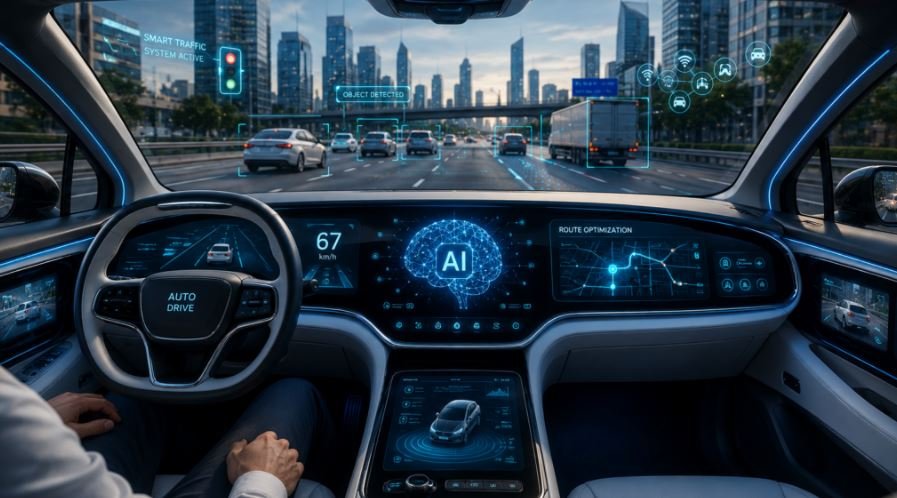
Automakers use “AI” as an umbrella term for anything from genuine machine-learning models trained on fleet data, to simple rule-based automation that’s existed since combustion-engine cars. Before evaluating any feature, it helps to separate them into three buckets:
- Data-driven AI — systems trained on large datasets that improve over time (route prediction, battery management, driver-monitoring systems)
- Rule-based automation marketed as AI — pre-programmed behaviors triggered by sensors, with no learning component
- Cloud-connected personalization — features that store your preferences but don’t “think”
Understanding which bucket a feature falls into tells you whether it will actually improve as software updates roll out, or whether it’s a fixed feature dressed up in AI language.
Battery and Charging AI — The Most Genuinely Useful Category
Predictive Preconditioning
This is the AI feature with the clearest, most measurable benefit. When a route to a DC fast charger is set in navigation, the system uses live battery temperature, ambient conditions, and trip data to warm or cool the battery pack so it hits the charger at its optimal temperature window. This can meaningfully cut charging time on cold days — the difference between preconditioned and non-preconditioned packs charging in near-freezing weather can be substantial. Exact percentage gains vary by brand and battery chemistry, and manufacturers rarely publish standardized, independently verified figures, so treat marketing percentages with some skepticism.
Predictive Range and Route Planning
Modern route planners increasingly factor in elevation, weather, traffic, and even individual driving style (not just average consumption) to recalculate range in real time. This is a real, incremental improvement over older static range estimates, and it reduces the anxiety-inducing gap between the dash estimate and rated WLTP/EPA range.
Predictive Maintenance and OTA Diagnostics
Fleet-scale AI models can flag anomalies in battery degradation, motor temperature, or 12V battery health before they cause a breakdown, then push an OTA update or service alert. This is one of the few AI features where the “learns from more data over time” promise is actually being delivered, because automakers with larger EV fleets have more data to train these models on. This is a legitimate area where scale genuinely helps — brands with hundreds of thousands of connected vehicles on the road have a real data advantage over newer entrants.
Driver-Assistance Systems — Useful, But Wildly Inconsistent
Adaptive Cruise Control and Lane-Keeping
These systems use sensor fusion (radar, camera, sometimes lidar) plus a trained model to keep pace with traffic and stay centered in a lane. Quality varies enormously — some systems intervene smoothly and predictably, while others (especially entry-level trims) hand off control abruptly or misjudge lane markings in poor weather. This is where “AI” branding can be most misleading: two cars with the same feature name on the spec sheet can perform very differently in practice.
Driver Monitoring
Camera-based systems that track eye movement and head position to detect drowsiness or distraction are increasingly standard, and they do use trained computer-vision models rather than simple rule-based triggers. This is a genuine safety feature, though false-positive rates (nagging alerts for a driver who is actually attentive) remain a common complaint.
Where the Hype Outpaces Reality
“AI” Voice Assistants
Most in-car voice assistants still struggle with anything beyond simple, pre-scripted commands (“set temperature to 21,” “navigate home”). Marketing copy calling these “conversational AI” or comparing them to large language model assistants oversells the experience — many are still closer to older voice-command systems than to a genuine LLM integration, though this is one area actively changing as more brands integrate true LLM-based assistants into 2025–2026 model years. ⚠️ Whether a specific model’s assistant is LLM-based or scripted should be verified per-brand, as this changes fast and isn’t always disclosed clearly in spec sheets.
“Full Self-Driving” Branding
No consumer EV sold today offers true driverless capability without a human ready to take over — regardless of how the feature is named or marketed. Branding that implies otherwise (through naming alone, without corresponding regulatory approval for hands-off, eyes-off driving) is the clearest case of marketing outrunning the actual technology.
AI Feature Categories
| Feature | Real AI/ML Component? | Practical Benefit | Worth Prioritizing? |
|---|---|---|---|
| Predictive battery preconditioning | Yes | Faster DC fast-charging in cold weather | Yes |
| Predictive route/range planning | Yes | More accurate real-world range estimates | Yes |
| OTA predictive maintenance | Yes | Early fault detection, fewer breakdowns | Yes |
| Adaptive cruise / lane-keep | Partial (sensor fusion + trained models) | Reduces driver fatigue on highways | Yes, but test before buying |
| Driver monitoring (camera-based) | Yes | Drowsiness/distraction detection | Yes, minor annoyance from false alerts |
| Voice assistant (“AI” branded) | Varies widely by brand | Convenience only | Not a priority |
| Personalized profiles/infotainment | No (data storage, not learning) | Convenience only | Not a priority |
| “Full self-driving” naming | No (not legally driverless anywhere for consumers) | None beyond current ADAS | Ignore the branding, check underlying spec |
Bottom Line
The AI features actually worth paying attention to when shopping for an EV are the invisible ones: battery preconditioning, predictive maintenance, and route planning that genuinely improve range and charging speed. Driver-assistance systems are worth testing in person rather than trusting the spec sheet, since quality varies sharply between brands. Ignore “AI” as a buzzword in voice assistants and autonomy naming — check the actual underlying capability and regulatory approval before assuming a feature does what its name implies.
Related EV Updates
- The Complete Guide to Electric Vehicles [Free PDF Download]
- How EV Motors Work: Simple Explanation for Non-Engineers
- What Is V2G (Vehicle-to-Grid) and Will It Work in Nigeria?
- EV Market Growth Statistics 2026: The Numbers
- Is It Worth Buying an Electric Car in 2026?
![The Complete Guide to Electric Vehicles [Free PDF Download]](https://evcarlatest.com/wp-content/uploads/2026/06/MG-07-4-1-218x150.webp "The Complete Guide to Electric Vehicles [Free PDF Download]")