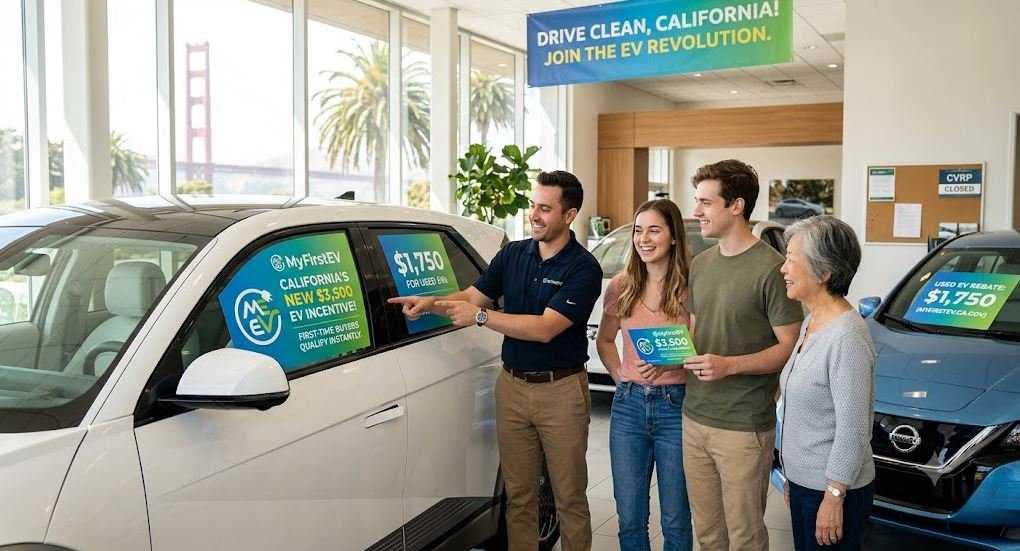
California will start handing first-time EV buyers a $3,500 instant rebate later this summer, after Governor Gavin Newsom signed SB 168 — the MyFirstEV program — into law this week. The rebate applies to new battery-electric vehicles priced under $50,000, with automakers matching half the funding. A separate $1,750 rebate covers used EVs priced at $25,000 or below. Below, we break down exactly which vehicles qualify, why two automakers get an exemption from the price cap, and how this program compares to the federal credit that expired last year.
Quick Summary
| Key Point | Detail |
|---|---|
| Rebate amount | $3,500 for new EVs, $1,750 for used EVs |
| Price cap | Up to $50,000 (new), up to $25,000 (used) |
| Eligibility | First-time EV buyers only, no income cap |
| Funding | $135.5 million from the state, matched by automakers (~$270 million total) |
| Launch | “Later this summer” 2026; participating automakers to be named next month |
What SB 168 Actually Does
SB 168 creates the MyFirstEV Zero Emissions Vehicles instant rebate program, administered by the California Air Resources Board (CARB). <cite index=”2-1″>A new program will provide an instant $3,500 rebate for Californians buying their first EV, provided the vehicle costs less than $50,000.</cite> Unlike a tax credit claimed the following spring, this is structured as a point-of-sale discount, so the reduction shows up on the sales contract at the dealership.
The <cite index=”6-1″>used-EV rebate applies to vehicles sold for $25,000 or less</cite>, and both rebates are designed to be applied immediately rather than reimbursed later.
Why Automakers Are Paying Half
<cite index=”1-1″>The incentive is for first-time buyers of new battery-powered models priced below $50,000, with half the amount covered by automakers.</cite> California put up $135.5 million in state funds; <cite index=”5-1″>the instant rebate is the centerpiece of a broader $600 million zero-emission vehicle package in the 2026-27 state budget, funded through Cap-and-Invest revenue and smog-abatement fees.</cite> The rest of that package covers heavy-duty truck vouchers, engine replacement programs, and lower-income buyer assistance under Clean Cars 4 All. CARB has not yet confirmed which manufacturers have agreed to match funding — that list is expected next month.
Why California Is Doing This Now
The timing isn’t a coincidence. <cite index=”1-1″>Sales of electric vehicles are booming worldwide, but have plunged in the U.S. since the federal government eliminated a $7,500 rebate last year.</cite> California accounts for roughly a third of U.S. EV sales, and the state has felt the drop sharply.
<cite index=”5-1″>After the $7,500 federal EV tax credit was repealed, ending last September, US EV sales are down at least 20% in the first half of 2026.</cite> <cite index=”1-1″>California’s EV market share fell from nearly a quarter of new vehicle sales a year ago to only 15.7% through the first quarter</cite> of 2026 — well short of the state’s 35% target for the year, and short of its longer-term goal of ending sales of new gasoline-powered vehicles by 2035.
The Rivian and Lucid Exemption
The most debated part of the program is a carve-out for California-headquartered, EV-only automakers. <cite index=”5-1″>The $50,000 price cap is waived entirely for EVs built by California-headquartered, EV-only automakers — companies whose corporate management and staff are based in the state as of January 1, 2026.</cite> In practice, that benefits two companies: <cite index=”5-1″>Rivian, whose engineering headquarters is in Irvine, and Lucid, based in the San Francisco Bay Area.</cite> <cite index=”5-1″>Their cheapest models, around $58,000 for Rivian and $71,000 for Lucid, sit well above the $50,000 cap that applies to everyone else, yet still qualify for the full $3,500.</cite>
Tesla, notably, does not get this exemption. <cite index=”6-1″>Tesla could have benefitted too, but it moved its headquarters to Texas from California a few years ago.</cite> Lower-priced trims of the Model 3 and Model Y still qualify under the standard $50,000 cap, though.
The exemption has drawn criticism on the grounds that it rewards where a company is legally headquartered rather than where it actually builds cars. <cite index=”5-1″>Tesla builds more EVs in California than anyone, with its Fremont plant employing thousands, while Rivian’s vehicles are assembled in Illinois and Lucid’s in Arizona.</cite>
Which Vehicles Qualify
Several mainstream, mass-market EVs fall comfortably under the $50,000 cap:
- Chevrolet Bolt — <cite index=”1-1″>priced from less than $30,000</cite>
- Chevrolet Equinox EV and Blazer EV — GM’s other two qualifying models
- Toyota bZ and C-HR — <cite index=”1-1″>small crossovers starting under $40,000</cite>
- Hyundai Ioniq 5 — <cite index=”1-1″>priced from $35,000</cite>
- Ford Mustang Mach-E — <cite index=”1-1″>starting at about $38,000</cite>
- Tesla Model 3 and Model Y — lower-priced trims qualify; the Cybertruck does not
Two lower-cost electric pickups aren’t in the picture yet: <cite index=”1-1″>a new $30,000 model from Ford and a utilitarian version from startup Slate, priced from $25,000, are set to arrive in 2027</cite> — after this rebate window opens.
How It Compares to the Old Federal Credit
The now-expired federal $7,500 credit came with income caps and domestic-manufacturing requirements that disqualified many popular EVs. <cite index=”6-1″>The California law isn’t nearly so rigid — there’s no income cap, and eligibility is governed mainly by vehicle price rather than where components are sourced.</cite>
Will It Actually Move the Needle?
Industry analysts are split. <cite index=”1-1″>Loren McDonald, CEO and chief analyst at Chargeonomics, is skeptical the rebate will change much, noting automakers are already offering similar discounts of $2,500 to $3,500 to move inventory.</cite> <cite index=”1-1″>Stephanie Valdez Streaty of Cox Automotive noted the new EV premium is still roughly $5,500 higher than a comparable gas model, so the rebate narrows but doesn’t close the gap — while the used-EV rebate could have a bigger impact given the volume of off-lease EVs entering that market.</cite>
New vs. Used EV Rebate Comparison
| Category | New EV Rebate | Used EV Rebate |
|---|---|---|
| Rebate amount | $3,500 | $1,750 |
| Vehicle price cap | $50,000 (waived for CA-HQ’d EV-only automakers) | $25,000 |
| Buyer eligibility | First-time EV buyer, no income cap | First-time EV buyer, no income cap |
| Funding split | 50% state, 50% automaker | 50% state, 50% automaker |
| Redemption | Instant, point-of-sale | Instant, point-of-sale |
| Example qualifying vehicles | Chevy Bolt, Equinox EV, Toyota bZ, Hyundai Ioniq 5, Ford Mach-E, Tesla Model 3/Y | Off-lease EVs entering the used market specific models not yet confirmed |
Exact launch date, the full list of participating automakers, and application mechanics have not been published by CARB as of this writing. Not disclosed: whether the rebate can be combined with other state or utility EV incentives.
Bottom Line
California’s MyFirstEV program is a well-targeted, point-of-sale rebate that fills part of the gap left by the federal credit’s expiration, particularly for first-time buyers eyeing sub-$50,000 EVs like the Bolt, Ioniq 5, or Mach-E. The Rivian/Lucid headquarters exemption is the program’s most questionable design choice, since it rewards corporate address over in-state manufacturing. For buyers on the fence, the used-EV rebate may offer the better near-term value given the volume of off-lease EVs currently hitting that market.
This article will be updated once CARB confirms the program’s launch date and participating automakers.
Related EV Updates
- Electric Car Maintenance Cost vs Petrol: Year-by-Year Breakdown
- $847 Gas vs $43 Tesla. One Month Cost Breakdown and Hidden EV Savings