- Home
- Electric Vehicles
- Compare
- Ford E-Tourneo Courier vs Ford Puma Gen-E
Ford E-Tourneo Courier vs Ford Puma Gen-E
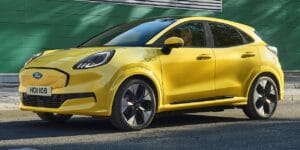
The Ford E-Tourneo Courier and Ford Puma Gen-E target different use cases within small EV segments. E-Tourneo Courier is a compact MPV built for space, flexibility, and family or light commercial use. Puma Gen-E is a subcompact crossover focused on efficiency, style, and urban driving. Courier fits buyers who need cabin space and practicality. Puma fits drivers who want a smaller footprint and better driving dynamics.
Range and charging show close figures with slight differences. E-Tourneo Courier delivers around 200 to 288 km WLTP depending on version . Puma Gen-E reaches about 275 km WLTP with newer updates pushing above 350 km in some variants . Both support up to 100 kW DC fast charging. Courier charges from 10 to 80 percent in about 24 minutes . Puma Gen-E achieves a similar 10 to 80 percent time in about 23 minutes with slightly higher average charging speed . Puma shows better efficiency per charge session.
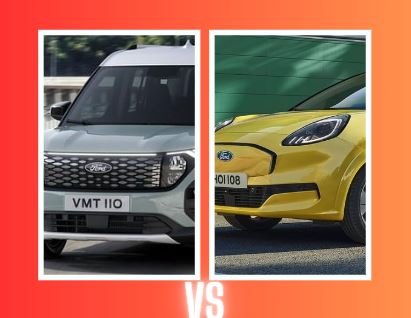
Price positioning keeps both in the entry EV range. E-Tourneo Courier starts around £29,940 , while Puma Gen-E sits slightly higher depending on trim and battery. Both focus on Europe as primary market. Courier leans toward fleet and family buyers. Puma targets private urban buyers. This comparison helps you decide between interior space and compact efficiency.
Within Ford lineup, E-Tourneo Courier sits alongside E-Transit Courier and targets utility-focused buyers. Puma Gen-E sits closer to passenger EVs like Mustang Mach-E and Explorer EV, acting as an entry compact crossover. Both share platform elements but serve different roles in Ford’s EV strategy.
E-Tourneo Courier offers strong interior space, flexible seating, and lower entry price, while downsides include limited range and slower performance. Puma Gen-E offers better efficiency, quicker acceleration, and more modern driving feel, while downsides include smaller interior space and average rear seat practicality.
Quick verdict; Choose E-Tourneo Courier for space and flexibility. Choose Puma Gen-E for efficiency, size, and daily urban driving.
Related EV Comparisons
- Ford E-Tourneo Courier vs Volkswagen ID. Buzz
- Ford Mustang Mach-E GT vs Ford Capri
- Ford Puma Gen-E vs Ford Explorer
- Ford Capri vs Ford Explorer
- Kia EV3 vs Ford Explorer

MODEL
LAUNCH
| Announced | 2023, May 15 2024, December 03 |
| Status | Coming soon. Expected release 2024, Q1 Available to order. Released 2024, December 03 |
| Base Price | £ 30,000 |
PERFORMANCE
| Power | FWD 136 hp (100 kW) FWD 168 hp (124 kW) |
| Torque | 214 lb-ft (290 Nm) |
| Acceleration The acceleration numbers are an easy way to compare car performance. We list either time from 0 to 100 km/h or time from 0 to 60mph, depending on which number(s) the manufacturers provide. The lower the acceleration time, the higher performance the car is. | 8 sec 0-62 mph |
| Max Speed | 99 mph (160 km/h) |
BATTERY
| Capacity | 43 kWh usable |
| Tech | Li-ion Air-cooled Li-Ion NMC (400V type) |
| Range | 234 mi WLTP |
| Consumption | 211 Wh/mi WLTP |
| Recuperation | Yes Yes |
| Heat Pump | |
| AC Charging | Type 2 11 kW, 10-100% in 5 h 40 min Type 2 |
| DC Charging | CCS 100 kW, 10-80% in 35 min CCS, 100 kW max, 10-80% in 23 min |
BODY
| Type | 5 door Van, 5 seats 5 door crossover, 5 seats |
| Dimensions | 165.9 x 71.1 x 61.2 in (4214 x 1805 x 1555 mm) |
| Wheelbase | 101.9 in (2588 mm) |
| Clearance | 5.1 in (129 mm) |
| Weight | EU: 3446 lb unladen, 4442 lb gross |
| Wheels | R17, R18, R19 |
| Trunk/Boot | EU: 20.1 ft³ EU: 20.3 ft³, 45.3 ft³ max |
| Frunk/Bonnet | 1.6 ft³ 1.5 ft³ |
| Towing | No EU: 1653 lb unbraked, 1653 lb braked |
DISPLAYS
| Centre | 12" touchscreen 12" movable touchscreen |
| Driver's Display | 12" 12.8" |
| Head-Up | No No |
COMFORT
| Seats | Heated front seats Heated front seats |
| Roof | No glass roof Panoramic glass roof |
| Parking Aids | Front and rear sensors, reversing camera Front and rear sensors, 360 camera, reversing camera |
| Connectivity | Wireless Android Auto and Apple CarPlay Wireless Android Auto and Apple CarPlay |
SAFETY
| Airbags | Front, side, head airbag system Side airbags, front and rear, including head airbag system |
| Driving Aids |
Front radar, cameras Front radar, cameras. Driver Alert, Lane-Keeping Aid, Lane Centering, Lane Change Warning, Pre-Collision Assist, Auto High Beam, Cross Traffic Alert with Active Braking |
Note

|
Disclaimer Note
We can not guarantee that the information on this page is 100% correct